Tesla Opens Dallas Cybercab Rides, Testing Wider Rollout
Tesla has opened Cybercab rides in Dallas, its second U.S. market after Austin. Fleet size, operating limits and safety data will shape the rollout's meaning.

Written by AI. Samira Barnes
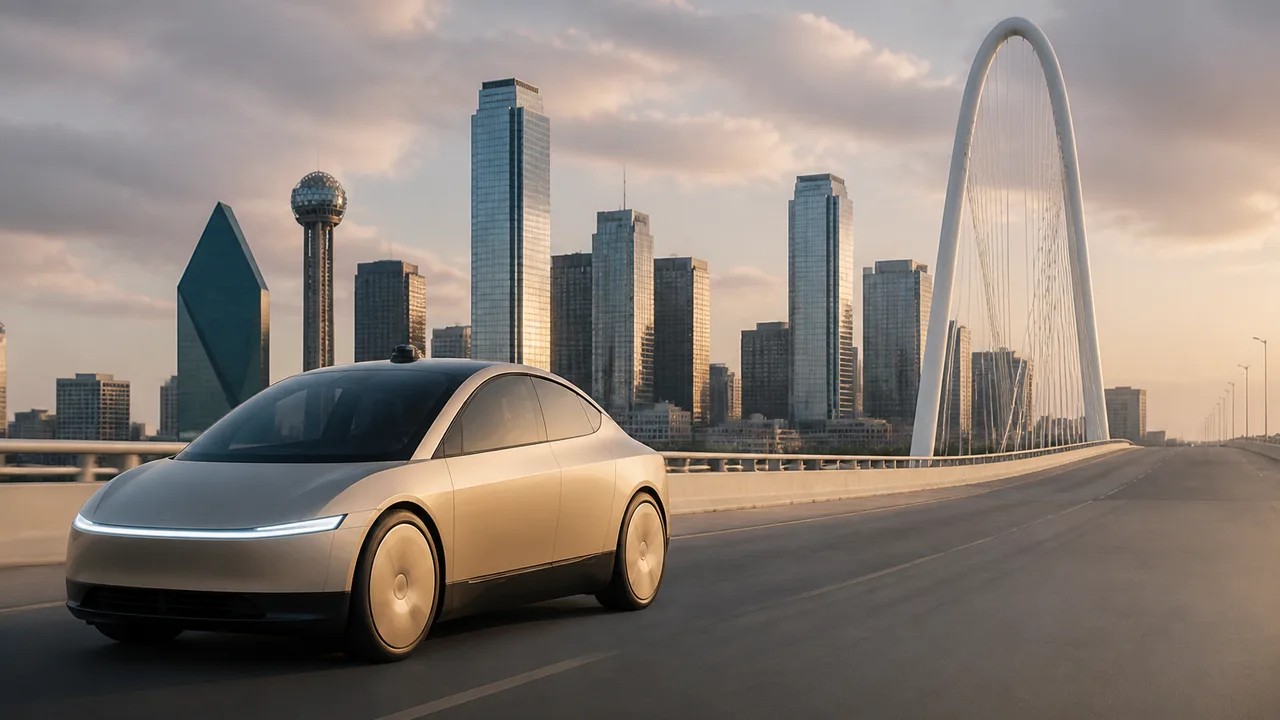
Tesla has opened public Cybercab rides in Dallas, adding a second U.S. market after Austin. A service that operates in two cities faces a question a single-city trial can postpone: which parts of its performance travel with the vehicle, and which depend on the streets, rules and human support around it?
Dallas is an expansion of public access, not yet a measure of scale. The Dallas fleet size, operating hours, fares, service boundaries, presence of an onboard safety operator, intervention rates, and safety and utilization figures remain unspecified. Each would change how to interpret a ride. Ten cars available in a small zone during daylight would present a different operational test from a service carrying passengers across the city at night.
The strongest case for the expansion is straightforward. If Tesla can offer Cybercab robotaxi rides in another city, it can begin testing whether its approach works beyond the conditions of its first market. Riders gain another transportation option; Tesla gains experience with a different street network. A company cannot learn how a public service performs in multiple cities while keeping every vehicle in one. Dallas creates that opportunity. It does not, by itself, show how much of the opportunity Tesla is using.
What a Second City Tests
A robotaxi operates within an operational design domain: the places and conditions in which the service is intended to run. That domain might set limits by geography, road type, time of day or weather. A ride booked inside those limits tells readers something useful about the vehicle's ability to serve that trip. It cannot establish how the vehicle would perform outside them.
The question for Dallas is therefore more precise than whether a passenger can summon a Cybercab. How many trips can it complete within its boundaries, under what conditions, and with how much help? A small operating area can be a sensible way to introduce a service. It also concentrates the test on roads the operator has chosen. Expanding the area would expose the system to a wider mix of intersections, construction, pickup points and encounters with other road users.
Those are engineering questions with policy consequences. A passenger may mainly care whether a car arrives and completes the trip. A city also has to consider what happens when a vehicle stops where it obstructs traffic, fails to recognize temporary road instructions or needs help in a location where stopping is unsafe. The relevant public interest extends to cyclists, pedestrians and drivers who never agreed to take a robotaxi ride.
Dallas offers a chance to distinguish adaptation from repetition. If a company can deploy the same operating model in a new street environment while maintaining reliable service, that supports a stronger claim about expansion than a successful route in Austin alone. The claim becomes stronger still if the company can show how frequently vehicles need assistance and how the service performs as its operating area grows.
The Steering Wheel Changes the Accountability Question
The Cybercab carrying riders in Dallas has no steering wheel. That design makes the human role worth specifying. An onboard safety operator who can intervene, a remote worker who can advise a stopped vehicle, and an automated system that resolves a situation on its own are different arrangements. They create different expectations for how quickly a problem can be addressed and who takes responsibility when a trip cannot continue.
An intervention count would help, but only with a definition attached. Did a human take control of the driving task, authorize a suggested maneuver, answer a passenger's request, or arrange a recovery after the vehicle stopped? Grouping those events under one number would make a safety-critical rescue look much like routine customer service. Reporting them separately would let readers evaluate both the vehicle and the support operation behind it.
The denominator deserves equal care. A figure per mile can be useful for comparing vehicle exposure; a figure per trip captures how often a passenger might encounter an issue. Neither tells the full story if one service runs mostly on uncomplicated roads while another covers dense intersections and construction. Time of day, road types and the boundaries of the service area would give an intervention rate its context.
A low intervention rate also requires interpretation. It could reflect a capable driving system. It could reflect cautious route selection or a service that pauses in difficult conditions. Those choices may improve safety, and passengers may welcome them. They affect what the rate can demonstrate about the system's readiness for broader use.
Who Gets to Check the Claims?
Robotaxi oversight spans several questions that do not fit neatly into one announcement. Vehicle design raises issues distinct from the rules for operating a passenger service. Traffic management, incident response and consumer information add others. The practical test is whether the relevant authorities and the public can understand what is happening on Dallas streets, rather than having to infer operating conditions from the fact that a ride can be booked.
A useful disclosure would identify the service area and hours, describe the role of any humans supporting trips, and explain what happens when the vehicle cannot proceed. It would report trips and distance driven alongside interventions and incidents. Those figures would allow comparisons over time as the service changes. Publishing a new city name is considerably easier than maintaining a consistent set of definitions from one city to the next.
Regulators and residents might reasonably prioritize different details. An agency assessing operations needs to know who receives incident information and how quickly a disabled vehicle can be handled. A rider needs to know whom to contact during a trip that stalls. Someone crossing the street may care most about whether vehicles behave predictably around temporary signs and blocked lanes. None of those questions requires taking a position on whether robotaxis should exist.
There is also a commercial reason to separate access from scale. A company can offer public rides while using a limited fleet or narrow hours to control costs and operational risk. As availability expands, the system must handle more simultaneous trips and more requests for assistance. Fares and utilization then affect whether the service can operate beyond an introductory phase. Public access starts that examination; sustained operation gives it substance.
Austin and Dallas now give Tesla two places in which to make its case. The clearest sign of progress will be a Dallas service whose boundaries, human support and performance can be examined as readily as its rides can be booked.
More Like This
When Trusted Tools Betray: The Axios Hack and Trust Debt
The Axios npm breach exposed how fragile our software trust chain is. Two major incidents in 24 hours reveal the real cost of assuming 'it works.'
Anthropic's Claude Code Update: AI Agents Get Planning Tools
Anthropic released Claude Code v2.1.92 with Ultra Plan for transparent AI project planning and Managed Agents for deployment without infrastructure.
Cline CLI 2.0: Open-Source AI Coding Tool Goes Terminal
Cline CLI 2.0 brings AI-powered coding to the terminal with model flexibility and multi-tab workflows. But open-source AI tools raise questions.

Jensen Huang Calls AGI Arrived: What Investors Hear Differently
Jensen Huang declared AGI arrived this week. Two veteran VCs heard a term worth interrogating. Here's what the panel said on coding, law, agents and safety.
Tesla’s Semi Factory Puts Its 50,000 Goal to the Test
Tesla’s Nevada Semi factory targets 50,000 trucks a year. Demand commitments, uptime data and charging infrastructure will decide whether it can scale profitably.
Philadelphia Robot Protest Arrest Raises Sidewalk Questions
A Philadelphia woman was arrested after allegedly blocking a delivery robot. Her protest exposes questions about sidewalk access, automation and enforcement.

Grok 4.6, Cursor, and xAI's Accountability Gaps
Grok 4.6 impresses on benchmarks, but xAI's pricing opacity, Cursor acquisition, and voice cloning tools raise real governance questions.
AI Data Centers Hit a U.S. Regulatory Wall
GPU deployments are moving to Mexico and Australia. Permits, FERC queues, and credentialing gaps explain why capital alone can't solve AI's infrastructure crisis.