Tesla’s Semi Factory Puts Its 50,000 Goal to the Test
Tesla’s Nevada Semi factory targets 50,000 trucks a year. Demand commitments, uptime data and charging infrastructure will decide whether it can scale profitably.

Written by AI. Jin Seo
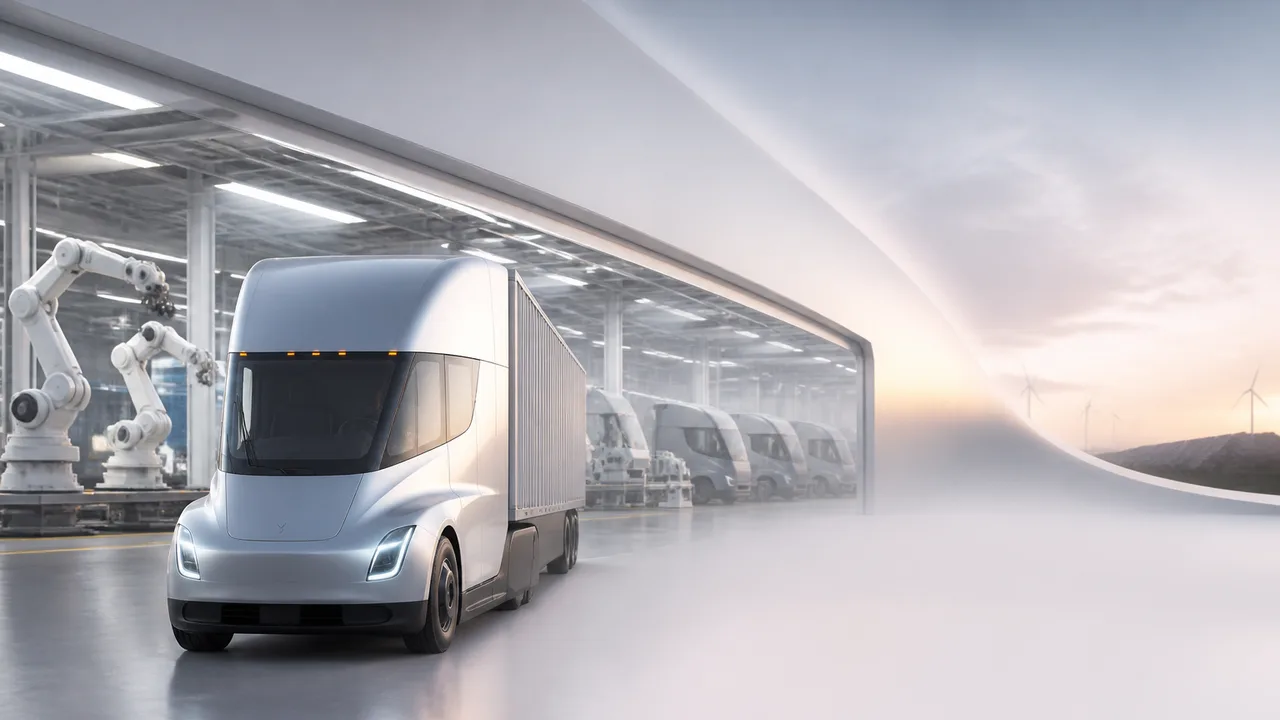
Tesla opened its first dedicated high-volume Semi factory in Sparks, Nevada, on Thursday, nearly nine years after Elon Musk unveiled the electric truck in 2017.
The plant gives Tesla something its freight ambitions have lacked: a factory intended to turn a long-running demonstration program into an industrial business. Tesla says the facility will eventually have capacity to build 50,000 Semis a year, roughly 1,000 a week, and that the production ramp will create more than 3,000 jobs in Nevada.
That headline number comes with an important boundary. Tesla has not disclosed the factory’s current production rate, and 50,000 describes planned annual capacity. It is neither present output nor a dated production forecast.
A factory opening proves that Tesla has committed land, equipment and money to the Semi. Fleet economics will decide how much of that capacity gets used.
Nine Years from Unveiling to a Dedicated Factory
Tesla began limited Semi deliveries in late 2022, with PepsiCo among the early customers. Reuters, as cited by International Business Times, reported that the first vehicle from the new high-volume line was completed this April. The company had previously expected production to begin years earlier, but the program encountered repeated delays.
That history changes Tesla’s position in the market. The company arrives with a well-known brand and a dedicated plant, but it no longer enters an empty lane. Volvo and Daimler Truck already have battery-electric trucks on the market. Freightliner also has an electric-truck line, while Ford and Rivian have delivered commercial vehicles in lighter categories.
The comparison with Ford’s E-Transit and Rivian’s Amazon delivery vans has limits. Those vehicles perform different jobs from a Class 8 tractor hauling heavy freight. Volvo and Daimler provide the closer product comparison. Taken together, however, the examples show that commercial electrification continued while Tesla moved from its 2017 reveal through limited deliveries and finally to a dedicated factory.
That delay can cut two ways. Competitors gained customers and operating experience. Tesla gained time to test trucks with early fleets before attempting a larger ramp. Publicly available figures in the reporting do not establish whether that testing advantage compensates for the years lost.
Capacity Has Arrived Ahead of Disclosed Output
The strongest evidence of demand currently consists of two large announcements. ZET SCALE, a purchasing alliance backed by shippers including Microsoft and PepsiCo, selected Tesla as lead supplier for an initial purchase of 2,500 battery-electric Class 8 trucks. The alliance ultimately aims to acquire at least 10,000 electric trucks from multiple manufacturers. Einride separately announced plans to add 500 Tesla Semis.
Those two announcements add to 3,000 trucks. That is substantial for a product previously delivered in limited quantities, but it sits well below one year of the plant’s stated 50,000-unit capacity. The comparison is a snapshot rather than a forecast: the disclosed figures may omit other customers, the Einride plan may unfold over several years, and Tesla has not supplied a timetable for reaching full production.
The demand structure also deserves care. ZET SCALE’s broader 10,000-truck ambition covers multiple manufacturers, so all 10,000 cannot be assigned to Tesla. Nor should an announced plan automatically be treated as delivered revenue. Investors and suppliers eventually need firmer details: binding orders, delivery schedules, selling prices and actual factory throughput. Factory capacity is a ceiling; revenue begins with trucks accepted and paid for.
Tesla’s best case is straightforward. A fleet customer can order hundreds or thousands of vehicles, giving a manufacturer larger and potentially more predictable batches than individual car sales. Commercial fleet orders can therefore create a different sales rhythm from Tesla’s consumer business. A successful ramp could also diversify a company facing sharper competition in passenger electric vehicles.
The risk follows from the same structure. A large buyer has leverage, keeps detailed operating records and can delay the next batch if the numbers disappoint. One fleet decision can fill a production schedule. It can also punch a large hole in one.
Trucks Are Purchased by Spreadsheet
Tesla built its passenger-car business partly by making electric vehicles desirable consumer products and then expanding manufacturing. Heavy trucking uses a colder scorecard. Fleet managers examine acquisition cost, energy use, maintenance, charging time, payload, service coverage and the revenue lost when a vehicle sits idle.
That makes Tesla engineering director Dan Priestley’s claim that Semis already in fleets have achieved 98% uptime more useful than Musk’s description of the vehicle as a “sports car in truck form.” Yet the published figure lacks enough context for an outside assessment. Tesla has not disclosed the number of trucks measured, the period covered, the duty cycles involved or the definition of downtime.
Range claims require similar discipline. Tesla says the long-range Semi can travel about 500 miles on a full charge, while the standard-range model is rated at about 325 miles. A fleet calculating total cost of ownership still needs to know how range changes with cargo, weather, road grade and charging availability. A brochure mile does not invoice a customer. A completed route does.
Service is part of that equation. Tesla says it is building a specialized Semi network, including mobile technicians able to perform field repairs. That could reduce downtime if technician coverage, parts availability and response times grow alongside the fleet. The 98% claim becomes more persuasive when customers can reproduce it across thousands of vehicles rather than a limited early population.
Charging supplies the other half of the operating system. Questions remain about whether Tesla’s existing network can support commercial-fleet power demand, and deployment timelines for dedicated Semi charging sites remain unclear. A truck and charger operate as one productive asset. Delivering tractors faster than charging infrastructure would move the bottleneck from the factory to the depot.
Autonomy is a Separate Wager
Musk has said Tesla expects eventually to bring Full Self-Driving technology to the Semi, suggesting a possible arrival around the end of 2026 or early 2027. His previous autonomous-vehicle timelines have repeatedly slipped, so that date offers a corporate target rather than a dependable planning assumption for fleets.
Tesla also faces specialists on this axis. Aurora Innovation and Kodiak AI are already testing driverless heavy trucks and hauling commercial freight. Their progress does not guarantee broad autonomous deployment, and testing freight is different from operating an unrestricted national network. It does show that Tesla’s Semi factory does not confer an automatic lead in driverless trucking.
For now, autonomy should be separated from the factory’s nearer-term test. The plant can succeed by producing reliable electric trucks that save fleets money with human drivers. Future driverless capability could improve the economics, but customers evaluating purchases today still have to build their calculations around hardware, charging and service that exist today.
The Nevada opening moves the Semi beyond years of sparse production and recurring promises. The next useful numbers will be less cinematic than 50,000: trucks built each quarter, chargers installed, orders converted into deliveries, and uptime measured across a fleet large enough to stress the system.
More Like This

Vetting Expired Domains in iGaming SEO
Craig Campbell explains why domain rating misleads iGaming SEO buyers, what the Wayback Machine reveals, and how to vet expired domains before spending.

Auditing Vibe-Coded Apps Without Reading Them
A Brainqub3 video argues you can safely ship 100k-line AI-generated codebases without reading them. The framework is sound. The business model behind it is worth examining.