TBS Source One V6 FPV Build: Cheap Frame, Real Costs
FPV Geek builds the TBS Source One V6 freestyle quad and hits a power layout problem that forced a full rework. Here's what actually happened.

Written by AI. Mike Sullivan
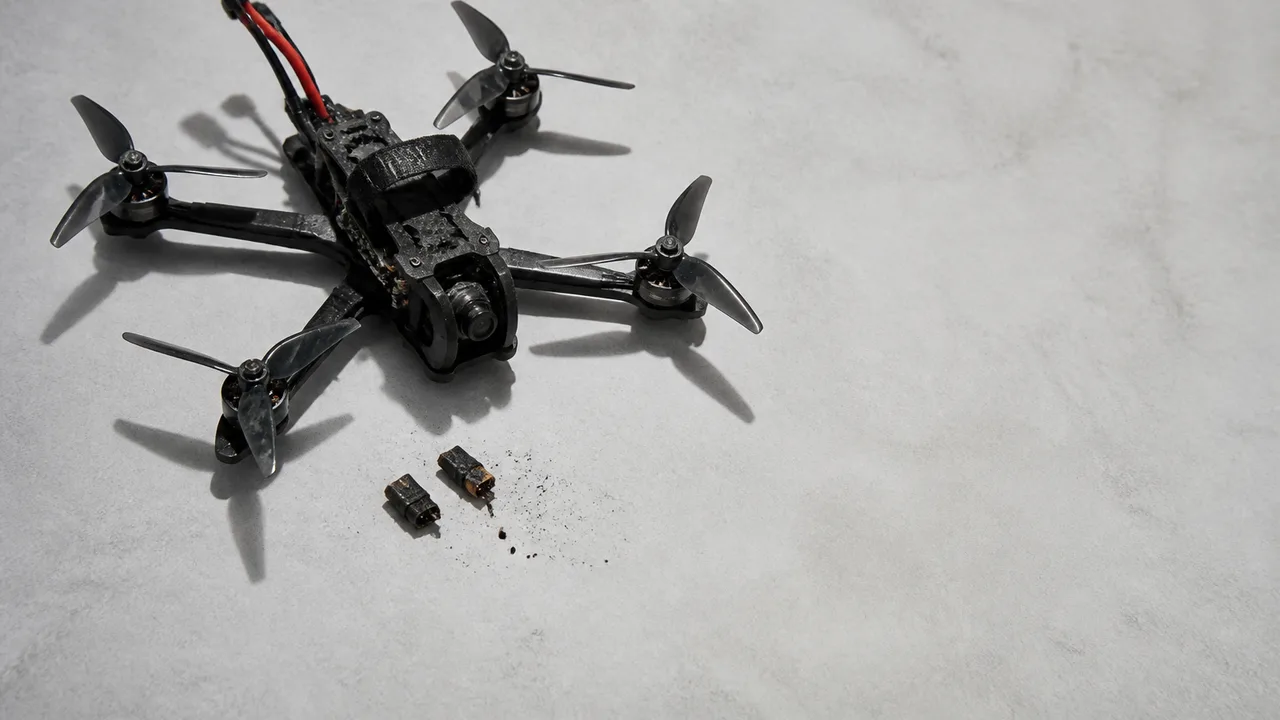
Photo: AI. Tomoko Hayashi
You've done it. We've all done it. You're twenty minutes into a build that was supposed to be straightforward, and there's a voice in the back of your head saying this is probably not ideal — and you keep going anyway, because stopping now means admitting the problem is real. FPV Geek's latest video is, at its core, a twenty-two-minute document of exactly that moment, played out across a TBS Source One V6 freestyle quad build that started optimistic and ended with a complete ESC flip and three different capacitors in the bin.
The frame cost somewhere around $25-30 USD on AliExpress — call it a third of what a comparable premium frame runs. That price point is where the interesting decisions start.
FPV Geek's stated goal was simple enough: after wrecking a previous quad in an abandoned building, build something that could be thrown into concrete and metal without inspiring regret. The TBS Source One V6 was the frame choice — a departure from a Mark V setup that had served well for years. "Is this actually a cheap frame that can take a beating?" he asks early on. "Or is it one of those deals that looks great at first and then annoys you with every tiny detail later?"
That's a question anyone who bought a cheap Pioneer head unit in 1994 knows the shape of. The answer, it turns out, is: mostly the former, with a specific asterisk you need to know about before you commit.
For motors, he went with T-Motor F60 Pros over his usual Velox V3s — a meaningful jump in price for motors that he openly acknowledges don't automatically outperform cheaper options just because they feel more premium in hand. "That does not mean they magically fly better just because they feel nicer in your hand," he says, which is the most honest thing anyone has said about aspirational hardware purchases in a while. I find that instinct correct and underrated. The Velox V3 costs roughly half as much. Whether the F60's tactile confidence translates to measurable flight improvement is a question this video doesn't fully answer, and FPV Geek doesn't pretend otherwise. The stack was a SpeedyBee F405 V4 55A — his stated go-to, based on anecdotal personal durability across multiple crashes. The F405 V4 is not marketed as waterproof or weather-resistant; his claim that it survived rain, snow, and water landings is his experience, not a spec sheet promise. Worth noting before you fly yours into a puddle expecting the same outcome.
The video system choice — DJI O3 Air Unit over the newer O4 Pro — is where the cost-to-trust math gets interesting. FPV Geek's argument is that on a quad specifically designed to crash into things, the replacement economics of the O3 matter more than the image quality delta. The O3 Air Unit runs around $130-150 depending on where you buy it. O4 Pro replacement parts and unit pricing are harder to nail down definitively; FPV Geek's characterization that the O3 is "not instantly a financial disaster" when the lens breaks is his read, and a reasonable one, but I'd verify current O4 part availability for your region before treating that as settled math.
Here's the actual problem, because it's the part of the video that earns its runtime.
The Source One V6's rear compartment is tight. Tighter than the Mark V. When FPV Geek went to mount the capacitor — the component that sits between the battery and the power system to absorb voltage spikes — there wasn't room to put it where he wanted it: directly adjacent to the power pads, leads as short as possible. So he extended the wires and moved it forward.
"And even while doing it, there was this little voice in my head going, 'Ah, this is probably not the cleanest solution.'"
He kept going. This is the decision the entire video hinges on.
After two battery packs — two — the XT60 connector looked, by his description, "way worse than it should." Heavy sparking on plug-in. Visibly damaged contacts on both the quad side and the battery side. The connector itself wasn't the root cause; the extended capacitor lead path was, per his diagnosis. The longer the path between capacitor and power pads, the more inductance in the circuit, which means voltage spikes don't get absorbed cleanly on plug-in. That's FPV Geek's read on the failure mode — it's electrically plausible, but I want to be clear that this is his working diagnosis of a system he built, not an independently verified root cause analysis. He went through three capacitor sizes — 2,200µF down to 1,000µF, then down to 670µF — before concluding that capacitor size was secondary to the actual problem: the wiring path length. The real fix was flipping the ESC orientation entirely so the power input pads faced forward, letting the capacitor leads stay short.
That's not a glamorous repair. That's an afternoon at the bench undoing work you already did, because a tighter frame than you were used to pushed you into a layout compromise you knew was suboptimal while you were making it.
My honest read on the Source One V6, filtered through this video: it's a strong frame for the money, but it taxes you on planning in a way a more expensive frame doesn't. "It is strong, cheap, and simple," FPV Geek concludes. "But if you want a clean 6S build with an O3, you really have to plan the power layout before you commit to it." That's real information, not a hedge.
The missing anti-slip battery pad and the separately-purchased battery straps are minor. The tight rear compartment is not. If you're building 6S with a larger capacitor and a full-size video unit, sketch the power layout on paper before you touch a soldering iron. The frame's price advantage evaporates pretty fast if you're reflowing solder joints and buying replacement XT60 connectors because you talked yourself through a warning sign.
There's a generation of people who learned this exact lesson on Pep Boys-brand car stereos and mid-tier Pioneer AVRs — gear that delivered 80% of the performance at 50% of the cost, right up until the moment a small design shortcut revealed itself and you ended up spending the difference anyway, plus labor. The Source One V6 is not that story, exactly, because FPV Geek got to a good outcome. But the shape of the lesson rhymes.
He ends with a fair verdict: not for beginners, genuinely solid for experienced builders who go in with eyes open. The quad flies direct and smooth. The frame arm stiffness — which he rates highly — matters for flight controller performance because less chassis vibration means cleaner stick response. The build got there. It just took a rework that a little more pre-planning would have avoided.
The question I keep sitting with is whether the Source One V6's value proposition actually holds at that price gap once you factor in the incremental cost of the problem it creates — not in parts, but in time. If your time has any value at all, the math on "cheap frame" has a variable in it that the AliExpress listing doesn't show you.
More Like This

Do You Really Need an $80 HDMI Cable? Maybe Not
Tech reviewer Adam tests a premium HDMI 2.1 cable. We examine what you're actually paying for and whether most users need it.

When Agents Generate Their Own UI: The Three Flavors Explained
CopilotKit's Tyler Slaton maps the spectrum of generative UI—from pixel-perfect control to agents writing raw HTML. Each approach makes different tradeoffs.
Can Unreal Engine 5 Run on a $500 MacBook? Sort Of.
Testing Unreal Engine 5.7 on the MacBook Neo reveals what happens when professional software meets budget hardware—and why friction matters.

GoPro Mission 1 Pro Review: 960fps Changes Everything
GoPro's Mission 1 Pro packs 8K60, 960fps slow-mo, and a 1-inch sensor. Here's what DC Rainmaker's month-long testing actually tells us about who should buy it.
Unreal Engine 5 Still Doesn't Play Nice With Apple Silicon
While most 3D software runs smoothly on M-series Macs, Unreal Engine 5 remains frustratingly unreliable. One creator documents the disconnect.

What vidIQ's Channel Audit Gets Wrong About Niche Creators
vidIQ audited Fast Freddy RC's small YouTube channel. The advice is technically sound—but it asks the wrong question entirely about niche creator value.

Huawei's Chip Folding Strategy: Bold Plan or Benchmark Math?
Huawei's Tao scaling promises 1.4nm-class chip density without EUV. The physics are real. The manufacturing gap between roadmap and reality is enormous.

VPNs in 2026: Useful Tool or Overhyped Security Fix
NetworkChuck got paid by NordVPN to make a VPN video, then tried to be honest about it. Here's what he actually got right—and what the industry still won't tell you.