Steam's Tuesday Maintenance: Predictable Downtime, Real Questions
Steam goes down most Tuesday nights for routine maintenance. It's scheduled, brief, and still frustrating. Here's what's actually happening and what it reveals.

Written by AI. Lily Tsai
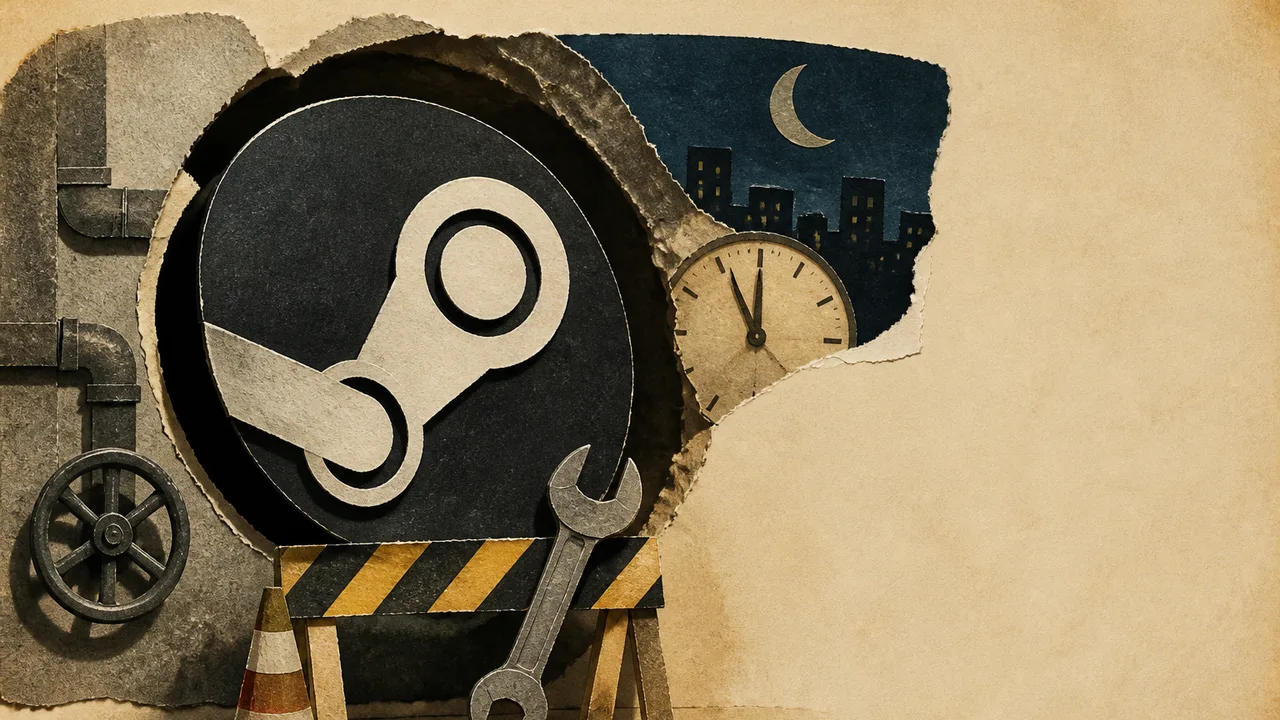
Every Tuesday night, somewhere on the internet, someone types "is Steam down?" into a search bar with the full conviction that something has gone terribly wrong. It hasn't. It's Tuesday.
This is the ritual. It repeats without variation. And it turns out that the ritual itself is kind of worth examining — not because scheduled maintenance is a crisis, but because the gap between what Valve communicates and what users experience tells us something real about how digital distribution platforms relate to the people who depend on them.
What's Actually Happening
According to SteamDB's outage tracker, Valve performs weekly scheduled maintenance on Steam servers on Tuesday evenings US time, with the window typically opening around 00:00 UTC on Wednesday. The maintenance usually lasts somewhere between 15 and 30 minutes. That's it. Brief, bounded, and — critically — predictable.
When users do hit issues during that window, the problem is almost always the same thing. App.com reported, citing Downdetector data, that the majority of Steam problems during these periods involve connecting to the server — not corrupted installs, not billing failures, not lost libraries. Just: you can't get in right now. Give it twenty minutes.
Downdetector's real-time Steam dashboard tracks these spikes as they happen, and the pattern is consistent enough that it reads almost like clockwork. Reports spike, then collapse as the window closes. The data is boring in the best possible way.
So: the maintenance is real, it's routine, it's short, and it's been going on long enough that multiple outlets now maintain evergreen explainers about it. Kotaku's piece frames it with a headline that says the quiet part loud — Is It Tuesday? Great News, It's Probably Just Maintenance Day — which is funny because it's efficient. PC Gamer's version is even more candid, noting in the piece that knowing it's going to happen "won't stop me from asking next week." That's not a criticism. That's a diagnosis.
The Communication Gap Is the Story
Here's the thing about predictable downtime: it only becomes frustrating when users don't know it's coming. Valve does publish information about scheduled maintenance — Steam's own help documentation exists for exactly this purpose. But the fact that third-party tools like SteamDB and third-party outlets like Kotaku, PC Gamer, and App.com are doing the informational heavy lifting suggests that Valve's in-platform communication isn't landing where users are when they need it most.
Think about the user journey during a Tuesday night outage: Steam client fails to connect → user panics or gets annoyed → user goes to Google → user finds a third-party article explaining the thing Valve already knows and could have told them. That's a loop with an obvious fix that hasn't been fully closed.
To be fair to Valve, 15-30 minutes of downtime once a week is genuinely not a large ask for a platform of Steam's scale. The infrastructure required to serve what is, by any measure, a massive global user base requires maintenance. You cannot opt out of server upkeep the way you might defer a software update. The question isn't whether maintenance should happen — of course it should — but whether users should have to go hunting for that context when they're already mid-frustration.
What This Looks Like From the Developer Side
For indie developers specifically, this is worth sitting with for a moment.
Steam is the dominant PC distribution platform for small studios. It's not the only one — itch.io, GOG, and the Epic Games Store all exist — but for most indie developers trying to reach a broad PC audience, Steam is effectively mandatory infrastructure. That's not a complaint about Valve; it's just the market reality in 2026.
Which means that when Steam goes down, it's not just gamers who notice. It's developers watching their storefronts go dark. It's someone mid-launch watching their wishlist conversion window close for twenty minutes on a Tuesday night. It's a tiny studio that scheduled a sale to end at midnight UTC and is now watching the countdown tick past while users can't connect.
None of that is catastrophic when the outage lasts 15-30 minutes on a predictable schedule. But "predictable" is only useful if you know to plan around it. For developers without that institutional knowledge — first-time launchers, international studios working in different time zones — Tuesday night at midnight UTC is just... a time. Until it isn't.
Valve's help documentation addresses the existence of scheduled maintenance, but the advice to developers on timing launches and promotions around these windows isn't prominently surfaced. That's a gap worth naming.
The Broader Shape of Platform Dependency
Zoom out and the Tuesday maintenance ritual is a small, well-lit window into a much larger conversation about what it means to build your gaming life — as a player or a developer — on infrastructure you don't control.
Digital game libraries are not the same as physical ones. Your disc collection doesn't go offline for maintenance. Your shelf doesn't require a server handshake to confirm you own what's on it. The trade-offs of digital distribution — instant delivery, automatic updates, no disc rot — are real and meaningful, but so is the dependency they create.
This isn't a new tension. It's been part of the discourse around digital-only gaming for as long as digital-only gaming has existed. But it's worth revisiting specifically in the context of routine, scheduled downtime, because that's actually the best-case scenario for platform dependency. A 15-30 minute window that happens the same time every week, documented by both the platform and third-party trackers, is about as benign as infrastructure disruption gets.
The scarier version — unplanned outages, platform shutdowns, server deprecations that pull games from libraries entirely — exists on the same spectrum. Tuesday maintenance is the predictable end of that spectrum. But it still connects to the same underlying question: when you depend on a platform to access something you've bought or built, what guarantees do you actually have?
The Part Where Nothing Really Resolves
What's genuinely interesting about the Tuesday maintenance story isn't that Steam goes down — it's that the pattern is stable enough to have its own SEO ecosystem, its own set of evergreen explainers, its own community joke. That's a platform behavior that has calcified into culture.
Valve hasn't broken anything. The maintenance serves a real function, the outages are brief, and the predictability is, as the brief notes, something users have largely adapted to. But "users have adapted" and "the platform has communicated well" are not the same sentence. The third-party infrastructure that now exists to answer "is Steam down?" — the SteamDB trackers, the Downdetector dashboards, the Kotaku and PC Gamer evergreens — exists precisely because the first-party answer isn't reaching users at the moment they need it.
That's a solvable problem. Whether it's one Valve is motivated to solve, given that the current arrangement mostly works, is a different question entirely.
Next Tuesday at midnight UTC, someone will type "is Steam down?" and find this article, or one like it. What they probably won't find, at least not first, is an in-client notification that told them it was coming.
More Like This

Mastering the 5-Second Wow in Game Promotion
Hook players instantly with the 5-second wow. Discover strategies for game promotion.

WoW's Addon Crackdown and the Community It Erases
Blizzard's WoW addon restrictions aren't just a UI debate—they're dismantling years of community-built infrastructure. Here's what's actually at stake.
GNOME and KDE Together? Linux App Summit Explained
GNOME's Sri and KDE e.V. President Aleix Pol talk Linux App Summit, Flatpak's future, and what it'll actually take to get mainstream apps on Linux.

Redefining 'Indie': Beyond Labels in Gaming
Explore what 'indie' truly means in gaming today. Is it a genre, a spirit, or something else entirely?

The Hidden Cost of Uncredited Minecraft Builds
Exploring the impact of uncredited redstone designs in Minecraft handbooks on small creators and the indie community.
AWS US-East-1 Has Failed Six Times in 15 Years
Six AWS outages, one Virginia region, fifteen years. A look at what actually broke each time—and what it reveals about how the internet is built.

PlayStation Killing Discs Will Reshape Game Pricing
Sony ends disc production in 2028. Analysts warn of higher prices and less consumer choice — with indie devs among the most exposed to platform control.
Kojima's OD Survives Xbox's Sweeping Reset
Xbox is cutting projects and studios in a major reset, but Kojima's horror game OD stays safe. What does that tell us about where the platform is heading?