GNOME and KDE Together? Linux App Summit Explained
GNOME's Sri and KDE e.V. President Aleix Pol talk Linux App Summit, Flatpak's future, and what it'll actually take to get mainstream apps on Linux.

Written by AI. Tyler Nakamura
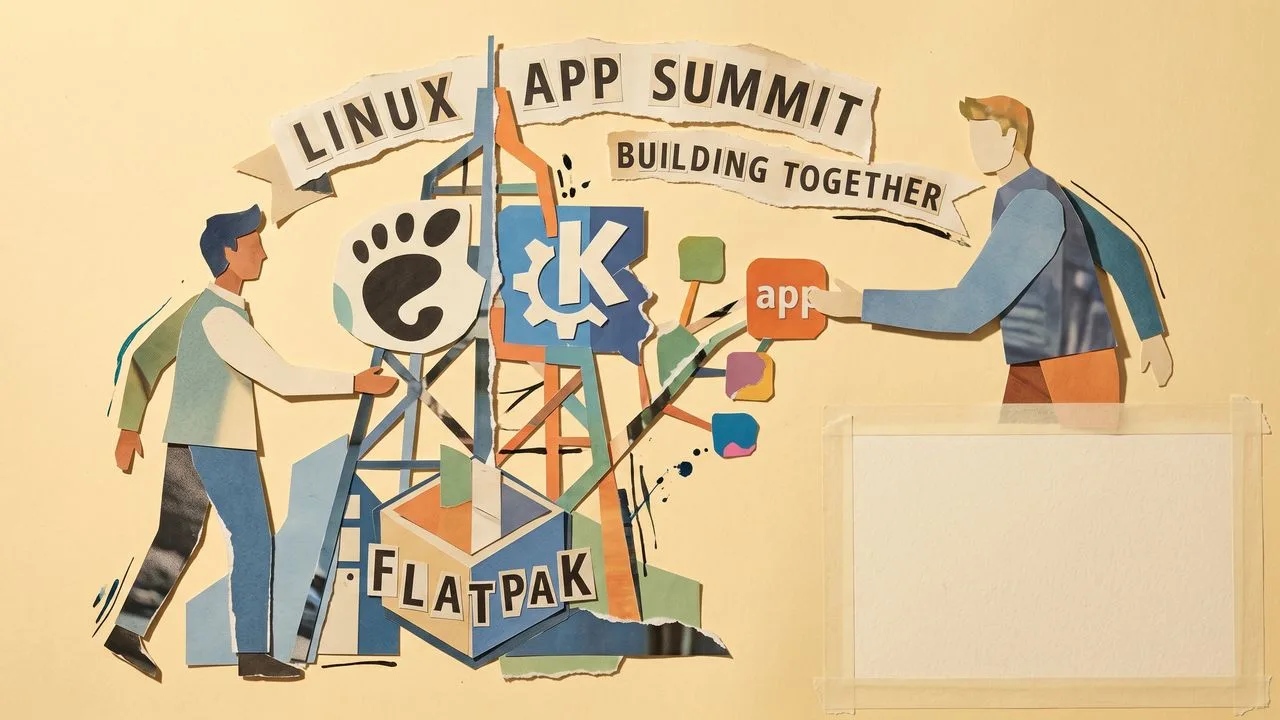
Photo: AI. Wren Sugimoto
If your mental model of Linux desktop culture is two rival camps — GNOME people over here, KDE people over there, never shall they meet — Michael Tunnell's recent interview is going to mess with that a little. He sat down with Sriram Ramkrishna from GNOME and Aleix Pol, who serves as President of KDE e.V. (the nonprofit behind KDE), to talk about the Linux App Summit, a joint conference the two projects have been running together since 2019. Watching the two of them riff on the same problems without once breaking into a turf war is, genuinely, kind of refreshing.
But the interesting part isn't the vibe. It's what they're actually trying to solve — and how honest they are about how much is still unsolved.
What Linux App Summit Actually Is
The short version: LAS is a conference for app developers and Linux platform builders to get in the same room and work through the stuff that makes shipping apps on Linux harder than it needs to be. It started, Sri explains, right around when Flatpak was getting off the ground — there was a moment where a bunch of different packaging formats were proliferating and nobody was really coordinating. LAS was the attempt to bring some order to that.
That's the founding story. The current mandate is broader. Aleix puts it plainly: "Is it easy for everybody to use Linux today on their personal devices? Not so much. So that's already one of the stoppers."
The blockers they name aren't a single thing you could fix with one good engineering sprint. It's a stack: Linux is still genuinely hard to use for normal people. Third-party developers don't know where to go to ask basic questions about the platform. The monetization path for indie developers is unclear. And the summit itself has a discoverability problem — most Linux users have no idea it exists, which is part of why Sri and Aleix were on Tunnell's show in the first place.
The dynamic they're trying to create is pretty sensible: developers need to know what the platform offers, and the platform needs to know what developers actually want. Neither side can figure that out without talking to the other one. LAS is supposed to be where that conversation happens.
Why Both Projects, Together
Here's the thing about GNOME and KDE co-running this: it's not just symbolically nice. Sri makes the practical case bluntly — "Doing LAS without one or the other is like trying to do an ecosystem with one hand." Separately, they're each significant. Together, they're actually representative of the Linux desktop in a way that either one alone couldn't claim to be.
What I think is genuinely interesting about how they describe the event is that they both say the conference changes how they think — not just what they know. Sri talks about a "brain change" where the default question shifted from "how does GNOME do this" to "how do we do this together." That's not a small thing in a community that has historically organized itself around project loyalty.
The GNOME and KDE philosophies are also genuinely different — GNOME is opinionated, consistency-focused, very "it should just work." KDE is flexible, options-heavy, trusts the user to configure their way to happiness. At LAS those philosophies collide in hallway conversations rather than forum threads, which apparently makes the collisions more productive. Aleix describes the ideal: "Having the KDE guy saying I would want to have 25 options, and the GNOME guy saying yes but this one should just work — that's also what LAS is about."
Flatpak Is Ten Years Old. What Comes Next?
Sri's most anticipated talk at this year's summit is one on "Flatpak: Next" — specifically, what happens to the primary app distribution mechanism for desktop Linux now that it's been around for a decade. This isn't just a housekeeping question. Flatpak was the answer to the nightmare of per-distro packaging — build your app once, it runs everywhere — and it worked well enough that it became the default recommendation. But ten years is a long time in software, and the question of what gets re-engineered is real.
Then there's Buildstream, which is the part of this conversation I want to make sure doesn't get lost in the shuffle.
Sri flags it as some of the most exciting work happening in the Linux ecosystem right now. Aleix is giving a talk on it. The pitch is that Buildstream is changing how the operating systems themselves get built — GNOME OS and KDE Linux are being assembled in fundamentally new ways, and that has downstream effects on how apps get developed and distributed.
Here's the part that matters to you specifically, whether you're running Linux on a secondary machine, considering it for your Steam Deck, or thinking about shipping something on the platform: the infrastructure underneath your apps is being rebuilt, and almost none of it is visible from the outside. The people making decisions about how GNOME OS and KDE Linux get constructed are doing it in rooms and mailing lists that most developers — let alone users — never see. If you're a dev who wants to ship a Linux app, or a user wondering why some app you want doesn't exist yet, the answer might be that the platform underneath it is mid-renovation and nobody posted the construction signs.
LAS is, in theory, supposed to be where some of that gets surfaced publicly. Whether it actually does depends on how much of the real conversation happens on stage versus in the hallways.
The Access Question
For people who can't attend in person: Aleix says they're streaming talks live and will be releasing individual cut-down videos on YouTube after the event. So it's accessible, which matters. The talks this year include Lennart Poettering (Aleix characterizes his talk as being about the OS creation layer and the handover from hardware to user, with apps as a major player — though that's Aleix's read on Poettering's focus, not a confirmed abstract), George Castro, Yuning Luang from DeepComputing, and Aleix himself on Buildstream.
The hallway conversation point is real though. Aleix mentions that some KDE developers told him the talks were almost beside the point — what they came for was the ability to have conversations that don't happen anywhere else. FOSDEM, for comparison, is enormous and everyone's stretched thin. LAS is smaller, which means the people you want to talk to are actually reachable.
What Success Looks Like (And What I Actually Think)
Aleix's definition of success is straightforward: mainstream applications that have historically ignored Linux finally show up. Spotify native. Figma native. The apps that people cite when they say "I can't fully switch to Linux." That's the goalpost.
Sri's version of success is more about what LAS itself becomes — he trails off before finishing the thought in the interview, but the implication is something like: a recognized, well-attended platform event that third-party developers treat as seriously as they'd treat an Apple WWDC session or a Google I/O talk.
So here's where I land on this, honestly: I think LAS is doing real work and I think the collaboration between GNOME and KDE is more meaningful than it looks from the outside. The fact that these two projects have maintained a joint conference for six-plus years, with shared organizing duties and actual cross-pollination of ideas, is not nothing.
But I'm skeptical that a conference alone moves the needle on the Spotify problem. The reason Spotify doesn't have a native Linux app isn't that their developers don't know who to call at GNOME — it's that Linux desktop market share hasn't historically justified the engineering cost. That math changes when more people are on Linux, and more people get on Linux when the apps are there. It's a loop, and conferences don't break loops by themselves.
What could break it: Steam Deck normalization is already doing something. The number of people who now have Linux as their primary gaming device without necessarily thinking of it as "running Linux" is real and growing. If LAS can get in front of developers who are already shipping on Steam Deck and show them that a broader Linux app play isn't crazy — that the platform is actually coherent enough to target — that's a concrete path. Not "Figma announces Linux support at LAS 2025," but a slower accumulation of smaller developers who ship on Linux and don't regret it, until the platform reaches a mass where the Spotifys of the world have to pay attention.
That's a years-long bet. Sri and Aleix seem to know it. The question is whether the Linux community has the patience for a slow build — and whether LAS can stay relevant long enough to see it pay off.
More Like This
Linux Kernel Draws a Line on AI-Generated Code
After six months of debate, Linux kernel developers establish new rules for AI assistance: disclosure required, human accountability mandatory.
Penpot Wants to Fix Design Handoff—Does It Actually?
Better Stack demos Penpot, an open-source design tool that speaks CSS natively. We look at what it solves, what it doesn't, and who should care.
Linux Spring 2026: Ubuntu, Fedora, Framework & More
Ubuntu 26.04, Fedora 44, Framework Laptop 13 Pro, the new Steam Controller, Zorin OS 18.1—Linux spring 2026 is stacked. Here's what actually matters.
Omacon 2026: Linux as Love Language
At Omacon 2026, DHH made the case that Linux tinkering is craft, not productivity. Is this a genuine movement—or a very aesthetic hobby?
Residues: Rethinking Software Design for the Unpredictable Era
Explore Residuality Theory and its fresh take on complex software architecture and resilience.
Copy Fail, Dirty Frag & the Linux News That Matters
Bazzite 44, CachyOS April, Arch Linux's latest ISO, and two kernel vulnerabilities the internet is catastrophizing. Here's what actually matters.
Meta Faces Lawsuit Over AI-Driven Layoff Decisions
26 former Meta employees allege AI scoring systems—not managers—decided who got laid off. Here's what that means for anyone who wants to work in tech.

Room-Temperature Quantum Materials Are Here
LSU physicists built a quantum material that works at room temperature. Here's what that actually means for quantum computing, and why it matters right now.