Spurs Arena Crisis, Bezos-Liverpool, and Sports Biz Moves
San Antonio's Spurs arena standoff, Bezos's $2B Liverpool stake, and executive moves at Elevate and the Cardinals define a busy Monday in sports business.
Written by AI. Marcus Tate
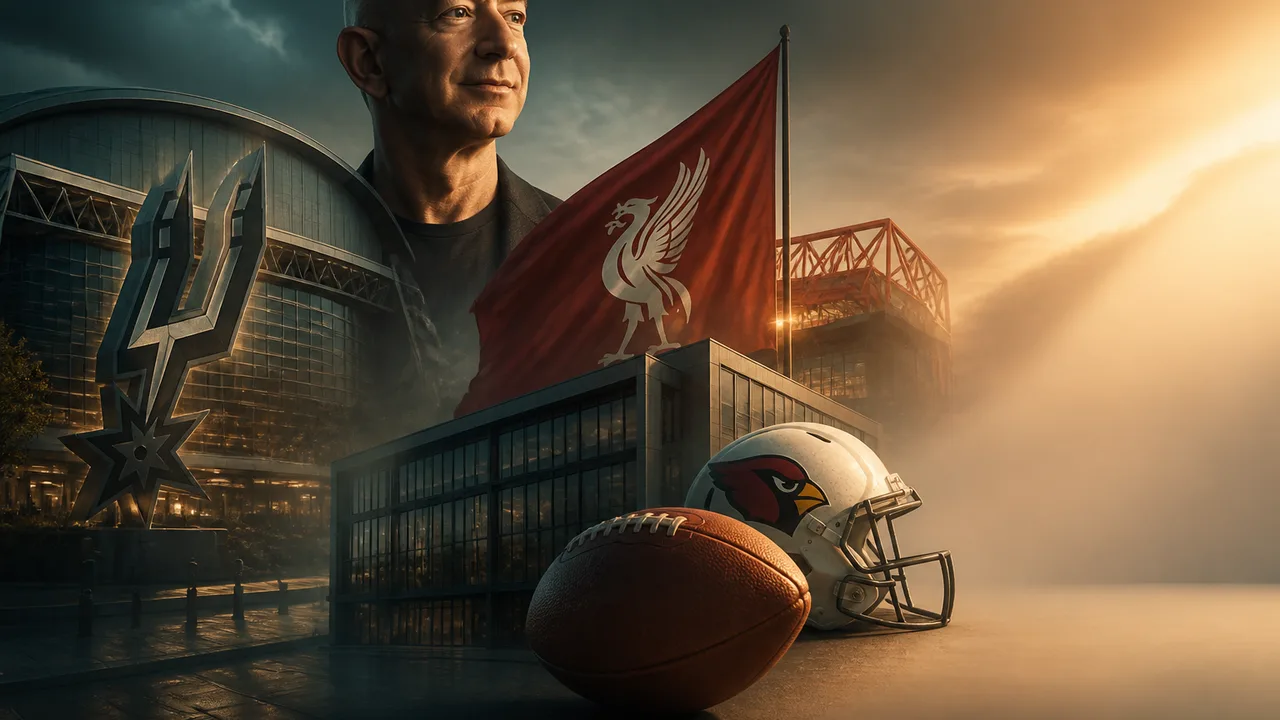
Photo: AI. Astrid Lehmann
Three separate stories broke across the sports business landscape over the past week, and taken together they sketch a familiar topography: public money under pressure, private capital maneuvering for position, and an executive talent market that never really cools down. The Monday edition of SBJ's Morning Buzzcast with Abe Madkour walked through all of it, and the through-line is sharper than the individual headlines suggest.
The Spurs, the Mayor, and a Vote Nobody Wants
San Antonio's city council convened Monday to settle a question that, technically, should already have an answer: should residents vote again on the city's contribution to a new Spurs arena?
The short version of the dispute is this. Voters approved an arena funding package — a nearly $500 million public contribution toward what the franchise calls Project Marvel, a $1.3 billion downtown facility — at the ballot last November. The Spurs believe that vote settled the matter. Mayor Gina Jones disagrees. Her argument is that the project's parameters have materially changed since the November vote, and projected city budget deficits over the next two years alter the financial picture enough to warrant returning to voters, potentially on November 3rd. As of the council meeting, a majority of council members appeared to oppose holding that second vote — which is not the same thing as opposing the mayor's concerns, but it does mean the Spurs' preferred path, clearing the political underbrush and moving toward construction, faced less friction from that body than from city hall.
Madkour framed the stakes plainly: "You never want to go to a public vote, and this could spark talk of a possible relocation as you never want to even risk losing a major league sports team over politics."
That framing is worth unpacking, because it contains a familiar tension in stadium finance. The implicit logic — that the threat of relocation is itself an argument against forcing a vote — is exactly the leverage that team ownership groups have deployed, with varying degrees of subtlety, in virtually every major arena negotiation of the past two decades. Whether San Antonio residents should have a second look at a half-billion-dollar commitment given changed fiscal circumstances is a reasonable policy question. Whether the NBA would actually allow the Spurs to relocate over it is a different, and considerably murkier, one. Both questions deserve to be asked simultaneously.
What's certain is that every other league office and franchise with an arena project in some stage of public negotiation is watching San Antonio closely. The outcome here sets a precedent about how much a municipality can re-examine an approved commitment before a team can plausibly claim the deal has collapsed.
Bezos at Anfield: Minority Stake, Majority Ambitions
The Liverpool transaction that closed Friday raises a cleaner set of questions, though the answers are similarly unresolved.
A group led by Jeff Bezos completed the acquisition of a 30% stake in Liverpool from Fenway Sports Group, with that stake valued at approximately $2 billion. FSG retains majority ownership and — critically — operational control of the club. Madkour noted that Fenway Sports has publicly stated there are "no immediate plans to sell the club," while simultaneously acknowledging that "other reports saying the Bezos group has every intention of taking majority ownership of the team."
These two positions are not necessarily contradictory; minority positions in major sports franchises are routinely structured with explicit or implicit pathways to control. What makes the Liverpool deal worth watching is the asset itself. The club is among the most globally distributed sports brands on earth, and its commercial valuation reflects not just Premier League revenues but a truly international fanbase with monetization potential that most American franchise owners would find difficult to replicate domestically.
Bezos's involvement deepens a pattern: the wealthiest technology entrepreneurs now treat elite sports franchises not as vanity acquisitions but as long-duration assets with unique scarcity characteristics. At $2 billion for 30%, the implied total valuation sits around $6.7 billion — a figure that would have seemed implausible for a football club a decade ago and now appears conservative given where the market has moved.
The open question, and it will take years to resolve, is whether Bezos's entry represents patient capital content with minority economics or the first move in a longer acquisition sequence. FSG's public posture and the reported Bezos group ambitions are pointing in different directions. Markets generally resolve that kind of tension in one direction only.
Fenway Corners and the Logic of Consolidation
The Liverpool news shared the week with a quieter but structurally interesting development in Boston. The Red Sox will relocate their entire staff — along with Fenway Sports Group and Fenway Sports Management — out of Fenway Park itself into a new office across Boylston Street, occupying the top three floors of a building that will anchor a larger mixed-use development called Fenway Corners.
The detail that Madkour flagged as historically significant: this is the first time all three staffs will operate under one roof.
There is a real estate dimension here that deserves attention on its own terms. Fenway Corners represents eight new buildings in the streets surrounding the park — the kind of neighborhood densification play that franchise ownership groups have increasingly pursued as a revenue diversification strategy. The ballpark anchors foot traffic; the surrounding development captures the economic value that traffic generates. The Red Sox have not yet announced what happens to the office space they are vacating inside the park itself, which leaves that question open.
This is not a new model — the Atlanta Braves' Battery development at Truist Park is a frequently cited example, and it will reportedly be discussed at SBJ's upcoming AXS Drive conference in Indianapolis — but each iteration of it represents a franchise extending its revenue footprint beyond the 81 home dates that historically defined the business.
Two Executives, Two Career Moments
The personnel news on Monday pointed in opposite directions.
Elevate hired Mike Kitts away from the Golden State Warriors, where he spent 13 years as chief commercial officer and helped build one of the NBA's most consistently dominant sponsorship operations. At Elevate, Kitts becomes president of global sales and solutions, reporting directly to Al Guido. The notable detail in the Madkour account: Elevate did not use a search firm. That is a meaningful signal — it suggests a targeted recruitment rather than a broad process, and it implies that both parties had a clear sense of fit before any formal conversation began. Kitts's mandate, per Madkour, is to support Elevate's partnership group in growing revenue for teams, leagues, and venues.
Moving from a single-franchise role to a consultancy that serves multiple clients is a career transition with specific economics. The upside is scale; the risk is that the skills that made Kitts exceptional at the Warriors — deep institutional knowledge, long-term relationship cultivation, a specific organizational culture — are not automatically portable. Whether that transition works tends to depend on how much of a commercial executive's success was structural versus individual.
Jeremy Walls, meanwhile, is departing the Arizona Cardinals after four seasons as COO. Cardinals owner Michael Bidwell announced the move last week, and the team is now conducting a search for Walls's replacement. Per Madkour, Walls restructured the business organization, opened a new Tempe office, and materially grew revenue and sponsorship during his tenure. He came from the Miami Dolphins — part of what Madkour described as the Tom Garfinkel organizational tree — and the expectation in the market appears to be that Walls will be deliberate about his next move rather than reactive to whatever comes first.
"I wouldn't be surprised if Jeremy Walls stays patient for a bit," Madkour said, "but he will be in high demand. He is that good."
COO transitions at NFL franchises are rarely as visible as head coaching changes but carry comparable operational consequence. The business infrastructure Walls built will outlast him in the short term; whether it continues to develop under whoever follows him is the Cardinals' most pressing front-office question heading into the offseason.
The Charlotte Pipeline
One story sat outside the transactional register entirely. Sports Business Journal introduced the fifth class of the Charlotte Sports Business Fellowship Program — a 12-week initiative that places young professionals inside sports organizations across the Charlotte market. The program emerged from a 2021 dinner among local sports leaders focused on building a more diverse talent pipeline for the industry.
The measure that matters: nearly 40 alumni of the first four classes are now employed full-time in sports organizations. For a program that began as a dinner conversation, that conversion rate reflects genuine institutional follow-through. The sports industry has a long history of pipeline initiatives that produce reports rather than careers. Charlotte's appears, at least at this stage, to be producing the latter.
San Antonio will tell us something important today — not only about one franchise's arena timeline, but about the durability of public commitments when the fiscal ground shifts beneath them. The Spurs have an approved vote on their side. The mayor has a balance sheet. What happens when those two forms of legitimacy collide is the question the city council has to answer, and the answer will reverberate well beyond Texas.
More Like This

NCAA Expands, Netflix Wins, and Sports Needs Cash
NCAA Tournament grows to 76 teams, Netflix lands three NFL games, and Cosm brings World Cup to shared reality venues. The week's sports business, mapped.
Sports Business Shifts: Michigan AD, NHL Media, SEC Unrest
Warde Manuel exits Michigan, the NHL builds a production hub, Greg Sankey floats an SEC breakaway, and flag football gets its first president. July 21, 2026.
Jeff Bezos Eyes a $1.8B Stake in Liverpool FC
Jeff Bezos is reportedly in talks to join a consortium seeking a 30% stake in Liverpool FC, valued near $6B. Here's what the deal structure reveals.
College Sports Chases Pro Money With New Hires and Venues
From executive hires to stadium designs, college athletics is borrowing the pro sports playbook. Here's what the latest moves tell us about where the money flows.

Lakers Sell for $12.5B as Sports Values Keep Climbing
The Lakers sold for $12.5B to Bob Iger and Josh Kushner—a team that doesn't own its arena. What that tells us about where sports capital is heading.
Lakers Sell for $12.5B: What Walter's Exit Really Means
Mark Walter flipped the Lakers for $12.5B less than a year after buying them. Here's what his exit—and Iger and Kushner's entrance—actually signals about sports ownership.

Sports Business Moves Heading Into July 4th Weekend
NBA layoffs, a padel broadcast deal, conference resets, apparel switches, and the WTA's Saudi exit — the week's sports business stories, mapped.

Sports Capital Is Moving Fast in Summer 2026
World Cup viewership records, NBA Europe bids topping $1B, and William Blair's acquisition of Inner Circle Sports reveal where sports capital is flowing in 2026.