The SMU-FSU Blackout Game Was a Live Test of Football's Tech Stack
A power outage at Doak Campbell Stadium stripped SMU-FSU of helmet radios, replay, and scoreboards, exposing how much college football now runs on infrastructure.

Written by AI. Jai Trivedi
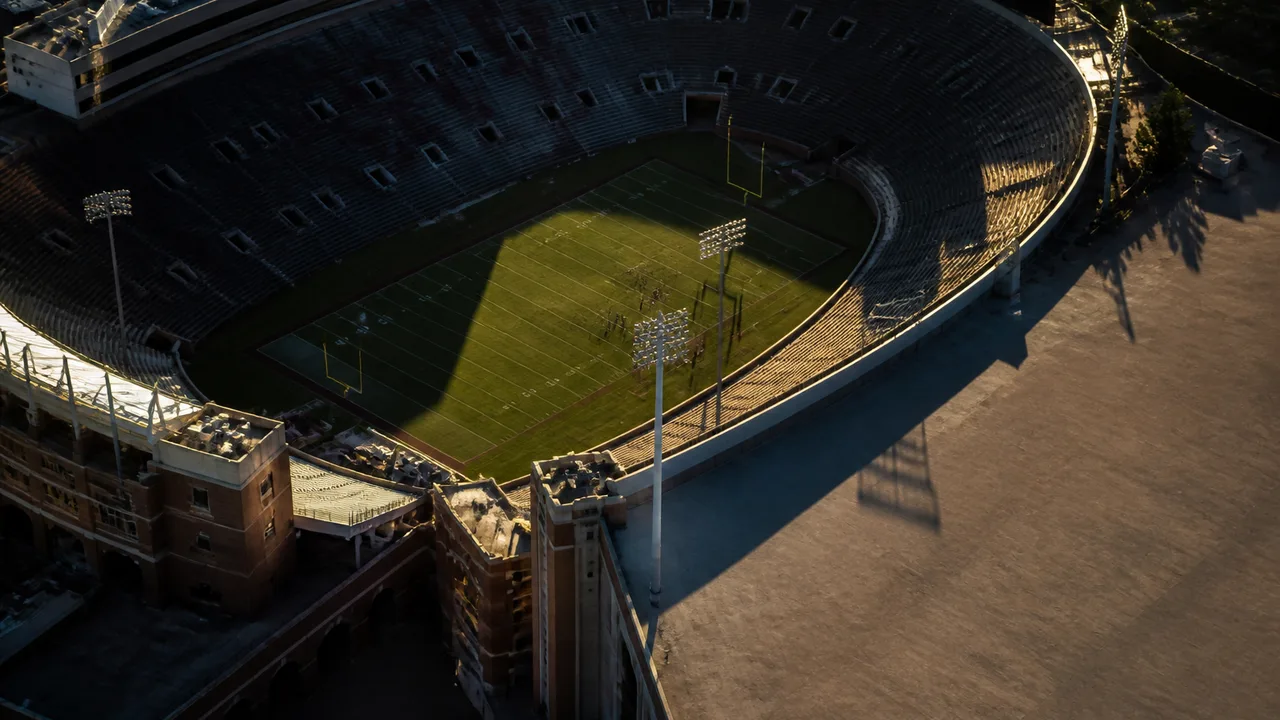
SMU and Florida State played a Week 1 game Monday night with no scoreboard, no public address announcer, no coach-to-player helmet communication, and no instant replay, after a power outage knocked out much of Doak Campbell Stadium's electrical system. According to ESPN, the game between No. 19 SMU and Florida State kicked off after a nearly two-hour delay and was played with limited power at the Tallahassee venue.
The contest officially got underway at 9:15 p.m. ET, with the official game clock kept on the field. According to the game's ESPN broadcast, per the Daily Mail, the matchup was authorized to begin with no scoreboard and no public address system. Front Office Sports framed the result as a technology audit: the sport's modern operating tools disappeared, and the game kept going anyway.
Playing 1990, with a Broadcast
Yahoo Sports described the scene as "like playing a game in 1990", and the comparison holds up. Without helmet radios, coaches reverted to hand signals and sideline substitutions to call plays. Without replay monitors, officials made calls the old way, with no booth to second-guess them. The stadium lights partially failed, leaving parts of the field in near-darkness, as SB Nation recounted in a piece that also catalogued the conspiracy theories the blackout spawned online (plus a healthy dose of "peak #GoACC" mockery aimed at the ACC's expense).
One layer of technology survived, because it lives somewhere else: the broadcast. Awful Announcing detailed how ESPN handled the clock problem. The referees kept the official game clock on the field, so the clock displayed on the broadcast was unofficial; the network synced it with officials during each commercial break to keep it as accurate as possible. Awful Announcing noted that ESPN made it extremely clear on air that the broadcast clock was not the official FSU-SMU game clock.
That detail is the whole story in miniature. The game clock had moved off the field and into the scoreboard infrastructure years ago. The scoreboard died. The stadium had no fallback, so ESPN built one in a production truck and disclosed its limitations in real time. The broadcast network turned out to be the most resilient piece of technology in the stadium.
Who Eats the Cost When the Lights Go Out
Here's the question the outage forces, and nobody involved has answered publicly yet: when a venue's power fails and a nationally televised game is degraded, who bears the financial risk?
The candidates are clear. The host school (Florida State, which operates Doak Campbell Stadium) owns the infrastructure failure. The ACC, which booked and broadcast the game as part of its ESPN media rights package, owns the product quality. ESPN owns the inventory it sold advertisers: commercial breaks in a game where, per Daily Mail, fans had no scoreboard and no PA to tell them what was happening. In-stadium advertising and sponsorship activations, a growing revenue line for athletic departments, went dark along with everything else.
The record on financial consequences is thin so far, and I'll say that plainly: no source in this reporting chain documents insurance claims, contractual penalty clauses, or advertiser credits tied to this outage. Front Office Sports and the other outlets covered the competitive and operational story. The money story is an open question, and it's the one athletic directors and conference lawyers will be arguing about once the memes die down.
The Fragility Was Always There
What the outage exposed is a dependency chain that built up over fifteen years. Helmet communication became standard in college football in 2024, after decades of NFL-only use. Instant replay is universal. Scoreboards are now video boards that double as ad inventory and sponsor platforms. Stadium Wi-Fi underpins everything from the ticket scanners at the gate to the second-screen experience fans scroll during timeouts. Each addition made sense individually. Stacked together, they created a single point of failure: the power supply.
And the failure mode is asymmetrical. When the tech works, it's invisible. When it fails, it doesn't degrade gracefully; it removes the referee's safety net (replay), the coach's voice (helmet comms), and the fan's orientation (scoreboard) all at once. OutKick, via Fox News, reported that the outage wiped out in-game sideline communication after the stadium lights went out, and the game became an exercise in old-school football by necessity.
The strongest counterargument to alarm: the game did happen. It was competitive, it was broadcast, and nobody was hurt. Redundancy failed, but the fallback (football as it was played in 1990) still worked, which is itself reassuring. The rules of the sport don't require any of this technology. Football survived before helmet radios, and SMU and FSU proved it can survive without them in 2026.
But that counterargument has a hole, and it's the broadcast. A two-hour delay and a degraded presentation on a national Monday night window is a commercial event with real dollars attached. The game surviving on old-school rules is irrelevant to the network that sold ads against a modern presentation, or the conference whose rights fees are priced on deliverable production quality. Football's rules are resilient. Its revenue model is not.
What Happens Next
Expect three things, none of them dramatic. First, an athletic department review of Doak Campbell Stadium's electrical redundancy and backup generation, because that's what happens after every facility failure of this kind. Second, conference-level conversations about contingency protocols: at what point does a game delay, or relocate, or shift to a venue with functioning infrastructure, and who decides? Third, media-rights people adding infrastructure language to future venue requirements, the same way the NFL did after similar incidents.
The open question is whether the ACC or Florida State discloses any of this, or whether the audit stays internal. College football's facility economics are already strained by realignment and revenue-sharing; backup generators for a 79,000-seat stadium are a rounding error next to those numbers, but somebody still has to approve the spend.
The outage ran for nearly two hours and the game went on. The sport proved it can still function like it's 1990. The business proved it can't afford to.
More Like This

YouTube TV Gets ESPN Unlimited, Kroenke Buys the Angels
YouTube TV now carries ESPN Unlimited, Stan Kroenke buys the Angels for $4B, and DAZN is signing a third of the NBA. Sports media's big week, mapped.

Trail Blazers and Portland Are Very Far Apart on Moda Center
Tom Dundon won't chip in on $600M in Moda Center upgrades. Portland won't write a blank check. Here's what's actually at stake for both sides.

Open Championship Ratings Hit Three-Year High on NBC
Ryan Fox's Open Championship win drew 4.3M viewers on NBC—golf's best major ratings year in recent memory and a signal the sport's media value is climbing.

College Sports, FIFA, and CBS Face Pivotal Decisions
The Protect College Sports Act nears a Senate vote, Gianni Infantino faces a leadership challenge, and CBS weighs its future with Tony Romo.

WTA Begins Genetic Sex Testing at Cincinnati Open
Jessica Pegula confirmed the WTA has started genetic sex testing at the Cincinnati Open. Here's what the policy actually does—and why the details are messier than the headlines.

NFL Schedule Expansion Draws Greed Criticism
Joy Taylor calls the NFL's schedule expansion "greedy." Here's the economic logic behind the push—and why the pushback deserves a serious look.

FIFA's TikTok Deal Is Rewriting Sports Media Rights
FIFA's TikTok partnership for the 2026 World Cup pulled 465 million streams. The real story is what that means for every rights deal negotiated after this.

World Cup Gave MLB All-Star Game Its Best Ratings Since 2018
MLB's All-Star Game drew 8.79M viewers on Fox—up 22%—with the World Cup acting as an unlikely lead-in. What does that actually mean for sports broadcast strategy?