Smartphones Carry Harmful Microbes, Research Shows
Molecular biologist Lotti Tajouri's research found thousands of microorganisms on healthcare workers' phones—and makes the case for rethinking hygiene.

Written by AI. Kira Yoshida
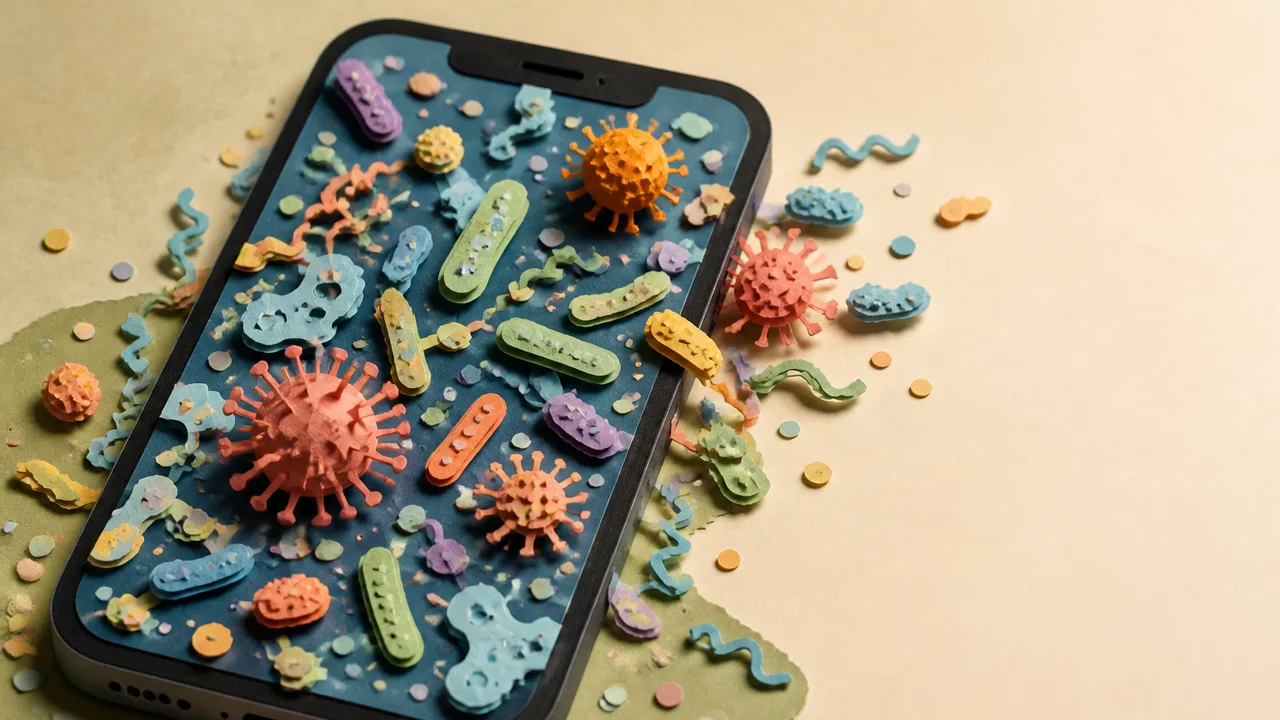
Photo: AI. Lila Bencher
Picture the most sterile environment you can think of. A surgical theater: every instrument autoclave-clean, every surface treated, everyone gowned, masked, gloved. Now picture a surgeon reaching into their scrub pocket for their iPhone.
That image—equal parts mundane and quietly alarming—is where molecular biologist Lotti Tajouri's research begins. In a recent TEDxBrisbane talk, Tajouri, an Associate Professor in Molecular Biology at Bond University and Adjunct Associate Professor at Murdoch University, laid out what his lab has been finding on mobile phones for years. The short version: a lot. The longer version is worth sitting with.
The original observation
Tajouri's entry point isn't a lab. It's a delivery room. In 2014, his wife underwent an emergency C-section, and he stood beside her in full protective gear—"from the very sexy bonnet on my head to the shoe booties on my feet"—watching healthcare workers use their smartphones while gloved, in a supposedly sterile environment. He stayed quiet. Three years later, at the birth of his second child, the same thing happened again. That repetition, he says, is what turned observation into research agenda.
It's a good origin story, and it earns its place in the talk. But it also raises the first interesting tension in Tajouri's argument: the gap between observing a behavior and quantifying its risk. Healthcare workers using phones in clinical settings is a documented phenomenon that infection control researchers have flagged before. What Tajouri brings is his own microbiological evidence about what's actually on those devices.
What the swabs found
In research conducted at Bond University and Murdoch University, Tajouri's team swabbed 26 mobile phones belonging to doctors and nurses working in pediatric wards and intensive care units. On those phones, they identified over 11,000 microorganisms, including bacteria and viruses associated with serious hospital-acquired infections—among them Staphylococcus aureus and Klebsiella pneumoniae, both well-known clinical troublemakers. They also found multi-drug resistant organisms: the superbugs that infection control teams spend considerable resources trying to contain.
The framing Tajouri uses for this is "Trojan horse," and it's the right one. The problem isn't just that phones are dirty—it's that they neutralize an intervention we already know works.
"Mobile phones negate handwashing," he says in the talk. "You can wash your hands perfectly, but the very moment you touch your phone, you recontaminate them."
This is the crux. Hand hygiene compliance in hospitals has been a major public health focus for decades, and it's genuinely effective at reducing infection transmission. But that effectiveness assumes the hands stay clean between patient contacts. A contaminated device that gets touched immediately after handwashing doesn't just fail to help—it actively undoes the effort.
Why phones are particularly good at this
Tajouri walks through the microbiological logic, and it's more interesting than it might sound. Phones create a near-ideal growth environment: they're warm from processor heat, humid from proximity to mouths during calls, and routinely supplied with organic material—skin cells, debris, and yes, food residue for the scrolling-while-eating crowd. They're also high-contact surfaces that, unlike hands, almost never get cleaned.
The bathroom factor compounds this. Tajouri cites studies suggesting a majority of people use their phones while on the toilet—which, combined with the environmental biology involved, helps explain the presence of fecal-associated bacteria like E. coli and Salmonella on devices. Your phone, in other words, doesn't just go where you go. It carries viable microbial evidence of everywhere it's been.
This is where the talk's argument extends beyond hospitals into biosecurity territory. In 2023, Tajouri swabbed 20 mobile phones from international travelers who had just arrived in Sydney from multiple continents for a medical conference. He was looking for pathogens associated with human disease. What his team cultured instead were living plant and animal pathogens—viable organisms, not dead traces. Among them was Pantoea agglomerans, which Tajouri identifies as a quarantine pest in Australia with implications for agriculture. Phones, unlike luggage, don't go through biosecurity screening.
The COVID-19 data point
Tajouri references a systematic review his team conducted during the pandemic, finding that 45% of mobile phones tested in various studies carried the coronavirus—at a time when healthcare workers were already wearing full PPE. The protective equipment, it seemed, didn't extend to the devices in people's pockets.
This is worth pausing on. The PPE story of COVID-19 was largely a story of supply chains, compliance, and frontline worker protection. The role of contaminated personal devices received far less attention in public discourse, and Tajouri's broader point—that our hygiene frameworks are systematically incomplete when they exclude phones—seems well-supported here.
What the argument doesn't fully resolve
The case Tajouri builds is substantive. The underlying microbiological evidence is real. But a few questions sit at the edge of the talk that don't get resolved, and they're worth naming.
The first is dose and transmission risk. Finding bacteria or viruses on a surface tells you something important, but it doesn't automatically tell you how often those organisms cause actual infections, or what the mechanism of transmission looks like in practice. Clinical microbiology is full of surfaces that carry pathogens without becoming vectors for significant disease. Tajouri's research establishes contamination; the causal chain from contaminated phone to patient infection is harder to establish and isn't directly addressed here.
The second is behavioral feasibility. Tajouri's individual-level recommendation—wipe your phone when you wash your hands—is genuinely simple. His systemic recommendation, placing UVC sanitization stations next to hand hygiene stations in high-risk environments, is also technically achievable; UVC technology for surface decontamination is established, and such systems do exist. What's less clear is how that infrastructure would be maintained, how compliance would be tracked, and how hospitals would prioritize this against the approximately thousand other infection control interventions competing for attention and budget.
None of this undermines the core observation. "If you wash your hands but never clean your phone, you're only doing half the job," Tajouri says, and that logic is hard to argue with. The question is how far the infrastructure piece scales, and who bears the cost of the mindset shift he's calling for.
The framing that sticks
What Tajouri does most effectively in this talk is give people a conceptual handle that's actually useful: your phone is your third hand.
It's catchy in the way that good public health messaging sometimes is—simple, slightly uncomfortable, accurate enough to change behavior. The comparison reframes a familiar object. You wash two of your hands. You clean neither of the surfaces your phone touches, the toilet, your face, your child's hands, the ICU patient's bedside table.
The hygiene frameworks we grew up with were designed for a world where the most contaminated surfaces people touched regularly were, well, surfaces. Fixed ones. Phones are mobile, personal, emotionally significant, and almost universally present in clinical environments now. The hand hygiene revolution took decades of infrastructure, policy change, and behavioral nudging to take hold. Tajouri is essentially arguing that we need to run a version of that playbook again, this time for a device that didn't exist when most of those protocols were written.
Whether that happens through policy mandates, hospital-specific protocols, or individual habit change probably depends on where you sit in the system. A hospital infection control officer has different levers than a person reading this on their phone right now, possibly in the bathroom.
That last part is not a judgment. It's just where we are.
Kira Yoshida covers fitness, movement science, and public health for Buzzrag.
More Like This

Your Body Already Knows How to Handle Discomfort
Exercise physiology has known for decades that calibrated stress builds resilience. So why does the wellness industry keep selling you comfort instead?

Smartphones and the Global Baby Bust
John Burn-Murdoch's data on falling global birth rates points to smartphones as a key driver—and the mechanism looks familiar to anyone who covers collective action failures.

Fitness Is Tracking the Wrong Scoreboard
The wellness industry optimizes for calories and scale weight—not health. A climate entrepreneur's insight about broken metrics applies directly to your body.
What an ER Doctor's Skill Failure Teaches About Learning
Jeremy Baird's TEDx talk on failing a lumbar puncture connects surprisingly well to sports psychology research on how bodies learn from physical errors.
Building a Cognitive Immune System Against Misinformation
New neuroscience frames the brain as having a cognitive immune system. Here's what that means—and who that framing conveniently lets off the hook.
How Friction and Awareness Can Reduce Doomscrolling
A recent video from The Art of Improvement outlines a practical, low-pressure system for breaking the doomscrolling habit—no willpower required.
How Your Circadian Rhythm Controls Morning Wakefulness
Your body already knows how to wake up naturally. Here's what sleep science says about training your circadian rhythm to stop dreading mornings.

Grounded Confidence Is a Body State, Not a Mindset
A viral Charisma on Command video gets the framework right but misses the physiology. Grounded confidence isn't a technique — it starts in your nervous system.