SKA Telescope Merges Radio Astronomy and Cultural Memory
The Square Kilometre Array is connecting historical star-watching traditions with cutting-edge radio astronomy. Here's why that matters beyond the science.

Written by AI. Nadia Marchetti
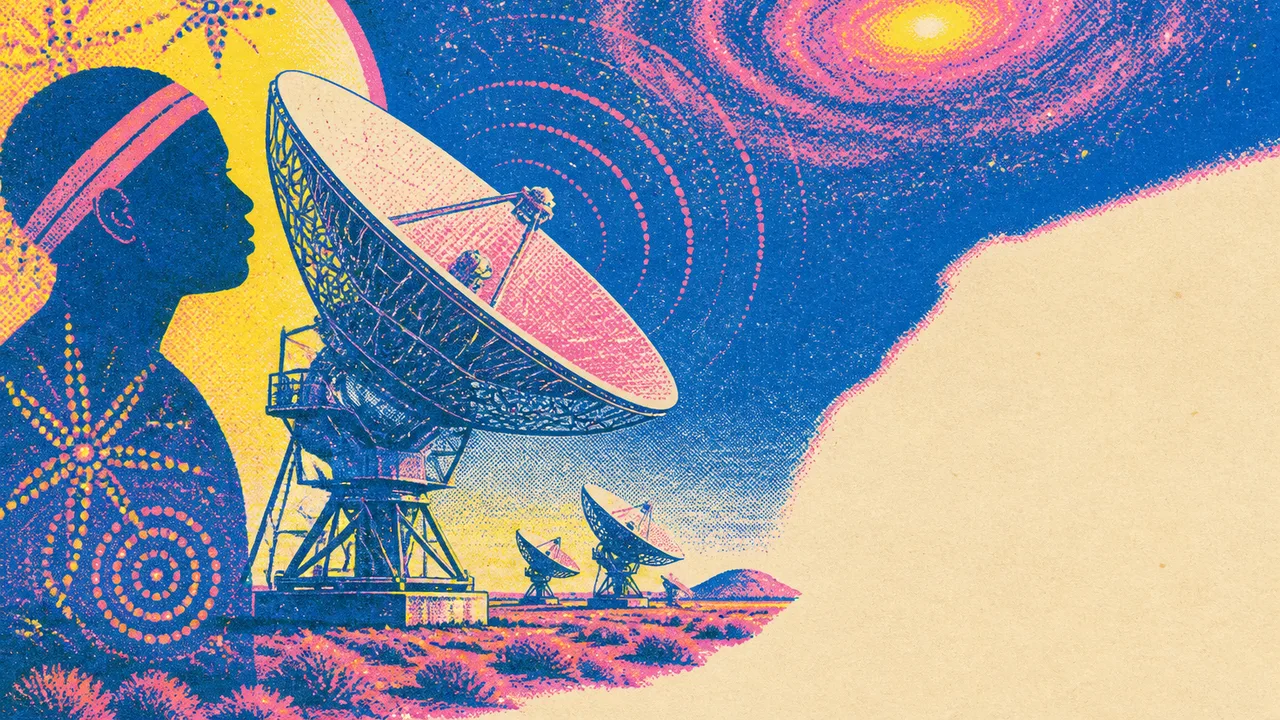
There's a recurring assumption in how we talk about science: that the past is prologue, a thing to acknowledge briefly before moving on to the real work. The Square Kilometre Array project is quietly making the case that this framing is wrong, and that the archives humanity has kept about the sky are not just historical curiosities but active scientific resources worth preserving and interrogating on their own terms.
According to phys.org, the SKA project is emerging as a model for integrating historical astronomical archives with modern scientific research, establishing what the outlet describes as a dialogue between local memory and advanced cosmological studies. That word, "dialogue," is doing real work here. It implies exchange, not just extraction, a relationship where historical knowledge shapes contemporary research rather than simply feeding it raw material.
What the SKA Actually Is
For readers who haven't been following radio astronomy, some grounding is useful. The Square Kilometre Array is a multinational mega-project to build the world's largest radio telescope, with receiver arrays distributed across South Africa and Australia. The combined collecting area will eventually reach roughly one square kilometre, hence the name, giving it sensitivity orders of magnitude beyond any existing facility. Its scientific targets span an extraordinary range: mapping the large-scale structure of the universe, tracking the formation of the first stars and galaxies, testing general relativity in extreme environments, and searching for the chemical signatures of life beyond Earth.
That last item tends to generate the most public interest, for reasons I find completely understandable. A telescope sensitive enough to detect the faint radio emissions of exoplanet magnetospheres, or the microwave fingerprints of complex organic molecules in distant molecular clouds, is also, incidentally, the most capable tool humanity has ever built for SETI, the search for extraterrestrial intelligence. The SKA collaboration has been careful not to oversell this angle, but it's there in the instrument's capabilities whether they advertise it or not.
What's less discussed is what the SKA project is doing with human history. That's the story worth examining.
The Archives Question
Every civilization that survived long enough left records of the sky. Chinese imperial astronomers tracked guest stars, what we now recognize as supernovae, with enough precision that modern researchers have reconstructed historical explosion dates from those records. Medieval Islamic scholars preserved and extended Greek astronomical knowledge during Europe's long scholarly dormancy, producing star catalogs that remained definitive for centuries. Indigenous communities across southern Africa, the Americas, and Australia developed sophisticated frameworks for celestial navigation, agriculture, and timekeeping, frameworks encoded in oral tradition, rock art, and architectural alignment.
These aren't footnotes. They are longitudinal datasets stretching back centuries or millennia, which is something no modern observatory can manufacture from scratch.
The SKA's engagement with historical archives, as reported by phys.org, positions the project as a potential steward of this record. The specifics of exactly which archives are being integrated, and precisely how, are not fully detailed in the available reporting, so I want to be careful not to overstate what we know. The phys.org piece establishes the project's direction and intent more than its granular methodology. That's a gap worth noting, because the difference between genuine archival collaboration and institutional window-dressing is usually found in those details.
Why Location Makes This Complicated and Interesting
The SKA's primary telescope sites are in South Africa's Karoo region and in Western Australia's Murchison, both of which sit within landscapes that Indigenous communities have inhabited and observed for tens of thousands of years. The Karoo is Khoikhoi and San territory; the Murchison sits within the country of the Wajarri Yamatji people, who are formal co-signatories to the SKA's land use agreements in Australia.
This is not incidental geography. The communities whose land hosts the world's most advanced radio telescope arrays are also the communities whose ancestors developed some of the oldest surviving astronomical knowledge traditions on Earth. The ethical stakes of that overlap are not trivial.
There's a productive tension here that honest reporting should not smooth over. On one hand, genuine integration of Indigenous astronomical knowledge with modern science is a form of intellectual restitution, an acknowledgment that centuries of colonial dismissal left real scientific value on the table. On the other hand, "cultural heritage" partnerships with large infrastructure projects have a troubled history of functioning as community relations exercises rather than genuine power-sharing arrangements. The SKA's reputation in this regard is better than most comparable projects, particularly in Australia where the Wajarri Yamatji partnership has formal legal standing. But the gap between structural inclusion and meaningful intellectual collaboration is one that institutional press releases tend to obscure.
The question worth asking, and one the phys.org reporting gestures at without fully answering, is whether the historical archives being incorporated into SKA research are being treated as sources that can generate genuine scientific hypotheses, or as cultural context appended to work designed entirely within Western scientific frameworks.
The Practical Scientific Value
Setting aside the ethics for a moment, is there actually useful science here? The answer is almost certainly yes, though the specific claims require proportionate confidence.
Historical records of variable stars, cometary apparitions, aurora sightings, and solar activity provide baselines that modern observation cannot replicate. The SKA's sensitivity to radio transients, phenomena that flash briefly and unpredictably across the radio spectrum, creates a direct scientific need for historical records that might document precursor events or long-period cycles invisible to observatories operating on human funding timescales. If a radio-bright source the SKA discovers today was also noted by an observer five hundred years ago as an anomalous "guest star," that historical data point can change the entire interpretation of what the modern instrument is seeing.
This is not speculative. Historical astronomical records have already transformed our understanding of specific objects. The remnant of the supernova observed by Chinese astronomers in 1054 CE is now the Crab Nebula, one of the most studied objects in astrophysics. The value of historical observation is demonstrated fact, not a methodological experiment.
What SKA Gets Right, and What Remains Open
There's something genuinely admirable about a project operating at the frontier of cosmological science choosing to look backward as well as forward. The SKA's framing of this as "dialogue," rather than extraction or preservation, suggests at least an aspirational commitment to treating historical knowledge as having standing in its own right.
The harder question is whether that aspiration survives contact with the institutional pressures that govern large-scale international science. The SKA Observatory is a treaty organization now, an intergovernmental body with member states, a governing council, and the funding rhythms of a diplomatic enterprise. These structures are not well designed for the slow, relationship-dependent work of genuine cross-cultural intellectual exchange. They are designed for building very large things on schedule and under budget.
The phys.org reporting frames the SKA's cultural heritage integration as an already-emerging model, and that framing may be warranted. But "emerging" is doing some load-bearing work in that sentence. A model that is emerging is not yet a model that has proven itself, and the difference matters if other major science projects are going to use the SKA as a template.
The stars don't care about our institutional arrangements. Hydrogen clouds at cosmic distances emit their 21-centimeter radio signatures regardless of whether the humans listening have correctly sorted out their relationship to the land their antennae sit on. But the humans doing the science live and work within those arrangements, and the quality of the knowledge they produce is not cleanly separable from the quality of the relationships that produced it.
Whether the SKA's archival dialogue becomes a genuine scientific methodology or a well-intentioned gesture is a question its own track record will eventually answer. It's worth watching.
More Like This

We've Been Teaching Heisenberg's Uncertainty Principle Wrong
The story we tell about Heisenberg's Uncertainty Principle is misleading. Professor Aephraim Steinberg explains what the textbooks got wrong—and what's right.

Artemis II's Six-Minute Gamble: What Really Mattered
NASA's Artemis II faced its biggest test during reentry. But the mission's real significance might be what happened at a crater called Carroll.

Indigenous Star Lore Is Reshaping Astrophysics
A new arXiv paper argues Indigenous astronomical traditions aren't just cultural history—they're a scientific resource. But who controls how that resource gets used?
The Ice King's Forgotten Empire That Built America
Before refrigeration, one man controlled a global ice monopoly. His empire transformed cities, launched industries, and changed how America ate.
Czech Sanctuary Near Chleby Predates Stonehenge by 1,000 Years
A 6,500-year-old Neolithic sanctuary in Czechia tracked the Sun and Moon long before Stonehenge. What the Chleby site tells us about prehistoric astronomy.
How Astroparticle Physics Built Itself From Borrowed Parts
A new arXiv review traces how astroparticle physics didn't emerge from a single discovery—it assembled itself from three fields that kept bumping into the same cosmic questions.
Do DMT Entities Point to Alien Consciousness?
Cognitive scientist Donald Hoffman claims DMT entities may be real alien minds. The math is real. Whether it proves anything about consciousness is a different question.
Viking Landers and the Unsolved Mars Life Debate
Fifty years after Viking landed on Mars, one experiment's positive result remains unexplained. Here's what the science actually shows—and what we've learned since.