Shingles Vaccine Linked to Lower Dementia Risk
New research using natural experiments in Wales, Australia, and the US suggests the shingles vaccine may reduce dementia risk—and slow its progression.

Written by AI. Priya Sharma
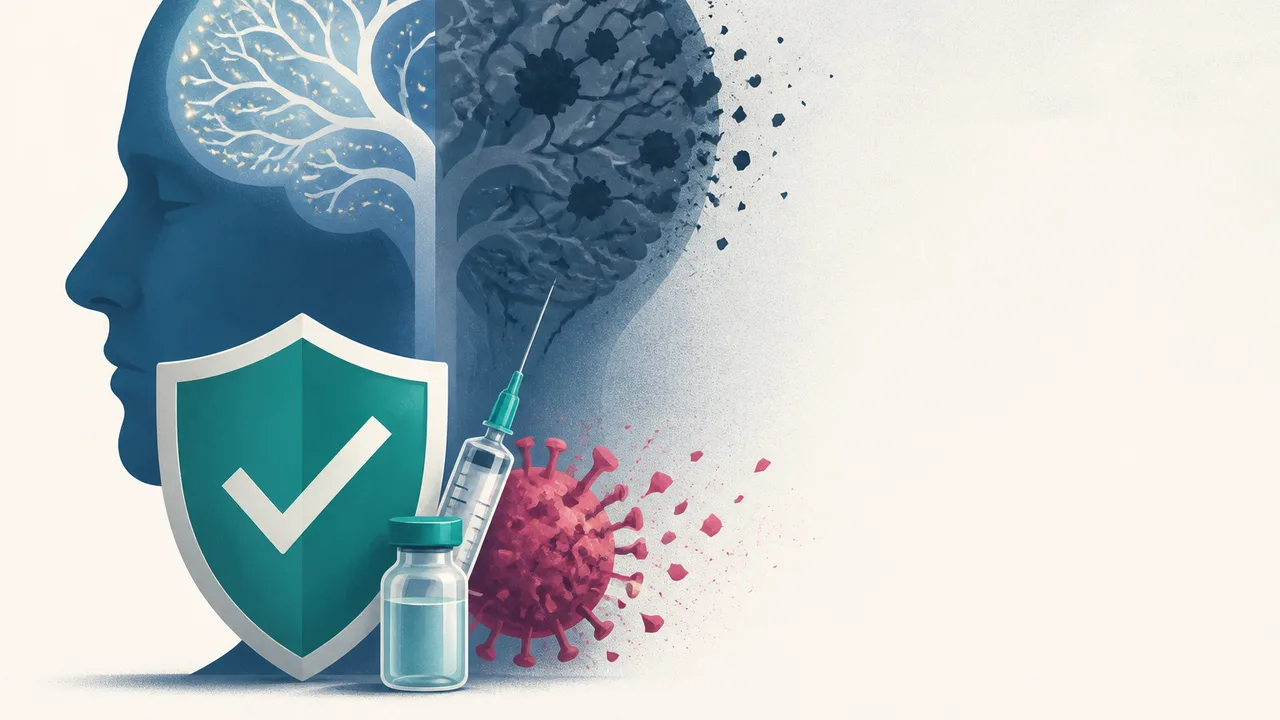
Photo: AI. Mika Sørensen
A blistering skin rash and cognitive decline seem, on the surface, to have nothing to do with each other. But researchers have been quietly accumulating evidence for years that shingles and dementia are linked in ways that are not merely coincidental — and that the vaccine for one may offer meaningful protection against the other.
Several studies published in 2025 have sharpened what was previously a murky correlation into something that looks increasingly like a specific, mechanistic relationship. The upshot, covered in a recent SciShow episode, is striking: the shingles vaccine may reduce the risk of developing dementia, and may also slow the disease's progression in people already diagnosed.
This is not a minor footnote. Dementia affects tens of millions of people worldwide, and we have precious few tools that demonstrably alter its course. A widely available, affordable vaccine potentially joining that short list is worth understanding carefully — which means understanding both what the evidence actually shows and where its limits are.
The Biological Plausibility
Start with the mechanism, because without it, the statistical association would be harder to take seriously.
Shingles is caused by the varicella-zoster virus — a member of the herpesvirus family, though distinct from the herpes simplex viruses responsible for cold sores or genital herpes. Like all herpesviruses, varicella-zoster establishes lifelong latency after the initial infection (in this case, chickenpox) and can reactivate decades later as shingles.
Herpesviruses have long been suspected of provoking neurological damage. The specific concern with dementia centers on amyloid beta plaques — the protein aggregates that are a hallmark of Alzheimer's disease. Research analyzing the brains of deceased Alzheimer's patients found that herpesvirus in the brain was concentrated largely inside amyloid beta plaques, and that the vast majority of plaques found contained herpesvirus within them. The two are not merely colocated; evidence suggests the virus hyperactivates the enzymes that produce amyloid beta, effectively triggering the brain's immune response to entomb it — and in doing so, commissioning the very plaques associated with cognitive decline.
As the SciShow host puts it: "It pretty much commissions the mason that builds its tomb."
The amyloid response may be protective in the short term — plaques do appear to trap and neutralize the virus — but chronic viral reactivation means chronic plaque accumulation, which is where the long-term damage appears to occur. This is a plausible pathway. It is not yet a proven one, but it gives the epidemiological data a coherent frame.
The Natural Experiment That Changed the Question
Testing whether the shingles vaccine prevents dementia is the kind of research question that sounds straightforward and is anything but. You cannot ethically randomize people to receive or not receive a vaccine. And observational studies are perpetually confounded by the fact that people who seek out vaccines tend to practice other health-protective behaviors — making it very difficult to attribute any dementia difference specifically to the vaccine.
What researchers needed was a situation where vaccine access was determined by something other than personal health consciousness. They found it in Wales in 2013, when a shingles vaccination program was rolled out with a strict age cutoff: eligibility was limited to people below age 80 on September 2nd of that year. People who turned 80 the day before the cutoff were eligible. People who had already turned 80 were not — permanently.
That administrative boundary created what epidemiologists call a natural experiment: two groups of people, nearly identical in age and health profile, separated only by whether a calendar date fell on one side of an arbitrary line. Researchers obtained permission to analyze the Welsh health records, comparing dementia rates among people in the eligible age range against those who had just missed the cutoff.
After seven years of follow-up data, the results showed approximately 20% less dementia among the group that had access to the vaccine compared to those who did not, according to the SciShow summary of that research.
That figure comes with caveats worth stating clearly. The researchers were not comparing people one day apart in age — they were comparing people across two eight-year age bands (roughly ages 71–79 versus 80–88), and health differences across that span are real and hard to fully control for. Additionally, less than half of eligible individuals actually received the vaccine, which means the reported effect size was modeled to estimate what the impact would have been at full vaccination rates — not a straight count of outcomes in the two groups. The 20% figure is a projected estimate, not a raw observation.
That distinction matters. It does not invalidate the finding, but it means the headline number should be received as an illustration of magnitude, not a precise measurement.
Replication and the Specificity Question
A single natural experiment, however well-designed, is a single natural experiment. The same research group subsequently applied their methodology to Australian data and found a similar association between shingles vaccination and reduced dementia rates — a replication that significantly strengthens the case.
A separate analysis drew on U.S. health records covering more than 100 million individuals aged 50 and older, according to the SciShow episode, and found the same shingles-dementia pattern. Crucially, this study also compared outcomes for people who received the shingles vaccine against those who received the pneumococcal polysaccharide vaccine — a vaccine that targets pneumonia, meningitis, and related infections, and that would be expected to confer general immune system stimulation but no specific action against herpesvirus.
The comparison is important because one of the live alternative explanations for the shingles-vaccine effect is that any vaccine might reduce dementia risk by triggering a beneficial immune response — making the shingles vaccine unremarkable and the finding less specific. If the pneumonia vaccine showed similar protection, that would support the general-immune-boost hypothesis. It did not. According to the SciShow episode, people who received the shingles vaccine showed a 33% reduced risk of developing dementia compared to those who received the pneumonia vaccine.
That gap is the most persuasive piece of evidence presented in the SciShow summary for specificity — for the idea that it is something particular about suppressing the varicella-zoster virus, not just vaccination behavior in general, that is driving the effect.
"It does look like the weird association between shingles and dementia is a specific relationship between those diagnoses," the episode notes.
What the Evidence Does Not Yet Settle
The researchers are careful — and so should readers be. Three alternative explanations remain on the table, and the data available today does not eliminate all of them.
The first is detection bias: vaccinated people who avoid shingles also avoid the medical visits that might trigger dementia screening, meaning dementia goes undiagnosed rather than unprevented. The researchers discount this explanation because the study populations were regular primary care patients, making systematic under-detection unlikely. But it cannot be ruled out entirely.
The second is the general immune hypothesis described above. The U.S. data comparing shingles to pneumonia vaccine recipients makes this less plausible, but a single comparison does not close the question permanently.
The third — and now the most supported — is that specifically suppressing varicella-zoster reactivation interrupts the cycle of plaque accumulation that contributes to dementia. This is mechanistically coherent and consistent with the brain tissue research showing virus-plaque colocation, but it remains a hypothesis about causation built on correlational and quasi-experimental data. No study has yet demonstrated the full causal chain in living humans.
The Progression Finding
Perhaps the most surprising element of the recent research is not the prevention signal but the progression finding. A further analysis of the Welsh data compared people who received the shingles vaccine after a dementia diagnosis against those who had dementia but did not receive the vaccine. Among the vaccinated group, dementia-related deaths over the following nine years were reduced, according to the SciShow episode. The effect appeared across different types of dementia and different stages of the disease.
This matters because it reframes the shingles-dementia link from a prevention story to something potentially more expansive. If vaccination after diagnosis affects disease trajectory, the implication is that ongoing viral activity — quiet, subclinical reactivations of varicella-zoster in the nervous system — may be actively accelerating cognitive decline in people who already have dementia.
That is a significant claim and an early one. But it is the kind of signal that tends to generate the next decade of research.
Why This Warrants Attention Now
The shingles vaccine is already recommended for older adults — in the United States, the CDC recommends the Shingrix vaccine for adults 50 and older — for the straightforward reason that shingles is painful, sometimes severely so, and can cause lasting nerve damage. The dementia connection, if it holds up under further scrutiny, would represent a secondary benefit of an already-indicated intervention.
"Considering how affordable and available the shingles vaccine is, it could be a way more effective dementia prevention strategy than what we've been working with," the SciShow episode observes.
That framing is optimistic, and the evidence does not yet fully support it as a certainty. What it does support is urgency around the next questions: Can randomized trials isolate the causal mechanism? Does the newer Shingrix vaccine, which replaced the older live vaccine used in the Welsh cohort, produce the same or stronger effects? And if suppressing viral reactivation genuinely slows dementia, what does that mean for the broader category of herpesviruses — several of which establish lifelong latency in the human nervous system?
The weird link between a skin rash and a neurodegenerative disease is starting to look less weird and more like a window into how the brain ages.
More Like This
Ovaries Age Before Menopause, Mouse Study Finds
A new mouse study shows ovaries undergo major aging changes well before menopause—raising questions about fertility, timing, and how little we've studied this organ.
Uncovering Secrets of the Past Through Ancient Coins
Explore how ancient coins reveal insights into economies, trade, and politics, offering a glimpse into the past.
6 Sunscreen Myths That Could Cost You Your Skin
From DIY recipes to oxybenzone fears, sunscreen myths spread fast online. Here's what the science actually says—and what's genuinely worth questioning.
Sugar, Soda, and Mental Health: What the Research Shows
New research links high sugar intake—especially from soda—to depression and anxiety. Here's what the science actually says, and what it doesn't.
How Fractals Moved From Math Curiosity to Tech
Fractals aren't just beautiful—they're inside your smartphone antenna, your microchip cooling system, and your eye exam. Here's how the math became engineering.
Vitamin D, Sleep, and Your Gut: A Neurologist's Case
Neurologist Dr. Stasha Gominak argues poor sleep is a biochemical deficiency, not a behavior problem—and that vitamin D and gut health are at the center of it.

Neuroscience Says Your Sense of Self Is a Story
Emory neuroscientist Gregory Berns argues the unified self is an illusion—a narrative we constantly rewrite. What does that mean for identity, memory, and change?
Length Contraction Has a Physical Cause in Electromagnetism
A new video argues length contraction isn't just a relativistic abstraction—it's a physical consequence of how electromagnetic fields deform when matter moves.