Satellite Data Show a Cyan Shift Near Pacific Garbage Patch
Waters near the Great Pacific Garbage Patch grew brighter in satellite records. Microplastics may explain the cyan shift, but water samples are the next test.

Written by AI. Olivia Meng
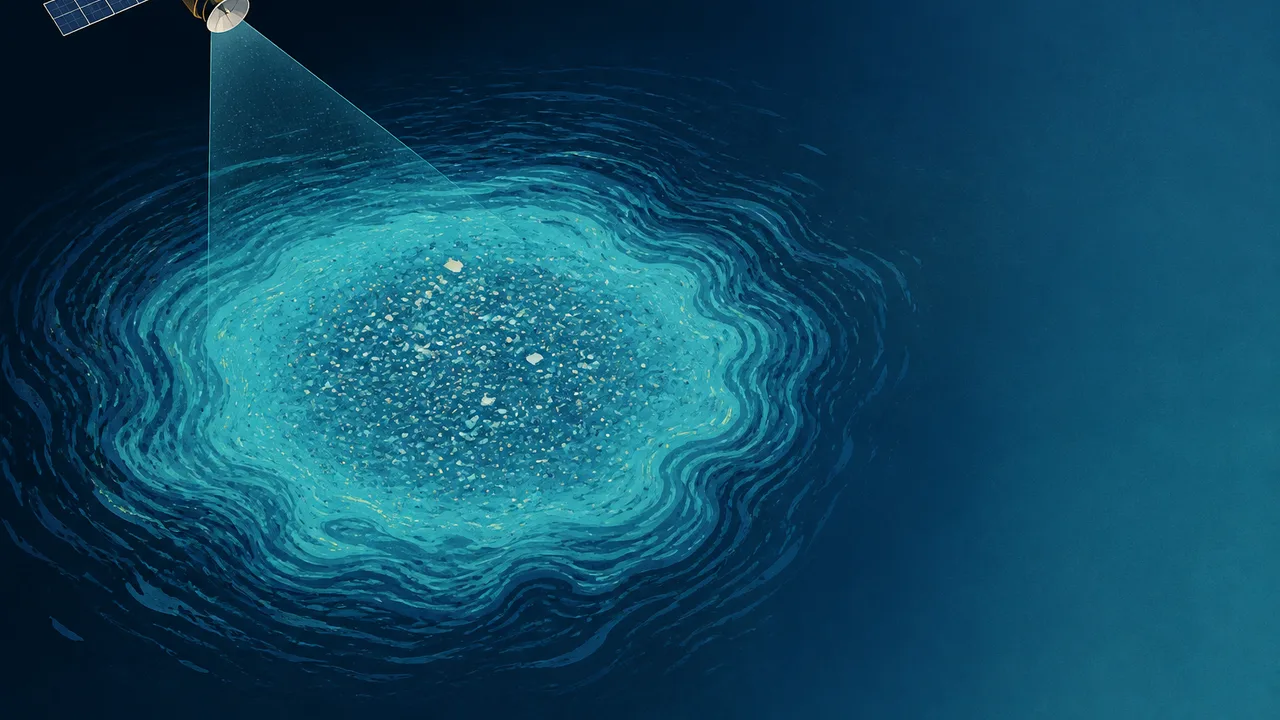
Waters near the Great Pacific Garbage Patch grew brighter in blue and green light between 2002 and 2022. That change, visible in satellite records, raises a consequential question: could tiny plastic fragments be altering the color of the sea?
Researchers at the University of Bergen found brightening near the patch relative to surrounding waters. Their proposed explanation rests on how microplastics scatter sunlight. The satellites measured light reflected from the water; they did not count plastic particles. Establishing that microplastics caused the shift will require water samples taken where the color changed.
The patch, between Hawaii and California, is an accumulation zone shaped by ocean currents. Those currents make it a plausible place to look for a plastic signal, but the area is a poor candidate for the tidy image its name suggests. Debris is spread through the water rather than gathered into one solid island. A possible change in reflected light offers a different way to investigate that diffuse pollution.
What Changed in the Satellite Records
Across three satellite datasets covering 2002 to 2022, parts of the patch showed an approximately 10 percent increase in blue light and a 2 to 4 percent increase in green light over the study period. The datasets agreed that some brightening occurred, although they differed on its extent. Brighter blue and green together create the cyan pattern the researchers investigated.
Those percentages describe changes in light, not changes in the amount of plastic. A 10 percent rise in blue light cannot be translated into a 10 percent rise in microplastics. The step between those quantities depends on what else is in the water and how each component interacts with sunlight.
That problem has a history. Ocean color has long offered clues about what seawater contains because sunlight interacts with water and the material suspended or dissolved in it. Other recent research has found broader ocean darkening associated with influences including agricultural runoff and phytoplankton growth. The patch’s localized brightening does not reverse that broader pattern. It shows why a color trend must be interpreted in its setting: different additions to seawater can push reflected light in different directions.
The Bergen team began with laboratory work on how microplastic fragments absorb and scatter light compared with materials naturally present in seawater. They then modeled whether the resulting optical pattern could appear in satellite observations and examined the older satellite records. That sequence gives the idea a physical basis beyond the location of the patch. It also leaves a testable question: do the waters showing the strongest cyan shift contain the particles, in quantities and forms, that would produce it?
The Strongest Alternative is Already in the Water
Plastic is one candidate among several things that change ocean color. Phytoplankton absorb blue and red wavelengths, which can leave water looking greener. Dissolved organic matter absorbs more blue light, tending toward a darker or browner appearance. Microplastics generally absorb little visible light and scatter it strongly, a combination that could brighten blue and green wavelengths at once.
The researchers compared those optical possibilities in simulations. Adding microplastics made the observed blue-and-green pattern more than four times as likely in their modeled scenarios. That figure compares outcomes within a model; it is not a measured probability that plastic caused the satellite trend. Some combinations of natural environmental changes also produced a similar signature, though relatively rarely in the simulations.
Mineral dust offers another useful comparison because it, too, can scatter sunlight. It is generally more abundant in coastal waters, and measurements from a nearby research station showed a stable dust-deposition pattern over the study period. That weakens one straightforward dust explanation for a changing signal near the patch. It does not eliminate every natural combination that might affect the light satellites receive.
The strongest case for microplastics therefore has three connected parts. Currents concentrate debris in the area. Laboratory work indicates that plastic fragments can scatter light in the relevant wavelengths. Satellite records show a change resembling the modeled effect. Each part supports investigating the next; together, they point to a promising place to sample rather than a particle count from orbit. The result is a potential satellite signature of microplastic accumulation.
From a Color Map to a Water Sample
A useful test would pair optical measurements of water from the brightening area with counts of its microplastics. Sampling locations with different color signals could then show whether particle abundance tracks the satellite pattern. If it does, researchers would have a firmer basis for testing whether the method works beyond this one accumulation zone. If it does not, the color records would still describe a change requiring an explanation.
The practical promise is substantial but narrower than a map of removable plastic. Daniel Koestner, another member of the team, hopes a verified approach could identify other places where microplastics accumulate and help direct cleanup efforts. Yet larger debris and tiny fragments pose different problems: cleanup efforts have removed larger pieces, while Cheatham described removing the smallest plastics from the water column as essentially impossible. A satellite clue could help decide where to investigate pollution without making every detected particle retrievable.
The next advance will come from matching light measured above the patch to particles measured within it. Only then can a change in the sea’s color begin to serve as a map of its plastic.
More Like This
Starlink Satellites Are Now Scanning Earth's Atmosphere
Kyoto University researchers repurposed 1,200 Starlink satellites as an accidental atmospheric scanner. Here's what that means for science—and who controls it.

OlmoEarth Brings Open Geospatial AI to Planetary Scale
Ai2's OlmoEarth platform turns satellite data into real-time, decision-ready insights. Here's what it does, how it works, and what's still an open question.
Microplastics: The Unseen Invaders in Our Lives
Explore the hidden world of microplastics in our daily lives and what you can do to minimize exposure.

Bolivia's Salar de Uyuni: Vast Lithium, Slow Output
Bolivia holds one of the world's largest lithium reserves at Salar de Uyuni, yet produces almost none. Here's the geology, policy, and chemistry behind that paradox.
A Deep-Earth Drip Explains the Green River's Odd Path
A 2026 study links the Green River's improbable canyon through Utah's Uinta Mountains to a lithospheric drip 200 km below the surface.