Bolivia's Salar de Uyuni: Vast Lithium, Slow Output
Bolivia holds one of the world's largest lithium reserves at Salar de Uyuni, yet produces almost none. Here's the geology, policy, and chemistry behind that paradox.

Written by AI. Olivia Meng
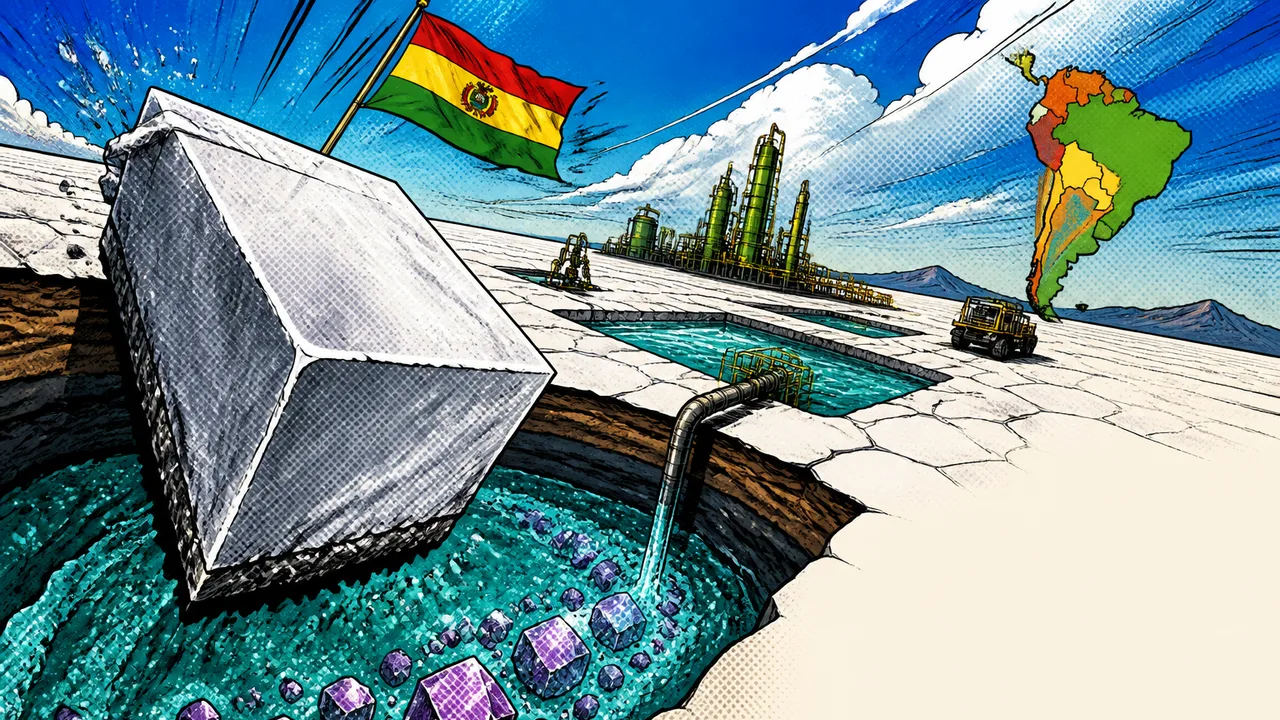
Photo: AI. Marco Velez
Stretch your gaze across the Salar de Uyuni and the horizon disappears. More than 4,000 square miles of salt flat sit in Bolivia's southwestern Altiplano, blindingly white, geometrically flat, looking from altitude less like land than like a lake that simply forgot to remain liquid. Beneath that crust, locked in supersaturated brine filling the pores of ancient salt like water in a sponge, sits one of the largest accumulations of lithium on Earth.
And yet Bolivia produces almost none of it.
That gap — between what the geology promises and what the industry delivers — is the real story of Uyuni. It involves chemistry, constitutional law, state capacity, and the awkward timing of a country trying to build a mining industry from scratch while the rest of the world is already well into the race.
The Geological Inheritance
The lithium didn't arrive by accident. According to a MysteryOfTheMap explainer on the Salar, this region once held a series of massive prehistoric lakes — the largest known as Lake Minchin — whose waters slowly evaporated as the climate shifted over tens of thousands of years. As the water left, it concentrated the minerals it carried, lithium among them, into the brine now sitting just below the salt surface.
The same process built the Atacama salt flats in Chile and the salt basins of Argentina. All three formations sit in the same high-altitude Andean corridor — a stretch now commonly called the lithium triangle — and together they hold well over half of the world's known lithium resources in one connected geological region.
The 2026 USGS assessment, cited in the video, puts Bolivia's reserves at roughly 23 million tons of lithium, Argentina's slightly ahead at around 28 million, and Chile's at approximately 13 million. Bolivia was long considered the single largest holder; by the most current figures it ranks second. What hasn't changed is its position as the least developed of the three by a considerable margin.
The Chemistry Problem Nobody Advertised
Here is where Bolivia's story diverges from its neighbors in ways that promotional narratives about the "lithium triangle" tend to underplay.
The brine beneath Uyuni carries an unusually high ratio of magnesium to lithium — significantly higher than what's found in Chile's Atacama. That distinction matters enormously in practice. Magnesium interferes with conventional lithium extraction methods and must be removed before processing can proceed, adding cost and complexity at every stage. As the video puts it: "Chile's brine chemistry made rapid, relatively simple evaporation-based extraction possible for decades. Bolivia's brine chemistry has made every processing attempt more expensive and more technically difficult right from the start."
Chile's head start wasn't purely a product of politics or investment climate. The Atacama brine was, in a meaningful sense, easier. Bolivia drew the harder geological hand.
The Policy Architecture
The geological challenge met a particular political response. In 2006, under President Evo Morales, Bolivia began constructing a legal framework premised on a specific diagnosis: resource-rich developing countries routinely export raw materials cheaply and import finished products expensively, capturing little of the value chain. Bolivia's 2009 constitution, in Article 348, declared all mineral resources part of the national patrimony and mandated permanent state ownership. A state company, Yacimientos de Litios Bolivianos — YLB — was put in charge of everything from extraction to processing to export.
The logic was coherent. The execution proved harder. "YLB lacked the money, the technology, and the specialized expertise needed to build a lithium industry from scratch," the video notes. Building processing infrastructure, training a technical workforce, and developing extraction methods calibrated to Uyuni's specific brine chemistry all require years and enormous capital. Having the resource does not automatically provide any of those things.
When YLB opened Bolivia's first industrial lithium extraction plant at Uyuni in late 2023, it was positioned as the turning point. It ran into serious design flaws and operational problems almost immediately, and has since produced only a fraction of its intended output.
The Pivot Toward Foreign Partners
That underperformance accelerated a shift Bolivia had long resisted. The government began actively courting foreign investment — a meaningful reversal given the ideological grounding of the state-ownership model.
A 2023 deal brought Russia's Uranium One Group into a pilot project at a separate salt flat called Pastos Grandes. In 2024, a larger agreement followed: a reported $1 billion deal with a Chinese consortium that includes CATL, the world's largest EV battery manufacturer, to fund two new processing plants at Uyuni. Those plants are designed around direct lithium extraction (DLE) — a newer approach that uses specialized filters to pull lithium directly from brine rather than relying on solar evaporation ponds. DLE's proponents argue it can achieve recovery rates that traditional methods cannot.
The combined capacity target for the new plants, according to the video, is roughly 35,000 tons of lithium carbonate per year once fully operational.
That number sounds significant. The caveat matters: DLE's commercial viability inside Uyuni's specific brine chemistry remains unproven at scale. Industry analysts cited in the video are explicit on this point — until the technology demonstrates consistent output under actual Uyuni conditions, much of Bolivia's reserve cannot be classified as a fully provable, minable resource under strict international reporting standards. Projections built on DLE's theoretical recovery rates are not the same thing as demonstrated production.
The Legal Friction That Money Alone Cannot Dissolve
Even with capital committed, Bolivia's legal framework shapes the pace of everything. Bolivian law requires YLB to hold at least a 51% ownership stake in any lithium project. Major contracts require congressional approval, a process that can extend to months or years. There is no access to international arbitration in the event of disputes — a feature that makes many Western mining companies and institutional investors reluctant to commit serious capital, regardless of the underlying resource quality.
"Combine that legal structure with the region's difficult brine chemistry," the video observes, "and you get a resource that looks enormous on paper but has consistently taken far longer to develop than anyone predicted a decade ago."
This is not a simple story of a bad policy blocking a good outcome. The state-ownership model reflects a legitimate historical grievance about how extractive industries have operated across the Global South. The question Bolivia is now confronting — with real urgency, given how fast the EV battery supply chain is consolidating around established producers — is whether that model, as currently structured, can deliver the industrial development it was designed to protect against exploitation.
What Actually Remains Open
Chile and Argentina didn't simply outperform Bolivia through better governance or smarter policy. They had easier chemistry, earlier starts, and legal architectures that made foreign capital comfortable earlier. Bolivia is attempting to compress that same developmental arc — supply chains, technical expertise, investor confidence — into a much shorter window, using technology whose commercial track record is still being written, while maintaining legal conditions that limit the pool of willing partners.
"Bolivia finally has real money and real technology pointed at Uyuni for the first time," the video concludes. "Whether that's enough to catch up with neighbors who got a decades-long head start is still very much an open question."
That framing is accurate, and the open question is genuinely open. The DLE projects with CATL are funded and active — not proposals. The 51% ownership requirement and the congressional approval process are structural constraints, not temporary bottlenecks. The brine chemistry has not changed and will not change.
The salt flat has held its lithium for tens of thousands of years without anyone's help. Whether Bolivia can extract it on its own terms, at the pace the global energy transition actually requires, is a question the geology cannot answer.
More Like This
How the Asteroid Impact Ended the Dinosaur Era
Explore the catastrophic asteroid impact that ended the dinosaurs, its immediate aftermath, and the long-term environmental changes.

Subcritical Reactors: Nuclear Power's Safety Fix?
A new generation of subcritical reactors promises to make nuclear meltdowns physically impossible. But can they deliver on cost, scale, and timeline?
Mountain Pass Mine and the U.S. Rare Earth Supply Gap
The Mountain Pass mine once supplied 70–80% of global rare earths. Here's how the U.S. surrendered that dominance—and what it actually takes to rebuild it.

Arkansas Lithium: Oil Giants Bet on the Smackover
ExxonMobil, Chevron, and Standard Lithium are racing to extract lithium from southern Arkansas brine. Here's what's real, what's promised, and what's unresolved.
Suriname's $10.5B Oil Bet: New Dawn or Same Old Story?
Suriname is betting a $10.5B offshore oil project will end years of recession. Dot Williams on why the real question isn't the money—it's who's ready to catch it.
La Paz, Bolivia: Life in the World's Highest Capital
La Paz sits at 3,650 metres and operates by its own rules—from a self-governing prison to unfinished buildings, coca leaves, and Pachamama sacrifices.

Fusion Energy Is No Longer Just a Physics Problem
Fusion reactors have cleared their core scientific hurdle. What remains are hard engineering challenges—and a tight race against the clock and other clean energy sources.

Where Sunburn Catches You Off Guard
Shade, cold weather, and clear water offer less UV protection than most people assume. Here's what the science actually says about when sunburn risk is highest.