Satellite Collision Software Faces a Test Beyond Speed
A Syracuse contractor pitches satellite collision automation as a way to cut debris costs. Operators will need proof it improves decisions without adding new risks.

Written by AI. Jonathan Park
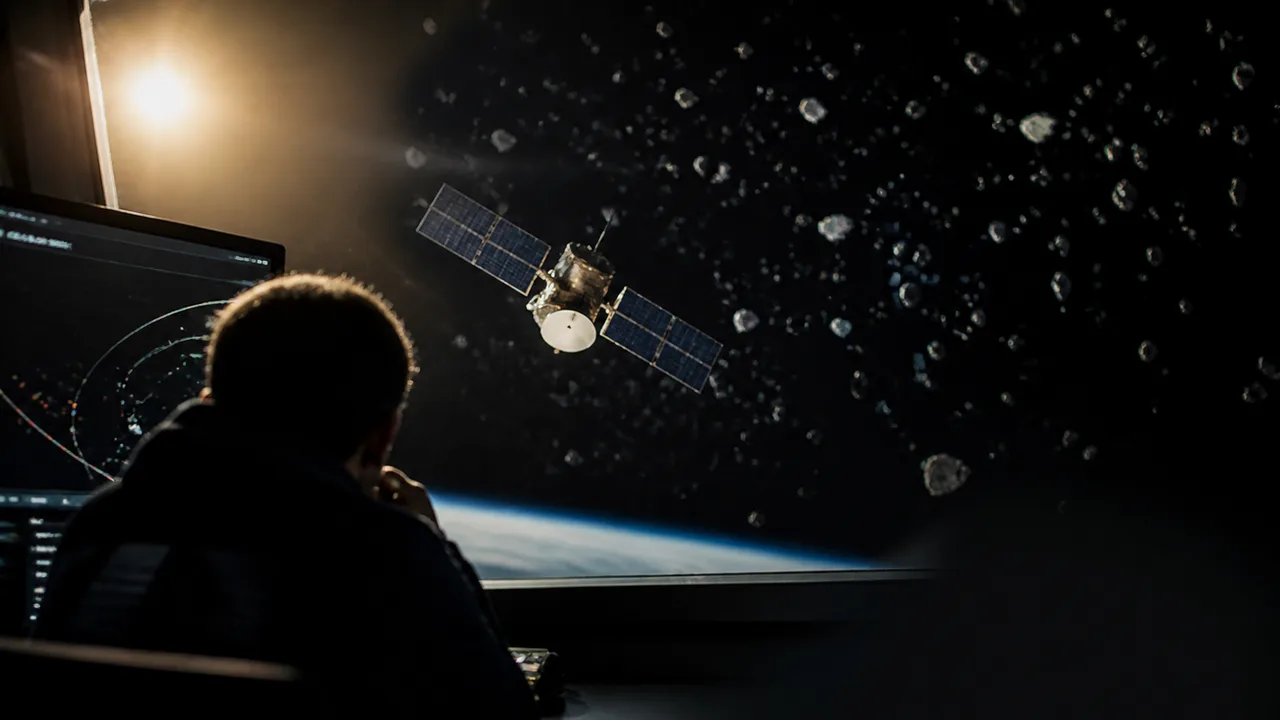
A Syracuse-based contractor is pitching an “autopilot for satellites” to help operators dodge orbital debris at lower cost. NASA estimates that space junk costs U.S. civil and military satellites $58 million a year. A collision can leave an owner, or the public, facing a far larger bill than the cost of deciding whether to move.
The contractor’s proposition is straightforward: calculate faster, give operators better choices and spare satellites some unnecessary maneuvers. The financial case is harder. An alert that leads to a needless move wastes resources; an alert dismissed in error can put an expensive spacecraft at risk. Speed helps only if the recommendation improves the decision.
That puts this pitch in a category familiar to anyone who has bought business software. A vendor promises to cut the cost of a labor-intensive process. The buyer still needs to know which work disappears, which new checks appear and who carries the risk when the system gets something wrong. In orbit, there is little room for an optimistic rollout followed by a leisurely patch.
What an “Autopilot” Would Have to Decide
Collision avoidance starts with an imperfect prediction. An operator must assess whether two objects could pass close enough to pose a threat, how uncertain their predicted positions are and whether a maneuver would reduce the danger. The decision also has a clock: as a possible encounter approaches, the window for choosing and carrying out a response narrows.
Faster calculations could help in that window. They might give an operator more time to examine an alert, compare responses or avoid moving when a refined assessment shows little danger. Those are potential uses of faster analysis, rather than verified capabilities of this contractor’s system. No independently verified savings or side-by-side performance figures accompany the pitch, so its dollar impact remains untested.
“Autopilot” can suggest that software takes the controls. For a prospective buyer, the useful question is more precise: what does the system recommend, what can it execute and what must a person approve? A tool that ranks options for a human team presents a different operational risk from one authorized to initiate a maneuver. Both might reduce work, but they demand different safeguards.
The comparison must also account for the quality of the information entering the calculation. A faster answer based on an uncertain orbital prediction can still be a poor answer. Operators would need to see how a tool handles uncertainty, how it updates advice as new information arrives and whether it explains a recommendation clearly enough for someone to challenge it before the deadline.
The $58 Million is a Cost Pool, Not a Savings Target
NASA’s $58 million annual estimate gives the Syracuse contractor a plausible business problem to address. It does not tell a customer how much of that cost the software could remove. Space junk imposes several kinds of expense, and a decision tool can affect only the portion tied to decisions it improves. Even within that portion, an operator would have to subtract the price of the software, integration and oversight from any savings.
Consider a maneuver that never happens. Avoiding it might preserve fuel and spare operational effort. The benefit depends on whether the maneuver would otherwise have been made, whether it truly was unnecessary and what it would have cost that operator. The same calculation looks different for a satellite with ample room to maneuver and one whose remaining fuel limits its useful life.
Then consider the opposite error. If software recommends staying put when moving would have prevented damage, the possible loss dwarfs the savings from skipping a maneuver. Operators cannot evaluate the product by counting avoided moves alone. They need to count risky encounters, compare recommendations with existing practice and ask what happened after each decision.
A fair trial would run the tool against the procedures an operator already uses, ideally across enough varied alerts to reveal more than its performance on easy cases. How often does it recommend a different action? How often does that change reduce work? Does it create extra reviews because its advice is hard to interpret? Those questions turn a broad industry cost estimate into a test a buyer can actually use.
Trust Has a Price, Too
Civil and military customers may approach the same software with different constraints. A commercial operator might focus on protecting a satellite’s working life and limiting staff time spent on alerts. A government buyer may also need to consider security, procurement requirements and the consequences of relying on an outside system for decisions involving a public asset. Neither has an incentive to save a modest sum by accepting an opaque recommendation with a poorly understood downside.
Trust need not require an operator to surrender control. A staged deployment could start with recommendations that staff review alongside their existing process. If the advice proves reliable, the operator could give it a larger role. That progression would create a practical test of the vendor’s claim: does the tool change decisions for the better, or does it merely produce answers sooner?
The people doing the work belong in that assessment. Automation can remove repetitive analysis, but it can also move responsibility onto a smaller team asked to sign off on decisions it cannot easily reconstruct. If an operator cannot explain why software advised a maneuver, oversight becomes a rubber stamp. If every recommendation requires a full manual review, the promised time saving shrinks.
Procurement creates another test. A signed contract would show that a customer is willing to pay for the product; it would not, by itself, show that the product cuts collision-avoidance costs. A pilot that compares recommendations with current procedures would say more about performance. Sustained use, paired with measures of decisions and operating costs, would say more about whether the business case survives daily work.
Orbital debris makes a strong sales pitch because the stakes are easy to grasp and the decisions are hard to make. The contractor has identified a cost that satellite operators would like to reduce. Its next task is narrower and more demanding: show that when its software advises an operator to move, or to stay put, the operator can understand the advice and make a better call.
More Like This

High Mortgage Rates Stall Housing Market Recovery
Three in five homes listed since January remain unsold as mortgage rates above 6% freeze out buyers. Here's what the data reveals about who pays the price.

USMCA Won't Be Renewed: What Annual Reviews Mean
The Trump administration has blocked USMCA's 16-year renewal, opting for annual reviews. Here's what that means for trade, business, and North America.

Micron's AI Memory Boom Faces an Old Cycle Question
Micron's memory rally runs on AI data center demand and tight supply. Here is what would have to hold for the good times to last, and what to watch.
Bill Ackman's Art of Finding Invisible Money
Explore Bill Ackman's strategy of finding hidden value in companies, beyond standard metrics.

AI Designs Chips, Plans Star Probes, and Cuts Off Elon
An AI solved an interstellar trajectory that stumped JPL engineers for six months. Plus: Architect Labs' Redwood chip, OpenAI vs. Cursor, and outcome-based pricing.
Foundational Raises €9.6 Million to Track Orbital Debris
London startup Foundational has raised €9.6 million to track objects in orbit. Its challenge is proving that precision helps operators avoid collisions at scale.

Greg Abel Takes Charge at Berkshire Hathaway
Greg Abel succeeds Warren Buffett at Berkshire Hathaway. What Alphabet's rising portfolio position tells us about where the company may be headed.
Druckenmiller vs. Bessent: The Bond Market Bet
Stanley Druckenmiller is calling Bessent's bond buyback strategy "price management" doomed to fail. Here's what's actually at stake in the yield debate.