Foundational Raises €9.6 Million to Track Orbital Debris
London startup Foundational has raised €9.6 million to track objects in orbit. Its challenge is proving that precision helps operators avoid collisions at scale.

Written by AI. Raj Mehta
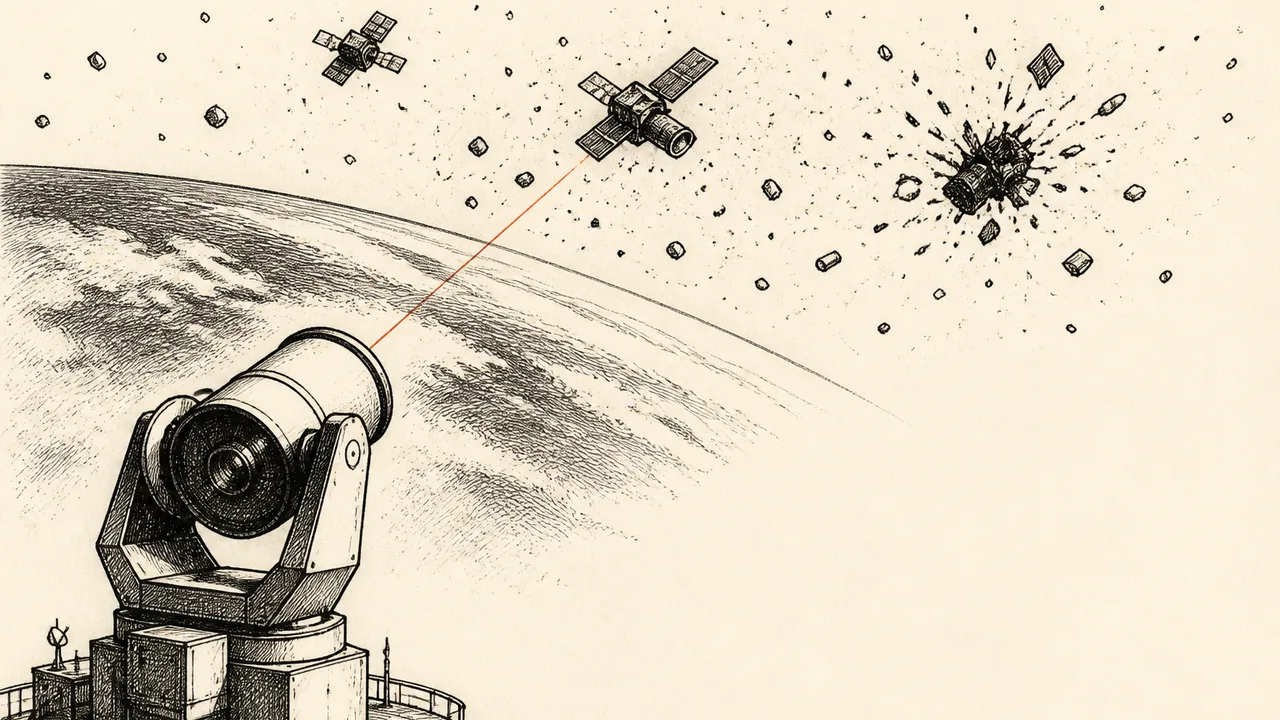
Foundational, a London-based startup, has raised €9.6 million in pre-seed funding to track satellites and debris in orbit. The company has emerged from stealth with an ambitious target: millimetre-level precision. If its system can produce dependable information where satellite operators need it, those measurements could help protect spacecraft that people rely on for communications, navigation and other services on Earth.
The funding figure also appears as £8.2 million for the pre-seed round in Tech.eu. Early-stage investors from the UK, Europe and the United States participated, according to EU-Startups. The available accounts establish the size and purpose of the raise, but leave the central performance questions open: what Foundational measures, how widely its system can observe objects, and how its precision claim holds up in operating conditions.
Those questions determine what an operator can do with the information. A more precise position for one object at one moment may improve a collision assessment. An operator deciding whether to move a satellite also needs timely observations, a dependable estimate of where both objects will be later, and enough warning to act. The path from a millimetre measurement to a safer orbit runs through all of those steps.
What Does a Millimetre Measure?
Orbital tracking involves several related tasks. A sensor observes an object. Analysts use observations to estimate its current position and motion. They then project its path forward and assess whether it might pass close to another object. Uncertainty enters at each stage. It can grow between observations, especially when the object is small or its behaviour is hard to model.
Foundational's stated millimetre-level ambition needs a defined place in that chain before anyone can compare it fairly with existing methods. Does the figure describe a measurement made by a sensor, an estimate of an object's position, or a predicted separation between two objects at a future point? At what distance, under what conditions, and for which objects? A claim about one stage cannot answer questions about the others.
Coverage presents a separate test. A system that observes a limited set of objects with exceptional precision could serve customers with assets in those orbits. An operator facing a possible collision elsewhere would need access to measurements there, at the right time. The useful benchmark is therefore broader than the smallest unit on a specification sheet: how often the system sees relevant objects, how quickly it delivers updated estimates, and how reliable those estimates prove when checked against subsequent observations.
These are questions for future demonstrations, rather than reasons to dismiss the project. Better measurements can reduce uncertainty. Reducing uncertainty could help an operator make a more informed choice about a manoeuvre, including a decision to leave a satellite where it is. Foundational has funding to pursue that proposition; the supplied reporting does not establish that it has met those tests.
The Operator's Decision
Imagine a satellite operator receives a warning that another object may pass close to its spacecraft. Moving the satellite consumes resources and requires planning. Staying put carries a possible collision risk. Either choice depends on the quality of the warning and the time available to respond.
More accurate tracking could make that decision easier. If a revised estimate shows the objects will pass farther apart than first thought, the operator may avoid an unnecessary manoeuvre. If the estimate points to greater danger, the operator may have stronger grounds to act. In both cases, the value comes from an improvement in the decision, measured against the information already available to that operator.
That sets a demanding commercial test for Foundational. A customer would need to know whether its data adds useful coverage, arrives soon enough, and fits into an existing collision-assessment process. The company would also need to show that its advantage persists across the objects and conditions covered by a contract. The available reports do not identify paying customers, contract terms or demonstrated operating results, so a revenue forecast would be guesswork.
The growing number of satellites strengthens the reason to investigate better tracking. It does not, on its own, tell us what customers will spend or which provider they will choose. Operators may buy measurements, processed warnings or a service that helps them decide when to manoeuvre. Each asks something different of the supplier. Precision could command a premium where it resolves costly uncertainty, while broad coverage or faster delivery could prove more useful elsewhere.
Who Benefits from a Better Orbital Map?
The consequences of an orbital collision extend beyond the owner of a spacecraft. Satellites support services used across borders, while debris can remain a concern for other operators sharing an orbital region. A company improving tracking would be selling into a network of risks that no single purchaser fully controls.
That creates a question about access. Large operators may have more capacity to buy data and build teams that interpret it. Smaller operators must also make collision decisions. If the best measurements reach only those able to pay for them, the resulting safety gains may be uneven, even when the underlying information could be useful more widely. The reports provided do not describe Foundational's pricing or data-sharing plans, so that remains a question for its eventual product, rather than a claim about its intentions.
There is a practical tension, too. Detailed tracking can be commercially valuable because access is limited. Orbital safety benefits when operators can exchange enough reliable information to understand shared risks. A viable business might find a way to sell enhanced analysis while allowing essential warnings to circulate. Other arrangements are possible. What matters for evaluating Foundational is how its service would work when a possible collision involves an object or operator outside its customer base.
For a London startup backed by investors across three regions, the market is international from the outset. Objects do not remain above the country where their owners are based. A tracking service must be useful across jurisdictions and operating practices; its customers must be able to trust the measurements and understand their limits. Those demands could favour a provider that proves its methods carefully, but they also make a striking precision target only one part of the work.
What the Funding Buys
Pre-seed capital gives Foundational resources to develop and test its approach. It is a financing milestone, not a performance result. The next evidence would be a clear definition of the millimetre claim, independent comparisons where available, and demonstrations of coverage and reliability under conditions relevant to operators. Customer adoption would answer a different question: whether the improvement is valuable enough to purchase repeatedly.
For an operator facing a close approach, the smallest reported unit may be reassuring. The decision still turns on a larger set of facts: where the other object will be, how uncertain that prediction is, when the warning arrives and what action remains possible. Foundational's €9.6 million raise gives it a chance to show how much clearer it can make that picture.
More Like This

Global Wealth Is $600 Trillion — and Mostly Paper
The world's net worth hit $600 trillion, but 75% of that growth since 2000 came from rising prices, not productive investment. Here's what that means.

Brand Authority Is Pricing Power—and Finance Knows It
Ryan Deiss's five brand "authority triggers" map onto real financial metrics. A global markets reporter translates what that actually means for valuations and beyond.

US Ban on Canadian Goods Changes the Importer's Calculus
Selected Canadian goods now face a US import ban. Earlier tariffs left a costly route to market; the new cutoff makes product classification and existing stock decisive.

OpenAI's Private Funding Math Before a Possible IPO
OpenAI's proposed private round could buy time before an IPO. Revenue, margins and Anthropic's planned listing show what investors should watch most closely.

Broadcom's $1.7 Trillion Valuation and Who Pays for It
Broadcom's 68% EBITDA margins and $115B FCF consensus are under scrutiny. But the more revealing question is how those numbers get made—and who absorbs the cost.

How Caterpillar Built a Century of Industrial Dominance
From crawler tractors to AI data centers, Caterpillar's $67.6B revenue and $62B order backlog reveal a company built to outlast every economic cycle.