Global Wealth Is $600 Trillion — and Mostly Paper
The world's net worth hit $600 trillion, but 75% of that growth since 2000 came from rising prices, not productive investment. Here's what that means.

Written by AI. Raj Mehta
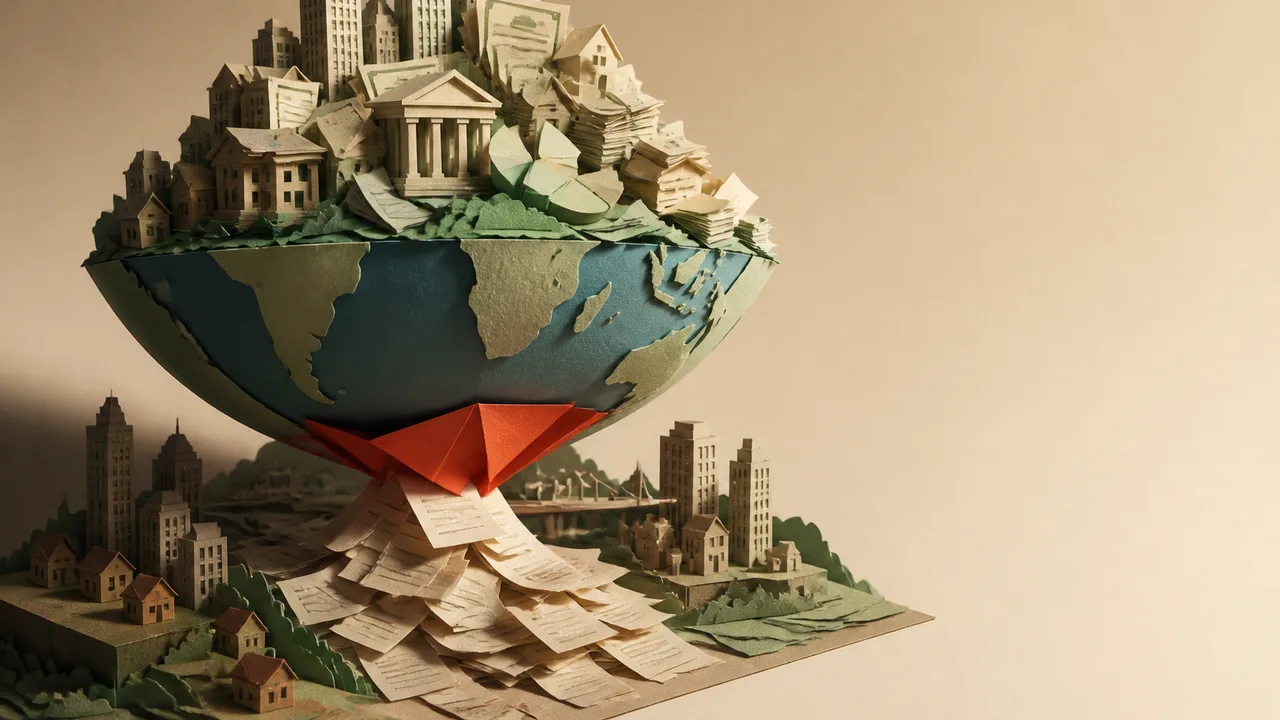
Photo: AI. Lila Bencher
The world is worth about $600 trillion. That number gets cited as evidence of unprecedented prosperity — and in a narrow technical sense, it is. Global net worth has quadrupled since 2000. It nearly doubled in the last decade alone. Over the same stretch, global GDP grew a comparatively modest 40%.
That gap is not a triumph. It's a warning.
A recent Economics Explained video works through this paradox carefully, and the core argument is worth sitting with: we have been measuring the wrong thing for a very long time, and the thing we've been ignoring tells a considerably less flattering story.
GDP Is an Income Statement. We Need a Balance Sheet.
GDP — the total monetary value of goods and services produced in a given country over a given period — is the economic indicator most governments, journalists, and central bankers reach for first. It's popular for a reason: transactions leave a paper trail, the math is straightforward, and rising GDP genuinely does correlate with job creation and consumer spending.
But as Economics Explained puts it, "GDP is not a measure of wealth or a country's net worth. It is simply a measure of economic flows or activity." The analogy used is precise: GDP is an income statement. A person earning $200,000 a year looks productive on paper. Add $300,000 in debt and no savings, and the picture changes entirely.
Warren Buffett, the video notes, is famous for spending more time on balance sheets than income statements, because balance sheets reveal what a business actually owns, owes, and is worth. The same logic applies to countries — and to the planet. The world has a balance sheet. We rarely look at it.
When you do look, you find that the world's gross assets total over $1.7 quadrillion. Financial liabilities — loans, bonds, deposits — sit at around $1.11 quadrillion. But on a global consolidated basis, those financial liabilities net to zero: every debt is someone else's asset, because the world only lends to itself. Strip away the accounting machinery and what remains is approximately $600 trillion in real assets: land, structures, infrastructure, intellectual property, natural resources.
Here is the composition that should give anyone pause: real estate accounts for more than two-thirds of all real assets. Intellectual property and software — the supposed commanding heights of the 21st-century knowledge economy — account for less than 5%.
Who Holds It, and How Unequally
Households own roughly 95% of global wealth. That's actually the intended design — wealth should ultimately belong to people, not abstract institutions. But the distribution within that 95% is where the story gets uncomfortable.
In 2024, the top 1% of global households held more than 20% of all wealth. In the United States, the figure is 35% — equivalent to roughly 5% of total global wealth concentrated in a single country's wealthiest tier. The bottom half of American households hold around $9,000 per person in net wealth, a figure that compares unfavorably to the bottom half in China.
Governments round out the remainder of ownership. The contrasts here are instructive: the US and UK governments carry significant negative net worth because public debt substantially outweighs public assets. China's government, by contrast, holds a large positive net worth through ownership of land and equity in state-owned enterprises — a structural difference that shapes how each country navigates financial stress.
The Mechanism: How $35 of Wealth Gets Created Per $1 of Investment
The video's sharpest observation concerns what's actually driving net worth growth. If wealth were expanding because the world invested in more productive capacity — better tools, infrastructure, technology — you'd expect GDP to keep pace or even accelerate. Instead, net worth now sits roughly 50% higher relative to income than its long-term historical average, having peaked at 6.1 times GDP in 2020 before settling around 5.4 times today.
The explanation, sourced from the video's breakdown: approximately 75% of net worth growth since 2000 has been driven by price increases. Of that price growth, only about 38% reflects inflation. The rest is what you might call pure paper — valuations rising not because underlying assets became more productive, but because more money was chasing the same assets.
Low interest rates, starting around 2001 and sustained for two decades, are the proximate cause. Cheap borrowing inflated housing prices. Near-zero savings yields pushed households into equities. COVID-era stimulus and quantitative easing injected fresh liquidity into markets already stretched thin. As Economics Explained puts it: "If you were wondering how the world created $35 of new wealth for every $1 of net new investment in the last 25 years, well, there's your answer."
The debt side of this equation is not incidental. For every dollar of investment, the world is generating roughly two dollars of debt. Households stretching to afford homes priced at three times their 2000 values are left with less capital to allocate toward productive uses. That's not a personal finance problem — it's a structural drag on productivity growth across the entire economy.
The Rocks and the Reset
The video uses a disarmingly simple parable to explain how paper wealth works — and how quickly it can vanish. Ten shiny rocks. A friend offers $1 for one. A stranger later offers $2. Suddenly all ten rocks are "worth" $20, even though only one sold and nothing about the rocks changed.
Stocks operate on the same logic. "Stocks are valued by applying the last transacted price across all current shareholdings," the video explains. "The value of your investments can go up and down on a daily basis at the whims of market sentiment when the underlying business value didn't actually change at all."
This is why the current moment carries genuine risk. Central banks have been raising rates and unwinding quantitative easing programs — actively contracting the money supply that inflated these valuations in the first place. If sentiment shifts and large numbers of investors attempt to liquidate simultaneously into a tighter monetary environment, the dynamic inverts: more assets chasing fewer dollars, prices plummet, and balance sheets revalue downward across the board.
For households and governments carrying heavy debt loads, declining asset prices create a particularly brutal feedback loop. Loan-to-value ratios spike. Deleveraging begins. Spending contracts. The video invokes post-1990 Japan as the reference case — a prolonged balance sheet recession that combined asset price collapse with years of stagnation.
The Structural Question: What Would Actually Help
The more optimistic scenario requires GDP growth to outpace the accumulated debt and asset price inflation — essentially growing the real economy fast enough to justify current valuations. The AI investment cycle, particularly the dramatic scaling of R&D and capital expenditure by major technology firms over the past 15 years, is positioned as a potential catalyst here. Whether it delivers productivity gains broad enough to matter is genuinely uncertain.
The structural interventions the video proposes are familiar to anyone who follows heterodox economics — and more contested than the video perhaps acknowledges. Land value taxes would replace conventional property taxes in a way that incentivizes development rather than land banking. Vacant property levies would discourage treating housing as a passive appreciation vehicle. Wealth taxes, as opposed to income taxes, would apply carrying costs to unproductive asset accumulation.
The analogy drawn is to inflation as a mechanism for discouraging cash hoarding: if keeping money under the mattress loses 18% of its purchasing power over a decade at 2% inflation, you invest. A similar logic applied to unproductive real assets — making them costly to sit on — could redirect capital toward uses that show up in GDP rather than just in balance sheet valuations.
Each of these policy instruments has real-world precedents, and real-world complications. France's Solidarity Tax on Wealth was repealed; land value taxes remain rare outside of parts of the developing world; wealth taxes consistently produce disputes about valuation methodology, capital flight, and administrative complexity. The video acknowledges some of this but doesn't dwell on it. Fair enough for a 29-minute explainer. Less fair when presented as a tidy solution to a structural problem that has resisted neat solutions for decades.
The Uncomfortable Question
That $600 trillion figure represents the world's net worth. It is also, in large part, a reflection of what people were willing to pay for assets at the last moment someone transacted. If those transactions slow, or if sentiment shifts, a meaningful portion of that number is not wealth in any functional sense — it's a market's guess about what someone else might pay tomorrow.
"After all, if the majority of that $600 trillion is just paper wealth," the video asks at the close, "are we actually any wealthier today than we were 20 years ago?"
That question doesn't have a clean answer. But the fact that it needs to be asked at all tells you something about what we've been measuring — and what we've been choosing to ignore.
More Like This

Brand Authority Is Pricing Power—and Finance Knows It
Ryan Deiss's five brand "authority triggers" map onto real financial metrics. A global markets reporter translates what that actually means for valuations and beyond.

GameStop's $56B eBay Bid: What the Math Actually Says
GameStop bid $56B for eBay despite a $12B market cap. We broke down the financing—shares that don't exist, a non-binding bank letter, and a CEO incentive worth examining.

Youth Economic Inactivity Is a Structural Problem
262 million young people are NEET worldwide. Unemployment figures miss most of them. Here's what the data actually shows about youth economic disengagement.

How Baby Boomers Reshaped the American Economy
A look at the data behind generational wealth gaps, housing unaffordability, rising tuition, and tax policy shifts—and what they mean for younger Americans.

China's Housing Bust Is Still Happening, Just Quietly
China's property crisis never ended — it got papered over by a manufacturing boom. Now that buffer is fading, and Main Street may feel it next.
The Economic Cost of Singlehood
Exploring how the rise in singlehood leads to higher costs and challenges modern economies' adaptability.

How Caterpillar Built a Century of Industrial Dominance
From crawler tractors to AI data centers, Caterpillar's $67.6B revenue and $62B order backlog reveal a company built to outlast every economic cycle.

Earning vs. Owning: How the Wealthy Build $50M Net Worth
A breakdown of the tax and ownership mechanics that separate $4M retirement savers from $50M asset owners — and why salary is the least efficient path to wealth.