Ros Atkins on Communicating Clearly Under Pressure
BBC's Ros Atkins explains how to strip out obstacles to understanding, build effective strands, and make communication feel personal to your audience.

Written by AI. Ellis Redmond
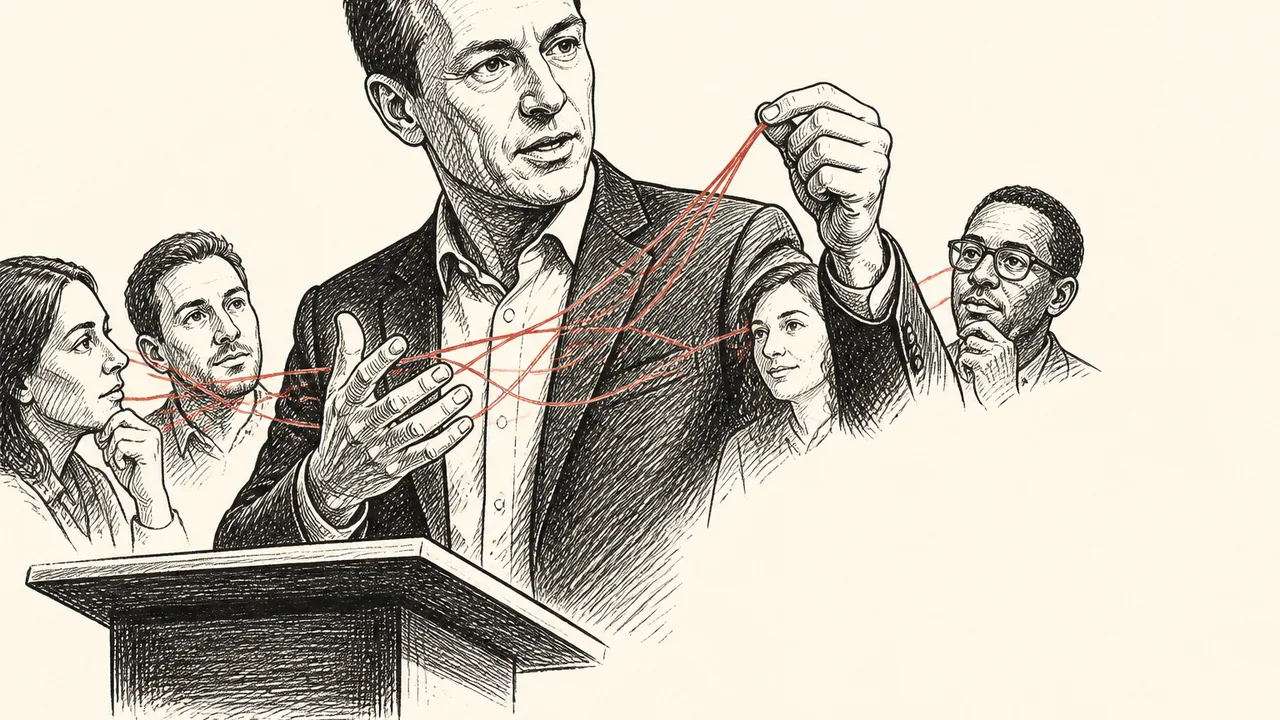
Photo: AI. Eira Pendragon
His BBC colleague Alan Little calls this "obstacles to understanding." Not neutral filler, not harmless extra detail. Active interference. In a conversation with philosopher Jack Symes, Atkins describes watching an old internal BBC training course that Little had recorded and experiencing the concept click into place: every unnecessary word, every extra adjective, every piece of context that doesn't serve the story is competing with the stuff that does.
That framing matters because it reframes editing from a chore into a mission. If you believe you're there to inform people, then padding your communication with stuff that doesn't need to be there isn't just inefficient. It's working against the reason you showed up.
Atkins has a name for the opposite: "high protein information." A three-minute explainer video that contains more substance than 40 minutes from someone else. According to his book The Art of Explanation, the process runs through seven steps: Set-Up, Find the Information, Distil, Organise, Link, Tighten, and Delivery. The Tighten step is where most people stop short.
The fish tank story he cites is probably apocryphal (he says as much), but the principle holds: drop your script in a tank, watch the bubbles, and admit there was more air in there than content.
The shelf
One of the more useful mental models Atkins describes is the shelf. Before any interview, broadcast, or debate, he imagines a shelf holding everything he might want to say on the relevant subjects. Each item is a "strand": a small, self-contained packet of information that can be pulled down and deployed when the conversation moves in that direction.
The difference between this and ordinary preparation is specificity. Atkins is not learning full sentences. He's learning bullet points, the key pieces of information attached to each point, so clearly that in the moment he can trust himself to assemble them naturally. "If the first time you say something is when it matters," he says, "you're taking a chance."
This is also where he addresses something you'll see in every debate but nobody names: the escape phrase. When a question takes you somewhere you've got nothing useful to say, or somewhere you want to redirect the conversation, certain phrases let you move without it feeling like evasion. "To understand this we need to zoom out." "Another thing I would say is." Atkins notes that a correspondent he once interviewed used exactly this on him when his question wasn't quite on point. She paused, said "yes, another thing I would say is," and took the conversation where it needed to go. He didn't mind. What she said was better.
Atkins acknowledges the fine line: between a well-deployed escape phrase and just not answering. The best communicators use them and you barely notice. Politicians use them and you notice immediately, because what follows is less interesting than what you asked.
The listening problem
Preparation can become a trap. If you walk into a debate or interview with your shelf perfectly stocked, there's a real risk you stop listening and start scanning for deployment windows. Atkins is direct: "The moment we stop listening, we stop giving ourselves the best chance of communicating well."
His practical fix: when someone is asking you a question, find the one or two distinctive words in what they're saying and reference them in your answer. It signals to everyone that you're paying attention. It also combines the advantages of preparation (you have good material ready) with the advantages of genuine presence (you're responding to this specific exchange, not a mental simulation of it).
Symes describes learning this lesson "more recently than I should have." Most people who communicate in public, whether in debates or lectures or meetings, think they're listening when they're actually waiting. Running the clock on what the other person is saying while rehearsing what comes next. Atkins's training exercise from the 2010s addressed this directly: he'd roleplay a guest without telling the trainee anything about who he was supposed to be, forcing them to build the conversation from what they actually heard.
Why this matters, and whether you have to say so
The phrase Atkins returns to most is: "the reason this matters is." He deployed it constantly while reporting from a rooftop in Athens during the Greek debt crisis in the mid-2010s, a story that was consequential but whose connection to audiences in Australia, America, or the UK wasn't obvious. If you're watching in Nigeria, here's why this affects you. If you're in the UK, here's the thread that connects. He describes measurable upticks in engagement when BBC World Service phone-in shows named specific geographies in their questions rather than asking generically.
The discipline he's proposing: before you say anything, try finishing the sentence "and the reason this matters is..." If you can't finish it for the person you're talking to, you're not ready. You haven't done the work of connecting it to them.
The Art of Explanation opens with several pages making this case before any technique appears. Atkins says his publisher was right to push for that. If the reader doesn't believe communication is worth improving, no framework is going to help.
What this framework was built for
Atkins is a BBC journalist, which means this entire conversation about communication operates within an institutional commitment to impartiality. He's clear that when he prepares his strands, he's not preparing arguments. He's preparing analysis. The distinction isn't always visible from outside, and Symes probes it: several prominent BBC presenters have left over the years partly citing frustration at not being able to share opinions. Atkins says he's not burning to do that, that impartiality is something he believes in rather than something imposed.
That's a reasonable position, but it shapes the framework. When Atkins talks about understanding different perspectives as preparation for communication, it comes from a journalist's stance: you need to understand why people believe what they believe in order to explain it accurately. Someone preparing for a competitive debate, where the goal is to win, is doing something structurally different. Anticipating counterarguments so you can dismantle them is a different operation from anticipating them so you can represent them fairly.
His tools still translate. Strands work in any format. Signposting structure works in any format. "The reason this matters is" works anywhere. But the goals these techniques were designed for are not identical to winning an argument, and someone applying them to adversarial contexts should factor that in.
The arms shake before the Edinburgh TV Festival. The deliberate check on what the first two or three things will be, rather than trying to rehearse every possible path the next hour might take. The commitment to saying something out loud before it matters, not to memorize it, but to stop it from being new.
That might be the most credible thing about the framework. Preparation does not eliminate uncertainty, and Atkins is careful never to promise that. It just means that when uncertainty arrives, you've met some of the material before.
More Like This

What Overthinking Actually Is and How to Slow It Down
Psychologists split overthinking into rumination and worry. A recent video breaks down the neuroscience and offers three CBT-based tools worth trying.
How to Sound Like Yourself on Camera
Nick Nimmin's advice on natural on-camera presence cuts against the creator economy's obsession with performance. Here's what it actually gets right.
The Power of Starting Conversations with 'What'
Discover how asking 'what' instead of 'why' can transform communication and influence.
Introverts Can Thrive in Public Speaking
Discover how introverts can overcome public speaking anxiety by reframing it as practice, reducing pressure and improving performance.

Michael Shermer on Truth, Bias, and the Post-Truth Era
Neil deGrasse Tyson and Michael Shermer unpack objective truth, motivated reasoning, and why your brain argues like a lawyer, not a scientist.

AI's Next Leap and the Skills That Will Matter
Daniel Miessler argues AI is on the verge of another major step change. His prescription: understand the world, know yourself, and master AI as a force multiplier.

Why Being Complicated Might Be the Point
Yahia Ghaleb's TEDx talk argues we should stop flattening ourselves into simple labels. Here's what the psychology actually says about living in the gray.
YouTube Lighting for Beginners: What Actually Matters
Before you buy a new camera, fix your lighting. A practical breakdown of what beginner YouTubers get wrong—and how to fix it for under $50.