How to Sound Like Yourself on Camera
Nick Nimmin's advice on natural on-camera presence cuts against the creator economy's obsession with performance. Here's what it actually gets right.

Written by AI. Vanessa Torres
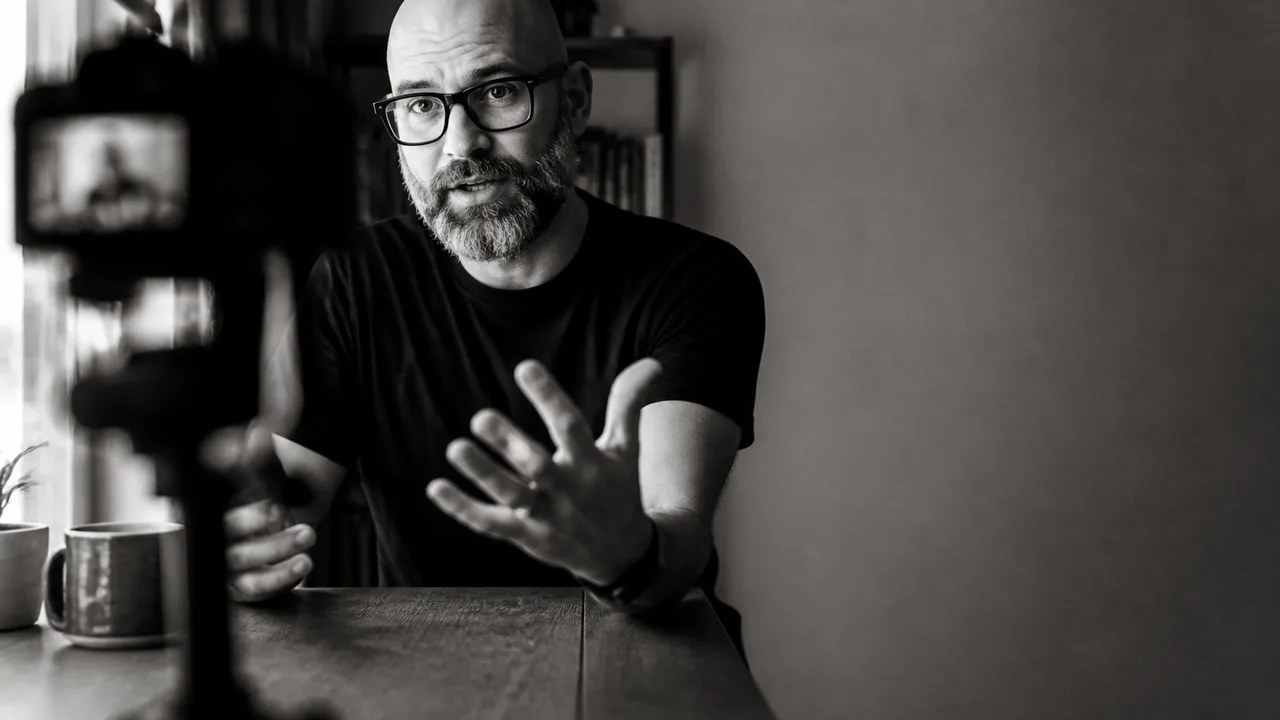
Photo: AI. Atticus Ferenczi
A camera turns on and something happens to your face. Not a dramatic something — more like a slow bureaucratic shutdown. The easy rhythm you have with a coworker over coffee, the way you can explain a complicated thing without thinking too hard about your hands — gone. You're suddenly aware of your own blinking.
Most advice aimed at this problem makes it worse, because it comes from a world obsessed with performing naturalness rather than actually having it. Watch enough YouTube tutorials on camera confidence and you'll notice they share a logic with the hustle content I've spent years arguing against: the idea that the solution to feeling fake is to optimize harder. Better lighting. Tighter scripts. A more "authentic" brand. The pressure to seem effortless gets marketed as a product you can buy or a system you can implement, and somewhere in that loop, the actual human disappears.
So when YouTuber Nick Nimmin put out a video on being more natural on camera, I was prepared to be underwhelmed. I wasn't.
Nimmin's core argument is almost stubbornly simple: you sound stiff on camera because you're treating the camera like an audience instead of a person. His fix — talk to it like a friend — is the kind of advice that sounds obvious until you actually try it and realize you've been doing the opposite your whole life.
The specific mechanics he lays out are worth taking seriously. The first one hit me before he even explained it. He makes a distinction between saying "hey guys" at the top of a video versus just starting with "you." His demo: "I'm going to show you guys how to make the best cake you've ever eaten in your life" versus "I'm going to show you how to make the best cake you've ever eaten in your life." Nearly identical sentences. But one puts you in a stadium and one puts you across a kitchen table.
This isn't new knowledge — radio broadcasters figured this out by the 1930s and 40s, when announcers discovered that speaking to one imagined listener created a different relationship than broadcasting to a faceless mass. What Nimmin is doing is applying that same intuition to video, and the reminder is useful because most of us have spent careers writing emails that say "hi team" and giving presentations to rooms, not people. Singular language is a muscle that atrophies.
Here's where I want to be honest about what this advice costs, because there's something the video doesn't fully reckon with.
The creator economy has spent a decade commercializing intimacy. The "talk to the camera like a friend" approach works — genuinely works — but it also exists inside an industry that figured out friendship is monetizable. Parasocial connection drives subscriptions, merchandise, and ad revenue. When a platform rewards you for seeming warm and real, the warmth and realness become, at minimum, strategic. That doesn't make the connection fake. But it does mean that "just be yourself" is not the innocent instruction it sounds like. It's also a business model.
Nimmin isn't being cynical about this — he seems to mean it genuinely when he says "just remember that the other person on the camera is also like you. You have your own problems that you're dealing with, you have the dreams that you have, you have your aspirations, you have the things in your life that suck, you have the things in your life that are awesome, just like me." That's a real thing to say, and it's grounded in something true. It's also, structurally, a growth strategy. Both things are true at once. The tension between them doesn't have a clean resolution.
I want to stay with one of his practical points for a second, because it surprised me.
Nimmin's advice on multiple takes includes a moment of unexpected transparency. He describes his own recording process — hitting record, losing his train of thought, stopping, starting again, taking several runs at the same sentence — and then says: by the time you see the edited version, it'll look smooth. He's not embarrassed by this. He's offering it as permission.
I've watched a lot of people freeze up before hitting record on something like a company all-hands message or a quick explainer for a client — people who are articulate and sharp in every other context, paralyzed by the idea that they have to get it right in one go. The revelation that professional video people take multiple cuts at almost every sentence isn't just a tactical tip. It's a significant piece of information that nobody thinks to share because everyone assumes everyone already knows it.
The same logic applies to his advice on leaving imperfections in. "When you are communicating in real life, you don't have the option to edit. So if you have to correct yourself when you're saying something, nobody freaks out about it." He's right. The self-correction, the slight stumble, the "actually, let me say that differently" — those are signals that a real person is thinking in real time. They build trust rather than eroding it. We've been conditioned to cut them out, and we probably shouldn't.
He also raises something worth sitting with: imperfection may become a meaningful signal of humanity as AI-generated video becomes more prevalent. Whether audiences have already developed sharp pattern recognition for AI speech is genuinely unclear — the research on that is still forming — but the underlying logic holds. The small tells of a person working something out in their head, live, are hard to fabricate.
The body-language advice — move before you record, let your hands do what they normally do, don't manufacture stillness — is easy to gloss over but probably matters more than it sounds. Stillness reads as either authority or anxiety, and most people going on camera for the first time are radiating the latter. Erving Goffman spent a career documenting how performance and social presentation shape identity in everyday life; the camera doesn't create a new self-consciousness so much as it amplifies the one that's already there. Moving your body before you start isn't a cute warm-up hack. It's recalibrating the nervous system before you ask it to do something hard.
The most useful reframe Nimmin offers is also the quietest one: "When you reduce it down to that, then you take the bigness away. And when you take that bigness away, it can also reduce some of the pressure."
That's the thing about the camera that nobody says directly. It feels big because we've been taught that cameras are for important things — news, movies, presentations to hundreds of people. Most of us don't have a mental model for a camera as something ordinary, something you talk through rather than at. Shrinking it down to one person on the other side isn't a trick. It's closer to the actual truth of what video is.
If you got asked last month to record something for a work presentation, or you're trying to understand why your kid's favorite YouTuber feels like a friend they've never met, or you're quietly wondering if you could do something like this yourself — Nimmin's framework is worth the ten minutes. Not because it promises to make you polished, but because it's specifically not promising that. It's asking you to bring less performance, not more. In a media landscape that keeps demanding you optimize your humanity, that's a genuinely unusual instruction.
More Like This
Claude Can Now Edit Your Videos. Here's What That Means.
AI automation creator Nate Herk demonstrates Claude's new video editing pipeline—trimming filler words, adding motion graphics, all through natural language.
Microplastics: The Unseen Invaders in Our Lives
Explore the hidden world of microplastics in our daily lives and what you can do to minimize exposure.

Are Your Goals Arbitrary? Ali Abdaal Thinks So
Ali Abdaal's God of War moment raises a real question: what if treating work like a video game—arbitrary, playful—is actually the smarter approach?

Jeremy Qualls on Leadership: Lessons from Fire and Post-its
Jeremy Qualls shares leadership lessons from personal adversity, emphasizing empowerment and resilience.

What Camera Sensors Can Teach You About Sound
StudioBinder's sensor explainer is solid filmmaking education — but it reveals something bigger about how creators misunderstand the infrastructure beneath their craft.
AI Video Editing: Claude's Natural Language Promise vs Reality
Nate Herk claims Claude can replace video editors with natural language prompts. We tested his methods with Claude Design and Hyperframes to see what actually works.

Sunlight Is a Nutrient Your Office Job Is Starving You Of
Photobiologist Gerardo Gutierrez explains why decades of sun avoidance and LED-lit offices are quietly wrecking our biology — and what to do about it.

Machiavelli Gave His Secrets Back to His Torturers
Ada Palmer reframes Machiavelli not as a cynic but as a patriot who handed his most valuable knowledge to the regime that tortured him. Here's what that actually means.