Raspberry Pi 5 16GB Is a Bad Deal Right Now
Jeff Geerling breaks down which Raspberry Pi models are worth buying right now — and the 16GB Pi 5 isn't one of them. Here's where the value actually lives.

Written by AI. Tyler Nakamura
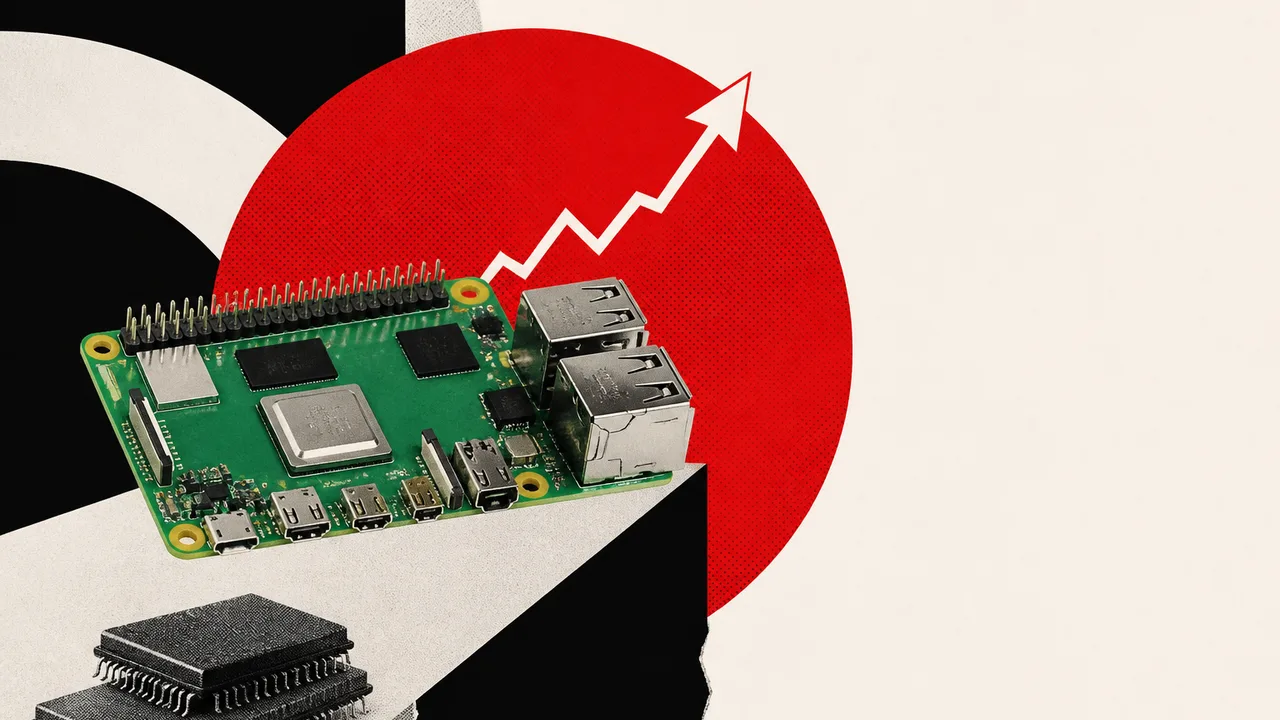
Photo: AI. Ondine Ferretti
A screenshot went viral recently: a Raspberry Pi listed at $426.95. Third-party markup, not MSRP — but it lit up the discourse anyway, because the anger behind the retweets was real. Raspberry Pi products have gotten more expensive, and a lot of people feel burned.
Jeff Geerling, probably the most watched Raspberry Pi creator on YouTube, dropped a video this week to sort out what's actually happening. His verdict is pretty surgical: most of the "Pis are expensive" discourse is aimed at the wrong products. But the underlying frustration? Completely valid.
The 16GB Pi 5 problem is structural, not greedy
When the 16GB Raspberry Pi 5 launched at $120 — a price confirmed by Raspberry Pi's own announcement — Geerling flagged it as "a bit out there." He was right then. At current street prices pushing $280 and beyond in some listings, his position has hardened: "16 gig Pi 5s, they've never been a good deal, and now they're just a bad deal. Like just don't buy them."
That's not a hot take — it's an engineering reality. Raspberry Pi's architecture traditionally relies on a single DRAM chip to handle all onboard memory. As Geerling explains it, when you're speccing a 16GB model, that one chip now consumes virtually the entire bill of materials. He's not accusing anyone of gouging: "The problem is not that Raspberry Pi is like, 'we're going to gouge people.' The problem is that Raspberry Pi's architecture traditionally uses one chip, one DRAM chip for all that memory... that is like the entire price of the Pi is going into that little DRAM chip."
Some competing boards have physically more room to fit two smaller chips — which ends up cheaper than one large one. Raspberry Pi has started doing this on a few models too. But until that becomes the norm across the lineup, high-RAM Pi configurations are going to keep being punishingly expensive relative to what you actually get.
For anyone shopping at those price points, the honest alternative is a used mini PC. Geerling estimates maybe ten people on the planet genuinely need a 16GB Pi 5 and couldn't be better served by something cheaper and faster. Honestly, that tracks. 💀
Where the value actually lives
Here's the thing the viral outrage misses: the low-end Pi lineup is still pretty compelling. Geerling calls the Pi 400 — a Pi 4 built into a keyboard with a full port selection — the best deal in the Pi 4/5 class right now at $50. He's not entirely sure why it's priced that low ("Maybe they're just not selling well and they're trying to offload these things"), but either way, $50 for a complete compute package is the kind of deal that genuinely catches my attention. That's not clearance-bin energy to me — that's a useful machine at a price that makes GPIO tinkering accessible to people who've been priced out of other options.
The Pi 500 Plus, on the other hand? Geerling's advice there is unambiguous: skip it. Over $300, and for that money you could build something faster with more RAM and more storage. It's a tough sell when the math doesn't work.
The "just buy a mini PC" crowd isn't wrong, but they're not fully right either
Every time Pi pricing comes up, someone posts: "lol just buy a mini PC." And look — for raw compute, they're often correct. But Geerling's pushback is worth sitting with.
Raspberry Pi's real case isn't performance-per-dollar on a benchmark. It's the ecosystem. GPIO pins for hardware projects. A massive library of HATs and accessories purpose-built for the platform. Software support that's been accumulating for over a decade. A new $80 10-inch Touch Display just dropped, and while it's frustratingly Pi 5 and Compute Module-only (no Pi 4 support — annoying), the point stands: you can buy a Pi 5 for under $50 and add a touchscreen for $80 and have a functional embedded display system. Try assembling that pipeline with a mini PC.
That's the actual value proposition. And it holds — just not at the 16GB tier.
Geerling's own rack is the most honest argument
The most useful part of Geerling's video isn't the pricing breakdown. It's the inventory tour. He walked through his studio and home racks and cataloged every Pi he's actually running in production — not for videos, but for real, persistent use. Home Assistant. NVR. DNS/Pi Hole. VPN. Network time server. UPS monitoring. Earthquake monitoring (yes, really — a Pi 3B running a Raspberry Shake sensor, still going strong after years).
The pattern that emerges: almost everything runs on Pi 4s, mostly 1GB or 2GB models. The Pi 5s in his setup? Most of them are there because he had them lying around from review units. He's honest about that. "I could do almost everything that I need to do on Pi 4s. There's only a couple of these that have to be Pi 5s because they use PCI Express."
That's the most credible buying guide I've seen in this format. This isn't a creator telling you what to buy — it's a creator showing you what they actually kept running after the cameras stopped rolling. Most of it is not the expensive stuff. None of it is the 16GB model.
The bigger context: DRAM, AI, and a platform in flux
Geerling is careful not to pin this entirely on Raspberry Pi as a company. DRAM prices are rough across the board right now, partly because AI infrastructure is consuming enormous amounts of memory chip manufacturing capacity — a dynamic that's affecting everyone from Raspberry Pi to major server vendors.
That context matters because it shapes the timeline. This isn't a temporary blip that resolves in a couple months. And with Raspberry Pi 6 reportedly not arriving before 2028, per OMG Ubuntu, there's no next-gen refresh coming to reset the value calculus anytime soon. The Pi 6 roadmap — no NPU, no M.2 confirmed — means the current lineup is what you're working with for a while. What you buy now is what you're living with.
So where does that leave you?
If you need GPIO, low power draw, a tiny footprint, and access to the Pi ecosystem of accessories and software — Pis are still the move. Just keep it modest. A 1GB or 2GB Pi 4 or Pi 5 covers the overwhelming majority of real-world use cases Geerling describes, and the Pi 400 at $50 is a legitimate surprise at that price point.
If you're eyeing the 16GB Pi 5 because the spec sheet looks impressive — walk away. As Geerling puts it: "It's kind of like going to a Lamborghini store and saying, 'Cars are so expensive.' Lamborghinis are expensive. The high-end stuff, it's insane."
The Pi you need almost certainly isn't the most expensive one. Buy accordingly. 🛒
Tyler Nakamura is BuzzRAG's consumer tech and gadgets correspondent.
More Like This
ZimaCube 2 Review: A Meaningful Upgrade or Incremental Refresh?
The ZimaCube 2 is a compact home server that earns attention for its processor upgrade—but a quiet software licensing twist deserves yours too.
Raspberry Pi 6 Won't Arrive Until 2028
Raspberry Pi engineers did an AMA and confirmed Pi 6 is 2+ years away, no NPU, no M.2. Here's what that actually means for your next board purchase.
Best Home Lab Gear Under $100: What's Actually Worth It
Raid Owl's budget home lab gear list skips the flexing and gets practical. Here's what the picks actually tell you about building a smart home lab setup.

This Tool Treats Your Home Lab Like Infrastructure Code
RackPeek documents home labs as YAML code in Git. Brandon Lee shows how this infrastructure-as-code approach beats static diagrams and spreadsheets.
30 Self-Hosted GitHub Projects Trending Right Now
From media automation to AI chat apps, here are 30 trending self-hosted GitHub projects that put you back in control of your data and infrastructure.

USB 10-Gig Adapters Are Finally Small Enough to Matter
New USB-C 10-gigabit Ethernet adapters promise full speed at half the price of Thunderbolt—but only if you have the right port. Here's what actually works.

YouTube Creators Are Reshaping Hollywood's Talent Pipeline
Backrooms, Obsession, and The Amazing Digital Circus prove YouTubers can open movies. But Hollywood is already preparing to misunderstand why it worked.

iOS 27 AirPods Features: Custom EQ and More
iOS 27 brings custom EQ, heart rate gym sync, and precision finding to AirPods Pro 3. Here's what changed, what's still beta, and who it's actually for.