Raspberry Pi 6 Won't Arrive Until 2028
Raspberry Pi engineers did an AMA and confirmed Pi 6 is 2+ years away, no NPU, no M.2. Here's what that actually means for your next board purchase.

Written by AI. Tyler Nakamura
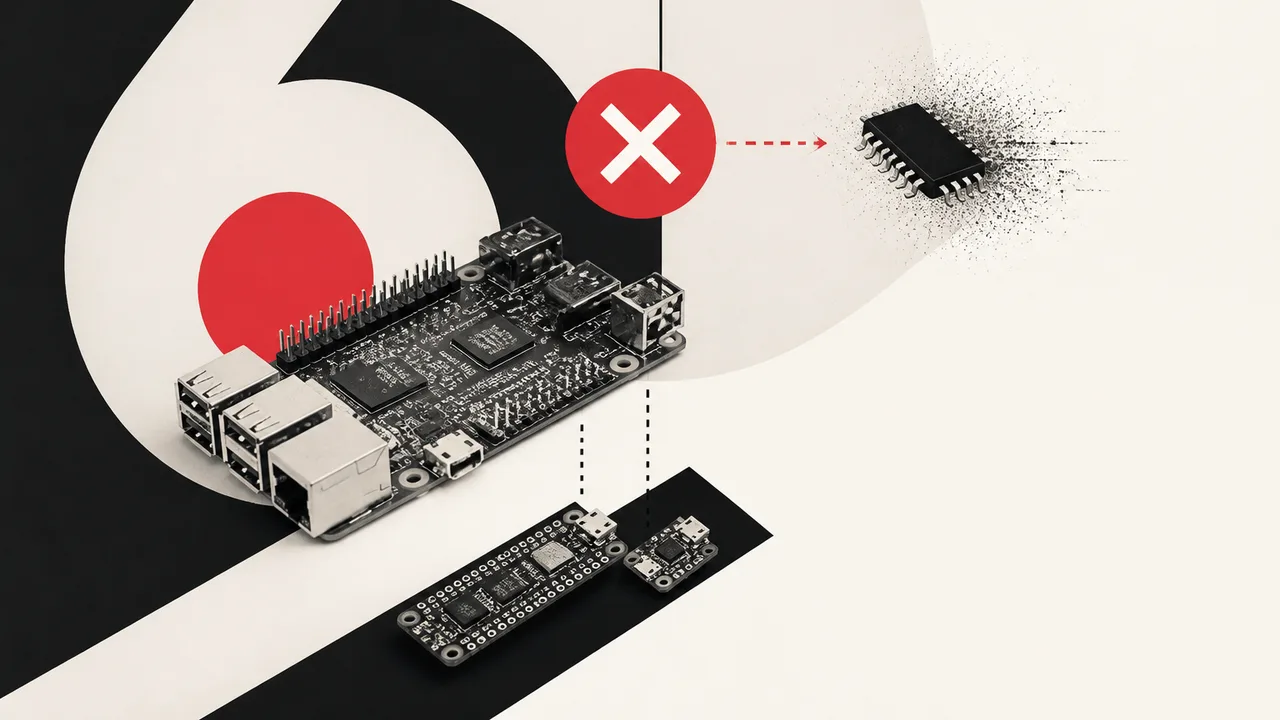
Photo: AI. Ondine Ferretti
I've had a Pi 5 sitting in a project box for eight months waiting on me to do something ambitious with it. I kept telling myself I'd wait and see what Pi 6 brought before committing to a full build. After this week's AMA, I'm done waiting—not because Pi 6 is coming, but because it definitely isn't. Not for a while.
On Thursday, three Raspberry Pi engineers—including Eben Upton, the CEO of Raspberry Pi Ltd.—hosted a public AMA on Reddit. Jeff Geerling, whose Pi coverage is basically required reading if you're in this hobby, broke down the key takeaways in a short video, and there's enough in there to recalibrate pretty much every expectation I had for what comes next.
The 2028 thing is real and it stings
Geerling did some historical math on Pi release cadence—Pi 1 in 2012, Pi 2 in 2015, Pi 3 in 2016, Pi 4 in 2019, Pi 5 in 2023—and landed on roughly 2.75 years between major versions on average. Worth noting that number shifts depending on which versions you count and how you define "major," so treat it as a rough pattern, not a law. But even by that generous estimate, a 2026 or 2027 Pi 6 seemed plausible.
Upton killed that. He pushed the window out to four to four-and-a-half years from the Pi 5, which means no Pi 6 before early 2028. The culprit is the global DRAM shortage—specifically that launching a new board right now would mean pricing it way above what Pi is supposed to cost. As Geerling puts it: "There's no sense in releasing an SBC that costs twice as much as the one we have right now."
He also referenced the old "$35 computer" sticker that Raspberry Pi used to hand out—a sticker that's now largely buried on his board. That detail does a lot of work in a few seconds. The Pi brand was built on democratizing hardware. A premium-priced Pi 6 isn't just a bad launch timing decision; it's genuinely against the point.
The NPU thing: I'm still chewing on it
Here's where I have to be honest about where I stand, because I've had this tab open in my brain for months. There's a version of me that really wanted Pi to be the affordable AI board. Not because I need to run LLMs on a $80 single-board computer—I don't—but because a lot of the projects I see from this community are exactly the kind of low-power edge inference stuff that an NPU would unlock at a price point that makes sense.
Upton's answer to that? Per Geerling: "Instead of wasting precious silicon space with an NPU, Evan said that they see the CPU as their venue for AI."
I go back and forth on this. The cynic in me thinks this is Pi covering for a decision that was mostly about cost and silicon constraints—you can't add an NPU to a board this size at this price without making painful trade-offs. The more charitable read is that they're right that a fast general-purpose CPU is more useful for more people than a dedicated AI block that only shines for one category of workload.
But here's the practical reality: if you were counting on a Pi 6 to be your affordable on-device AI board, that's not happening. The Hailo AI HAT add-on exists, and Orange Pi and Radxa have boards with built-in NPUs that are worth looking at if that's your specific need. Pi is making a deliberate choice to stay in its lane, and I don't think that's cowardly exactly—but it does leave a gap that someone else is going to fill.
The Zero situation is kind of a mess
I feel like the Pi Zero 2W (listed at $15 at official retail, though availability has been a persistent problem and prices at third-party sellers have run higher) only just became reliably purchasable, and there's still no Zero 3 on the horizon. Geerling explains the two-part problem clearly.
First: a Zero 3 would require abandoning the single-sided PCB design because stacking RAM on top of a more modern chip is harder when you're dealing with more heat. That adds cost. Second, and more fundamentally, LPDDR2 RAM—the ancient memory that keeps the Zero 2W cheap—is what Raspberry Pi has been sitting on in a stockpile. That's the dirty secret of the $15 price point. When that stockpile runs out and they'd need to use current-gen RAM, the economics break. A Zero 3 at $15 probably isn't possible. A Zero 3 at $25 or $30 would compete with the Pi itself.
Meanwhile, the substrate shortage has been choking Zero 2W availability. So many AI accelerator chips are being manufactured—all competing for the same older process node wafers—that even Raspberry Pi has to fight for fab time. They're working with a new vendor to expand capacity, but the timeline is unclear.
While I was absorbing all this, there was a casual data point dropped in the AMA thread that I can't stop thinking about: Upton mentioned, per Geerling's video, that the decade-old Pi 3B is still selling close to a million units a year. That number comes directly from Upton in the AMA thread, so attributing it to Raspberry Pi itself seems solid. Nearly a million units a year—for a board that launched in 2016. People are buying it as a lower-cost alternative to the Pi 4 and Pi 5. That says something real about how price-sensitive this market is.
The Pico thing that kind of snuck up on me
Buried near the end of Geerling's video is probably the most structurally interesting piece of news, and it didn't get the headline. According to Eben Upton in the AMA, microcontroller shipments—Pico and its RP-series chips—surpassed Raspberry Pi SBC sales for the first time in 2025.
Think about what that means. Raspberry Pi started as a single-board computer company. It launched the Pico almost as a side project. And now the microcontroller side has lapped the main thing. Geerling notes that gap is probably widening as Pi prices continue creeping up and more people route around with RP2040/RP2350-based boards for cost-sensitive projects.
James Adams, the hardware CTO, also mentioned in the thread that the RP2350 had trickier-than-expected power and security challenges—but a new silicon stepping fixed a current leakage bug that had been causing headaches. That's the kind of detail that usually lives in a changelog nobody reads. Good that it's acknowledged.
The micro USB vs. USB-C debate on the Pico came up, and Adams confirmed it's just a cost issue: USB-C connectors cost more and take up more board space. USB-C will "probably happen someday." I'm choosing to believe someday is soon, because I am genuinely tired of owning micro USB cables in 2025. That's not analysis. That's just a feeling.
Why I'm still buying Pi anyway
The last thing worth noting from the AMA is a commitment from Gordon Hollingworth, the software-side CTO, to dedicate 95% of software engineering time to libraries, drivers, kernels, and open-source work. When I explain to people why a Pi costs more than a technically comparable Orange Pi or generic SBC, this is always my answer: the software just works. Forums are active. Drivers exist. The kernel gets updated. You don't spend four hours fighting a WiFi module.
That's not a small thing, and Pi engineers seem to know it's their actual competitive moat—not the silicon, the software. As Geerling puts it, "if there's one thing where Raspberry Pi excels versus other embedded companies, it's software support. That's the reason people might still pay more for a Pi product despite the lack of new hardware."
So I'm going back to my Pi 5 project box. No more waiting for Pi 6. The Pi 5 is a genuinely good board and it'll be the flagship for at least two more years—which means the ecosystem, the HATs, and the software support are all going to keep maturing around it. That's actually fine.
What I'm less sure about is what happens to the Pi community's budget tier in the meantime. If the Zero stays constrained, the Pi 3B ages out, and the Pi 4 creeps up in price—who does the $15-to-$35 slot belong to?
📌 Editor's note: The AMA ran on r/engineering (linked in Geerling's description as reddit.com/r/engineering), not r/raspberry_pi as one might expect. Readers should verify the link directly. Eben Upton's current title of CEO of Raspberry Pi Ltd. is sourced from the AMA post header. The Zero 2W $15 price point reflects official MSRP; third-party availability and street pricing have varied. The "2.75 year average" is Geerling's calculation and depends on which boards count as major versions—your mileage may vary. The nearly-one-million-Pi-3B-units-a-year figure is attributed directly to Upton in the AMA thread.
More Like This
World's Fastest Drone Reclaims Record with V4
Discover how Peregreen V4 reclaimed the world's fastest drone title with a speed of 657 km/h.
Investment Banking Interviews Demand 8-Hour Days of Prep
An investment banking recruiter breaks down the reality: 30 emails a night, 2% response rates, and behavioral questions harder than technical ones.
How to Build Git Version Control Into Your Apps
LibGit2 lets developers embed Git functionality directly into applications. Here's what that actually looks like in practice, and why it matters.
Framework 13 Gets ARM—But Should You Actually Want It?
MetaComputing's new ARM mainboard for Framework 13 promises modular computing's future. Tech journalist Jeff Geerling tests whether it delivers.
Penpot Wants to Fix Design Handoff—Does It Actually?
Better Stack demos Penpot, an open-source design tool that speaks CSS natively. We look at what it solves, what it doesn't, and who should care.
ZimaCube 2 Review: A Meaningful Upgrade or Incremental Refresh?
The ZimaCube 2 is a compact home server that earns attention for its processor upgrade—but a quiet software licensing twist deserves yours too.
Meta Faces Lawsuit Over AI-Driven Layoff Decisions
26 former Meta employees allege AI scoring systems—not managers—decided who got laid off. Here's what that means for anyone who wants to work in tech.

Room-Temperature Quantum Materials Are Here
LSU physicists built a quantum material that works at room temperature. Here's what that actually means for quantum computing, and why it matters right now.