Pig Kidney Xenotransplant Sets a Nine-Month World Record
A gene-edited pig kidney kept a man with end-stage kidney disease off dialysis for nine months, setting a world record in xenotransplantation research.

Written by AI. Nadia Marchetti

Nine months is how long a genetically modified pig kidney kept a man with end-stage kidney disease off dialysis while he waited for a human organ, according to New Scientist. That duration is a world record for a functioning xenotransplant in a living patient. The man has since received a human kidney transplant, STAT News reports.
The clinical summary makes it sound tidy. Standard hemodialysis runs three sessions per week, each three to five hours long, with a needle in your arm and a machine cycling your blood through a filter outside your body. Patients describe the aftermath as a fog that does not lift until the next morning, and then it is almost time to go back. Fluid and dietary restrictions constrain nearly every meal and every drink. Nine months off that schedule is roughly 108 fewer sessions, 108 fewer recovery days, a window of something resembling ordinary time. Whatever else this experiment was, it was that, for him.
The biology is stranger than the headlines suggest
Stop and look at what happened, because the clinical framing moves past it quickly. A kidney from a pig, gene-edited to remove the molecular markers that prompt immediate human immune rejection, was placed in a human abdomen, connected to human vasculature, and it worked. It filtered urea and creatinine. It regulated electrolytes. It produced urine. For nine months, the organ operated as a kidney operates, while the man's immune system, held back by immunosuppressive drugs, largely left it alone.
My beat runs toward the edges: UAPs, cryptids, phenomena that science has not finished processing. A pig kidney inside a human body does not belong in that category; the underlying biology is well understood. But the boundary between "human physiology" and "pig physiology," when you look at what this organ actually did for nine months, is more permeable than the phrase "animal organ" implies. The body accepting this kidney did not register something foreign. The kidney did not register somewhere unusual. Nine months of mutual tolerance is a long time for two organisms to share one body without incident, and I find it hard to read the account without pausing on that.
What made it work
Pigs carry a sugar molecule called alpha-gal on their cell surfaces. Human immune systems recognize alpha-gal as a threat and attack immediately, which is why early xenotransplant attempts failed so fast. The gene-editing work behind recent trials removes that marker and typically adds human genetic sequences to reduce immune conflict further.
eGenesis, one of the leading companies in xenotransplantation research, uses CRISPR-based gene editing to rewrite pig genomes for human compatibility. Multiple genetic modifications are required to produce an organ a human immune system will not destroy on contact, and eGenesis has pursued some of the most extensive edits in the field. Revivicor, a subsidiary of United Therapeutics, uses a separate gene-editing approach and has also been active in recent clinical trials. Both companies have contributed to the current wave of xenotransplant research.
The immunosuppressive drug regimen running parallel to the genetic modification is the other half of the equation. Without it, even a well-edited pig organ would eventually trigger rejection. How that drug burden distributes across a larger, more varied patient population, and whether the infections and complications that immunosuppression invites are an acceptable tradeoff for most people in kidney failure, is a question that one successful case cannot settle. That calculation will emerge from more data, across more patients, over more time.
The bridge model, and what it implies
According to Medical Xpress, this case represents what researchers call bridge therapy: a xenotransplant used not as a permanent replacement but as a tool to keep a patient stable long enough to receive a human organ. Wired frames the record nine-month duration as the key clinical signal, suggesting pig organs can hold patients in viable condition across the extended wait times the transplant system currently demands.
The U.S. kidney transplant waiting list runs to tens of thousands of people at any given time, and a significant number do not survive the wait for a matching human organ. If pig kidneys can reliably bridge patients across months without catastrophic complication, the organ shortage calculus shifts. The supply bottleneck for human kidneys does not disappear, but its lethality becomes partially manageable in a way it currently is not.
The ethical questions that have shadowed xenotransplantation since its early days are not resolved by one successful case. Animal welfare advocates have raised sustained objections to breeding pigs for organ harvesting, and those objections deserve engagement rather than dismissal. The porcine endogenous retrovirus (PERV) question also remains open: pig genomes carry viral sequences that could theoretically activate in a human host. Researchers have not documented PERV transmission in the recent xenotransplant cases, but monitoring for it is a clinical priority, and a longer track record across more patients will be required before anyone can responsibly call the risk negligible.
The regulatory framework at the FDA has been evolving alongside the science, and recent trials have proceeded under careful oversight. A path to broader clinical use will require the kind of accumulated safety data that only time and scale can produce.
What nine months actually tells us
STAT News reports that recipients of gene-edited pig kidneys have successfully gone on to receive human organs, which means the bridge model is working, in at least some cases, as designed. Nine months of data shows that a gene-edited pig kidney can be managed inside a human body long enough to be medically useful. It shows that immune rejection is deferrable for longer than anyone had demonstrated in a living patient before. It does not show that the immunosuppression tradeoff is easily managed across diverse patient populations, or that PERV risk is resolved, or that the ethics of industrial pig breeding for organ supply are anywhere near settled.
The man who set the record spent nine months with a pig's kidney doing his body's filtering work while he waited for a human one. His pig kidney came out when his human kidney went in. But those nine months happened, and they are documented, and something that carried no biological relationship to him kept him out of a dialysis chair three times a week while it did. Strange true things deserve the same sustained attention as strange things that eventually get explained, and this one is not done surprising anyone yet.
More Like This

We've Been Teaching Heisenberg's Uncertainty Principle Wrong
The story we tell about Heisenberg's Uncertainty Principle is misleading. Professor Aephraim Steinberg explains what the textbooks got wrong—and what's right.

Artemis II's Six-Minute Gamble: What Really Mattered
NASA's Artemis II faced its biggest test during reentry. But the mission's real significance might be what happened at a crater called Carroll.
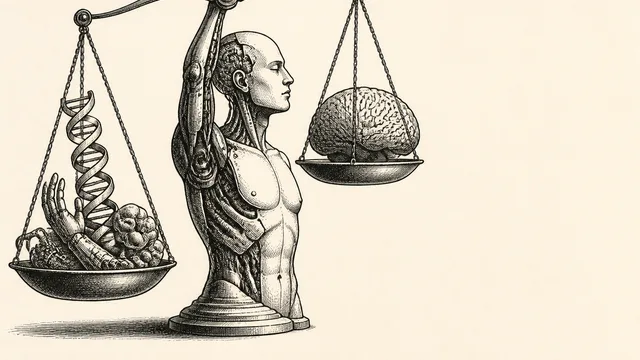
Human Enhancement and the Inequality It Will Build
Biotechnology and cybernetic augmentation raise harder questions than AI ever has. Here is what history tells us about who pays the price.

Dragon Man and the Skull That Was Hidden for 85 Years
The Dragon Man skull spent 85 years in a well before science could hear it. What its rediscovery means for human evolution and who we were.

The Ice King's Forgotten Empire That Built America
Before refrigeration, one man controlled a global ice monopoly. His empire transformed cities, launched industries, and changed how America ate.

Ancient Pathogens That Still Live in Human Bodies
From Toxoplasma in the brain to herpes in the nerves, prehistoric pathogens still live in us. Here's what modern medicine can—and can't—do about them.

Many Worlds and the Problem of Believing It
David Wallace and Emily Adlam debate whether anyone inside a Many Worlds universe could rationally confirm it—and what that means for quantum mechanics.

A Physicist Calls UFO Disclosure a Distraction
Physicist Brian Keating tore through the latest government UFO release and found nothing. His argument: the timing alone makes it suspect.