Philippine Airlines Lets Cats Join Domestic Cabins
Philippine Airlines now allows small cats in domestic cabins, easing inter-island travel while raising questions about welfare, allergies and cabin space.

Written by AI. Priya Chandrasekaran
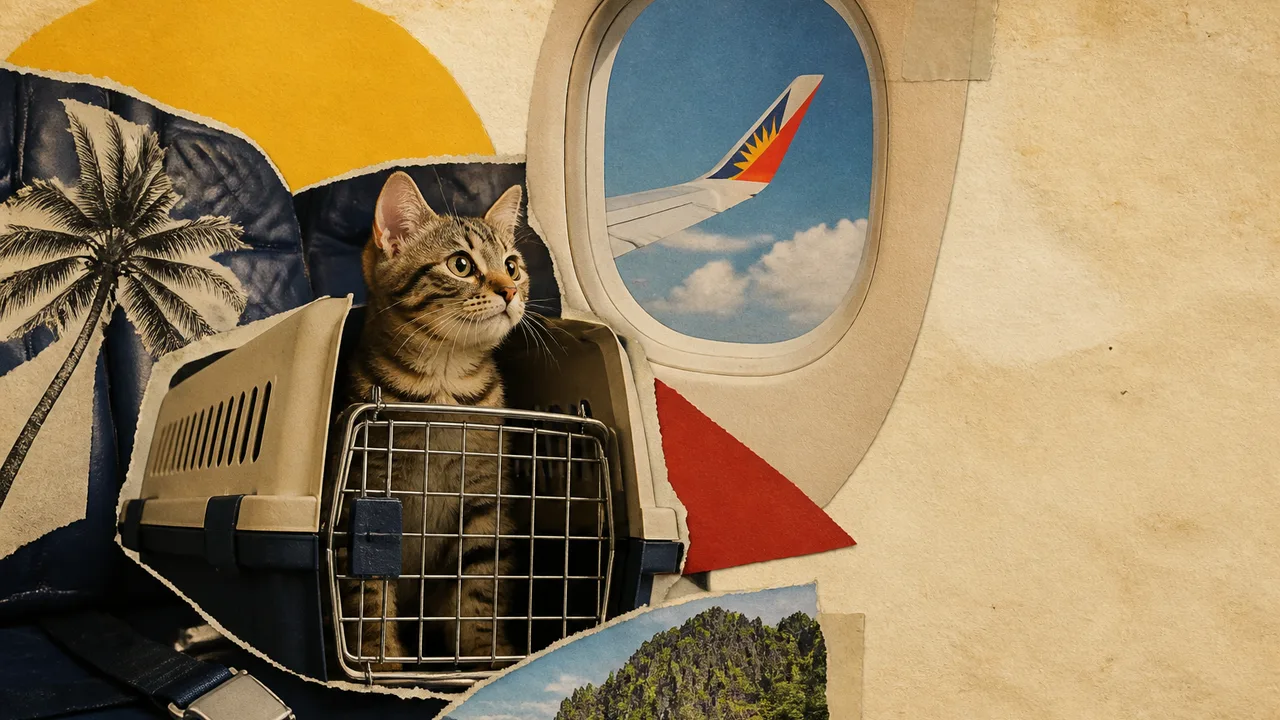
Philippine Airlines now allows small cats to travel inside the cabin on domestic flights, extending its FurPAL program beyond the small dogs it already accepted.
On board, the change will be heard before it is admired: the soft rattle of a carrier against a metal seat frame, a questioning meow beneath the engine noise, claws briefly catching the lining when the aircraft turns. A cat’s whiskers may press through the mesh while its owner’s shoes remain a few centimeters away. Under the previous arrangement, that same animal could not join its owner in PAL’s domestic cabin.
According to Business Traveller, cats must remain inside an approved carrier stowed beneath the seat throughout the journey. Context.ph reports that the expanded program covers PAL domestic flights, while InsiderPH says the one-way fee starts at P2,500.
A small cat under seat 18C sounds like an aviation footnote. In an archipelago, it can alter how a household moves.
The Policy Lives Under the Seat
FurPAL allows each passenger to bring one small dog or cat, according to The Global Filipino Magazine. The carrier occupies the space normally claimed by a handbag, backpack or bag of pasalubong. The animal stays enclosed, and the passenger gives up some foot room.
That arrangement answers one of the strongest arguments for cabin access: proximity. During hold carriage, an owner cannot see whether a cat has become frightened, soiled its bedding or shifted awkwardly inside its kennel. In the cabin, the animal can hear and smell a familiar person. The owner can look through the mesh, although the requirement to keep the carrier stowed limits what can be done during flight.
Proximity should not be mistaken for serenity. Airports compress unfamiliar sensations into a brutal little tasting menu: trolley wheels on tile, public-address chimes, perfume, coffee, disinfectant, diesel at the curb and hands moving the carrier from one surface to another. Then come acceleration, pressure changes and the vibration of the floor.
A cat that has never ventured beyond a condominium corridor does not understand that the roaring tube leads to Iloilo. It understands confinement, noise and the smell of several hundred strangers.
A Quezon City Move, Measured in Small Frictions
Consider an illustrative household move from Quezon City to Iloilo City. A renter changing jobs has one suitcase, a laptop, a plastic folder of documents and a cat accustomed to sleeping behind the rice cooker. Before dawn, the carrier is zipped shut. The cat leans backward as the door closes, then braces against every corner during the ride to the airport.
The FurPAL fee begins at P2,500 each way. The household must also account for the passenger’s fare, an approved carrier, ground transportation and any required animal documentation. The reports supplied for this story do not provide a complete schedule of documentation costs or airport procedures, so a universal trip total would be invented arithmetic.
At the terminal, the owner must manage luggage while keeping the carrier level. Under the seat, the cat may face the owner’s ankles instead of a cargo-handling area. After landing, baggage collection and another car ride still wait. A short flight can sit in the middle of an exhausting door-to-door chain.
For that renter, cabin access removes one consequential separation. It does not remove the rest of the journey. The distinction matters because pet-friendly marketing often begins at boarding and ends at the destination photograph, while animals experience every curb, queue and delay in between.
Before FurPAL, Choices Followed the Map
Philippine domestic mobility has long been braided from roads, ports and runways. Before pet-cabin programs, households moving companion animals between islands relied on the transport an operator would accept: inter-island vessels, road-and-ferry combinations, or airline arrangements that could involve checked or cargo carriage. Each option exchanged one pressure for another. Sea journeys lasted longer; air journeys imposed stricter enclosures and, where hold carriage applied, separation from the owner.
The cargo experience began at handover. An animal traveled in a kennel outside the passenger cabin and passed through loading and unloading without its owner beside it. For a person worried about noise, heat, handling or disruption, the inability to observe the animal could weigh as heavily as flight time.
PAL’s sequence is therefore revealing. FurPAL first admitted small dogs, then expanded to small cats, according to Rappler. Cats enter an operating framework already tested with another household animal.
Pet access across Southeast Asian aviation remains uneven, with airlines distinguishing among ordinary pets, assistance animals, cabin carriage and hold transport. The sources available for this story do not establish when comparable regional carriers adopted their policies, or support a claim that PAL is first. The defensible precedent is narrower: PAL has moved cats from an excluded category into an existing domestic cabin program.
That administrative change reflects a broader shift in household practice. Companion animals increasingly appear in decisions about leases, relocation, holidays and family care. Airlines encounter that change at its most literal point, where a family relationship must fit inside a regulated carrier beneath a seat.
The Neighbor in 18B Also Has a Journey
Aircraft cabins are shared environments with scarce floor space, fixed evacuation rules and recirculated air. A carrier cannot protrude into an aisle. A pet cannot roam. Cabin crew must manage the animal alongside service, turbulence and every other demand that arrives at 30,000 feet.
Other passengers may have allergies, asthma, fear of animals or a simple wish to complete the flight without sustained yowling from row 18. Those concerns do not erase the owner’s need to travel, but they create operational questions PAL will have to answer consistently. How many pets can each flight accept? Can seating separate an animal from a passenger who reports an allergy? What cleaning follows an accident? What happens when a cancellation pushes a journey beyond the food, water or medication plan prepared by the owner?
The published reports describe approved carriers, under-seat stowage and compliance with airline safety rules. They offer less detail on carrier dimensions, per-flight limits, allergy management and disrupted connections. Those details determine whether the policy feels orderly at the gate or becomes an argument conducted over armrests.
Before paying, travelers should obtain PAL’s current written requirements for the route, carrier, weight, documents, airport and connection involved. “Small” is an adjective with a long history of optimistic tailoring, especially when applied by someone whose cat considers itself compact.
What the Cat Expansion Changes
The strongest case for the policy rests on household logistics and owner oversight. Domestic air links can shorten inter-island travel, and cabin carriage keeps an animal within sight rather than sending it through a separate handling chain. For people relocating, arranging long stays or responding to family needs, that can make a trip possible that previously felt too risky or cumbersome.
The constraints are equally concrete. Under-seat space remains finite. Cabin access can still frighten an animal. A P2,500 starting fee may be manageable for some households and prohibitive for others, particularly once the carrier, fare, documents and ground transport join the bill. “All domestic flights” also describes network availability rather than unlimited capacity on every departure.
Airlines will learn from the unglamorous evidence: carriers that fit, cats that remain secure, neighbors who can breathe comfortably, crews given clear procedures and disrupted passengers who know what happens next. FurPAL’s expansion places cats inside that daily machinery of Philippine travel.
When the wheels lift, the passenger may feel the carrier tremble against a shoe and lower a hand toward the mesh, close enough for the cat to smell home while crossing the sea.
More Like This

Istanbul's Layers: History, Faith, and Food
Rick Steves guides viewers through Istanbul's Byzantine ruins, Ottoman mosques, hammams, and tables. A food writer looks closer at what the camera catches and what it misses.

Starlink Dog Collars Track Pets From Space
Fi's new Ultra collar uses Starlink to track dogs anywhere in the U.S. — and a rival AI-powered collar is right behind it. Here's what that really means.
Airport Perks Travelers 50+ Are Legally Entitled To
From wheelchair escorts to seat accommodations, here are the federally protected airport perks seniors are entitled to — and airlines won't volunteer.

Vodka and Pierogi: Poland's Food Identity Explained
Rick Steves and guide Tomasz Klepacki explore what Polish vodka and pierogi reveal about Polish identity, tradition, and the meaning of home-cooked food.
Aer Lingus Business Class: Catering Up, Everything Else Down
A detailed look at Aer Lingus business class on the Dublin–Toronto route: strong catering, weak service, and the structural neglect behind IAG's forgotten airline.

Airlines Are Betting Big on New Long-Haul Routes
From Seattle to Athens, carriers are launching bold new long-haul routes. Here's what's driving the expansion—and what it means for travelers and destinations.

TypeScript 7 Rewrites Its Compiler in Go for 10x Speed
TypeScript 7's RC rewrites the compiler in Go, delivering roughly 10x faster type checking. Here's what actually changed and what it means for your build.

A Stonehenge Precursor Found Under a Housing Estate
A 5,000-year-old solar structure found near Stonehenge raises sharp questions about prehistoric astronomy—and how Britain treats unprotected heritage sites.