The Periodic Table From Ancient Atoms to Lab-Made Elements
Neil deGrasse Tyson traces the periodic table from Greek atomic theory to modern particle accelerators, with 1920s quantum physics explaining why it all works.

Written by AI. Amelia Nwofor
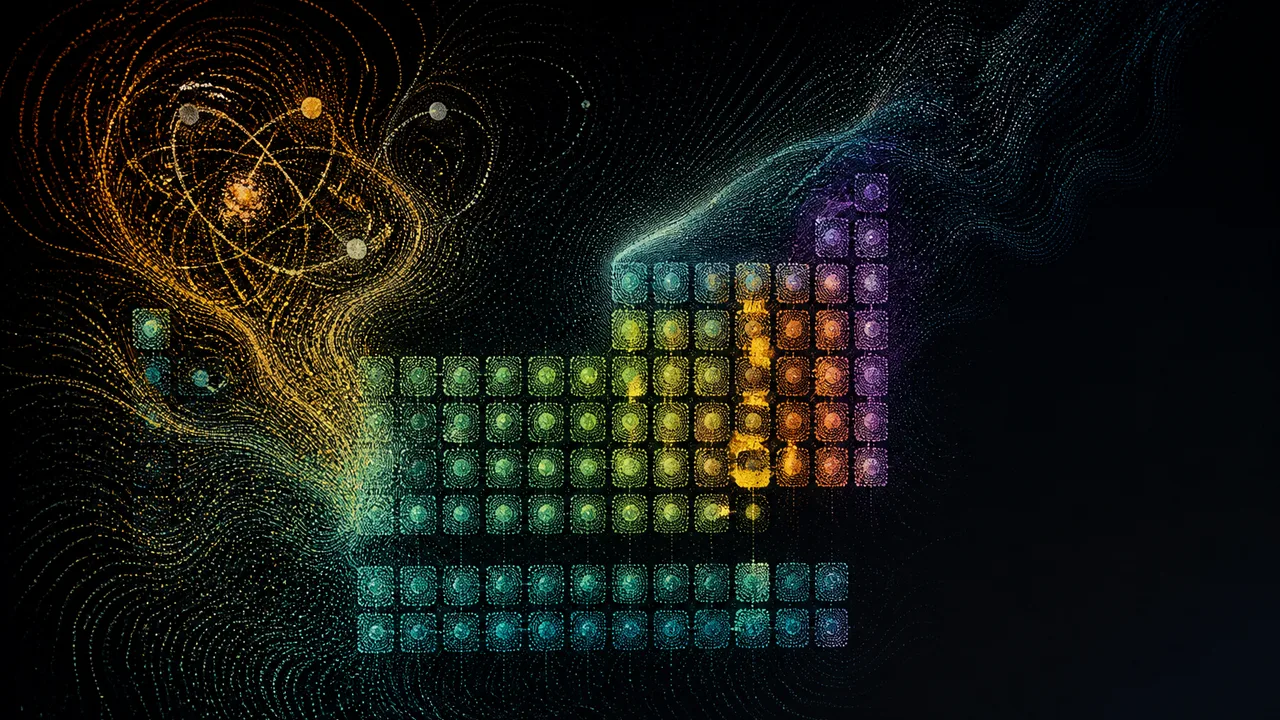
Photo: AI. Dexter Bloomfield
Neil deGrasse Tyson owns a tie printed with the periodic table of elements, and in a recent StarTalk episode he wore it to prove the point that this is his subject.
In Fun With the Periodic Table, Vol. 1, Tyson and co-host Chuck Nice walk through the table's origin story: from Greek philosophers arguing about the nature of divisibility, through alchemists cataloguing reactions they couldn't explain, to Mendeleev's pattern recognition, to the 1920s quantum physics that finally accounted for why the pattern existed at all. It's a good episode. Tyson is a natural teacher, Nice is a good foil, and the material rewards the attention.
But the episode moves fast, and speed has a cost.
From four elements to 118
The Greeks had earth, wind, fire, and water. They also had the atom: the philosophical proposition that if you keep dividing something in half, you eventually reach a point where division stops. The Greek word for that point is atomos, meaning indivisible. "Atom. Boom," Tyson says. "That's where this word comes from."
He's right to credit them. Moving from "the world is made of four essences" to "the world is made of irreducible particles" required genuine imaginative leaps, arrived at through argument rather than experiment. The Greeks got the conclusion approximately right for reasons that had nothing to do with empirical observation, which is a strange position for science to occupy. They were wrong about atoms being indivisible, as Tyson notes, but the conceptual frame survived.
The alchemists came next. Tyson is generous with them in a way popular science often isn't: "they bet on the wrong horse, but they kept good records." That record-keeping mattered. Systematic observation of how substances combined, transformed, and behaved under heat was the infrastructure on which later chemistry ran. The law of conservation of mass, which Tyson illustrates with a log-and-ash thought experiment (weigh the log, burn it, weigh the ash and smoke, recover the original mass), emerged from that painstaking tradition of tracking what went where.
As RSC Education notes, elements in the modern table are arranged by increasing atomic number, but that ordering came only after chemists had spent generations cataloguing what substances couldn't be broken down further. Carbon is carbon. Sulfur is sulfur. Mercury is mercury, liquid at room temperature.
The table takes shape
Mendeleev's contribution was noticing that heavier elements sometimes had the same chemical properties as lighter ones. Carbon bonds with oxygen the same way silicon does: carbon monoxide, silicon monoxide; carbon dioxide, silicon dioxide. Quartz is essentially silicon dioxide. If two elements behave identically, put them in the same column. "Like little gangs of elements," Nice offers. Yes, exactly.
What Tyson frames as intuitive pattern recognition was, in Mendeleev's hands, something more audacious: he left deliberate gaps in his table for elements he predicted must exist but hadn't been found yet. Science News traces how earlier chemists like Johann Wolfgang Döbereiner had already spotted clustering patterns, describing triads of elements whose atomic weights fell predictably between their neighbors. Mendeleev built that into a systematic predictive tool. The table wasn't just a description of what existed; it was a forecast. That forecasting capacity is what separates Mendeleev's work from a well-organized list.
The noble gases complicated the picture. Helium, neon, argon, krypton: none of them interact with any other element. Isolating them was a methodological nightmare precisely because they wouldn't cooperate chemically. Most were identified in the 1890s. Tyson notes, with evident irritation, that the group was named "noble" and reads that naming as a British class-system joke, elements that keep themselves separate from common society. That's Tyson's characterization rather than etymology (the term edelgase was coined by German chemist Hugo Erdmann in 1898, referencing chemical unreactivity parallel to noble metals, not social hierarchy), but as rhetorical framing it holds. The scientists who clustered these discoveries in the same decade did produce a remarkable run of them, and there is something satisfying about parking the snobs together in the far-right column.
What Mendeleev couldn't have known
The table worked before anyone understood why. Mendeleev arranged elements and found repeating chemical properties. The repetition is why it's called periodic, as in recurring with a regular interval. But the mechanism behind that repetition had to wait for 1920s quantum physics.
Ernest Rutherford's gold foil experiment established that atoms are mostly empty space, with a dense positive nucleus surrounded by electrons at a distance. Chemical behavior doesn't come from the nucleus, Tyson explains; it comes from the outer electrons. Specifically, from how many there are and whether the outermost shell is full.
Quantum mechanics explained the shells. An electron in an atom behaves as both a particle and a wave. A complete orbital requires a whole number of wave cycles. Once an orbital is full, no more electrons can join. "You can't have a partial wave because you can't have a partial particle," Tyson says. Elements with complete outer shells don't bond with anything; those are your noble gases, parked at the far right. Elements with one outer electron to spare bond eagerly with elements that need one. Run that logic across the full sequence of proton counts and you recover exactly the repeating pattern Mendeleev drew by hand, decades before the mathematics existed to justify it.
That gap between discovery and understanding is the thing Tyson's episode gestures at but doesn't fully inhabit. Mendeleev built a table that correctly predicted undiscovered elements. He had no concept of electron orbitals. The table worked as a predictive instrument before the theory arrived. Science is supposed to move from observation to theory to prediction, but chemistry ran this sequence out of order, and the table survived the theory intact when it finally caught up.
The human story the episode moves past
Tyson name-checks Antoine Lavoisier as the chemist who identified oxygen's role in combustion. It's a quick reference, delivered with a joke about cigarettes and singed eyebrows. What goes unmentioned: Lavoisier was guillotined in 1794 during the Reign of Terror. The presiding judge reportedly dismissed any appeal with the observation that the Republic had no need of scientists. He was fifty years old. His work on oxygen, on conservation of mass, on the systematic naming of chemical compounds, was so foundational that modern chemistry is largely organized around it. The table we're celebrating exists partly because of work he completed before his execution interrupted everything. Popular science episodes move fast and have to, but reducing Lavoisier to a footnote on combustion flattens what his story actually shows: that scientific progress doesn't accumulate cleanly, and the people doing the accumulating are subject to history in ways their discoveries are not.
Synthetic elements and an open question
Beyond uranium, proton number 92, the natural periodic table stops. Every element from 93 onward was created in a laboratory, using particle accelerators to force protons into nuclei that wouldn't exist in nature. The table now runs to 118. Tyson timestamps this expansion by noting the Knicks' 1973 championship, a useful cultural anchor for a New York audience and a timestamp that has only gotten more remote since he first started using it.
Whether any of the heaviest synthetic elements are useful for anything beyond confirming they can be made is, as Tyson acknowledges, a question for a follow-up episode. That's the right call. "What's the use of all these elements?" deserves a real answer, not a footnote.
The table isn't a finished artifact. It's a running count, and the count is still open.
More Like This
Exploring the Enigma of Negative Time in Quantum Physics
Dive into the perplexing world of negative time in quantum physics with insights from Prof. Aephraim Steinberg.
Fission vs Fusion: The Physics Behind Our Energy Future
A nuclear engineer's corrections to a viral science explainer reveal why misunderstanding fission and fusion has real costs for the energy transition.

The Doppler Effect: From Train Whistles to Speed Traps
Neil deGrasse Tyson unpacks the Doppler Effect on StarTalk—from 19th-century train whistles to sonic booms and the geometry hiding in your speeding ticket.
Exploring Black Holes and Asteroids with StarTalk
Neil deGrasse Tyson delves into black holes, asteroids, and more in StarTalk's latest Cosmic Queries episode with Chuck Nice.
Altermagnetism: Physics Just Got a Third Magnetic Class
Physicists have confirmed a third fundamental class of magnetism. Here's what altermagnetism actually is, why it matters, and who's positioned to control it.
IBM's Data Science Periodic Table, Mapped and Examined
Aaron Baughman's data science periodic table organizes ETL, drift, PCA, and more into one framework. Here's what it gets right—and what it quietly leaves out.

Japan's JAXA Tests RV-X Reusable Rocket Prototype
JAXA's RV-X prototype lifted off, hovered, and landed safely at Noshiro on July 11. Here's what the test actually showed—and what it didn't.

Measuring the Sun's Temperature Without Touching It
How 19th-century physicists used spectroscopy and radiation laws to calculate the Sun's temperature from Earth—no probe, no contact, no vaporized instruments required.