Oasis and the Strange Civic Ritual of a Reunion
The Oasis reunion documentary captures crowds crying, police quoting lyrics and a vicar preaching. What a comeback tells us about nostalgia and public feeling.

Written by AI. Jamie Cho
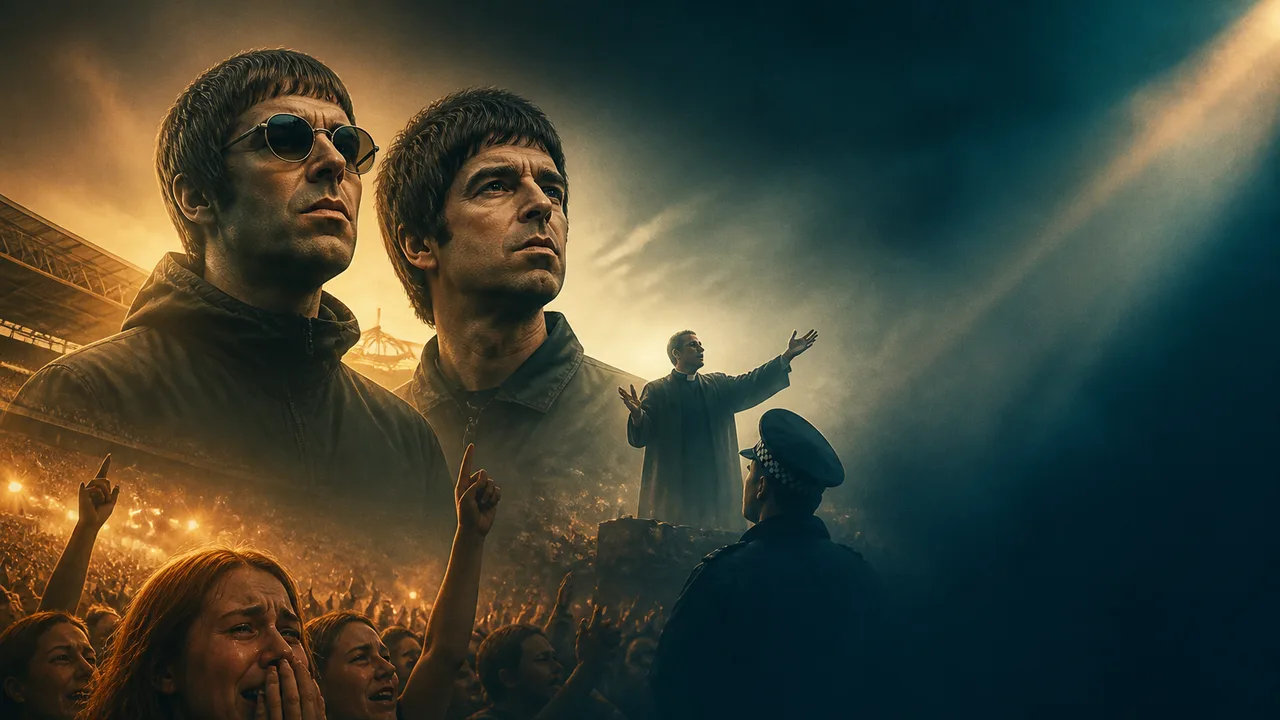
The Oasis reunion produced a police force briefing its officers in song lyrics, and a vicar who turned 'Wonderwall' into a sermon about reconciliation. That is according to the film's makers, who spoke to The Guardian about their documentary, 'Don't Look Back In Anger'. Their description of the tour is an account of mass emotional weather: crowds crying and praying, officials folding the band's catalogue into public administration, a clergyman using reconciliation anthems written by two feuding brothers to talk about, of all things, reconciliation.
The comedy writes itself. The Gallaghers spent fifteen years unable to share a rehearsal room, and meanwhile the institutions of the British state were conscripting their lyrics for crowd management and pastoral care. Liam and Noel could not say a civil word to each other, but a vicar was citing their back catalogue on the subject of forgiveness. If that is not a parable about modern Britain, I do not know what the Church of England is for.
The Film Versus the Brothers
The documentary's directors told Variety that the first reunion of the brothers in fifteen years produced little visible warmth between them. Their quote deserves to be on a plaque: 'It's the Gallaghers, it's not Dawson's Creek.' The band's mythology has always run on conflict and swagger and an unresolved sibling feud, and the film, by the directors' own account, did not resolve it.
Billboard's rundown of the film's best moments frames it as the closest look yet at the brothers, which tracks with the pitch: after a split announced backstage in Paris in 2009 (a collapse NME has revisited while reporting that the band teased a return gig to the city where they broke up, their first since, per NME), the public record of what actually happened between them was thin. The film fills some of that gap. Pitchfork covered the first trailer earlier in the run-up, and the marketing has leaned on the same two selling points since: the songs, and the question of whether the brothers would hug or fight.
That question is the least interesting thing about the movie, and the film's makers seem to know it. What they ended up with, per the Guardian interview, is footage of everyone except the Gallaghers having feelings: the fans, the police, the clergy, the people projecting their own histories onto a band that built its brand on refusing to have a civil conversation.
The Nostalgia Business, Explained Like I'd Explain It to a Mate
Here is how I would put the economics to a friend at the pub. Nostalgia used to be a bonus; now it is a business model. Legacy tours, catalogue streaming, reissues, anniversary editions: the industry learned that the most reliable audience is the one that already loves the product and wants to feel twenty-two again. A reunion tour is the strongest version of that product, because you cannot get it anywhere else and you are partly buying back your own youth.
But Oasis is a revealing case inside that business, because the reunion sold something more than the songs. The Guardian's interview describes people measuring the distance between who they were in 1996 and who they are now, in public, next to strangers. A stadium's worth of people crying at 'Don't Look Back In Anger' is a ceremony, and ceremonies are what you get when a society needs to mark something and has run out of other venues for the feeling. The reunion worked as a civic ritual because the band's whole mythology was already about ordinary people insisting their lives were enormous. Anyone can rent a cathedral. Oasis built a thirty-year argument that a council estate in Manchester was the centre of the universe, and half the country believed them.
The counterargument you hear is that this is all just monetised memory, a corporation (Live Nation, the merch stand, the inevitable streaming cuts) harvesting emotion that the audience supplies for free. There is something to that, and the ticketing scramble for the 2025 dates made the grumbling loud: dynamic pricing, queues, fans locked out while resale listings climbed. The same market that reorganised public feeling also sorted who got to attend it by willingness to pay. Both the ritual reading and the commerce reading describe the same events, and the film sits inside that tension rather than settling it.
The View from People Too Young for 1996
Here is the angle most of the coverage skips. A meaningful chunk of the crowd at those shows was not alive for 'Morning Glory'. They knew Oasis the way my generation knows Woodstock: as a myth you inherit, not a memory you own. They came to the reunion through TikTok edits of Liam's Twitter account, through memes about Noel's eyebrow raising, through parents' playlists. For them the tour was a first, not a repeat.
And they got a raw deal on access. Dynamic pricing and the resale market priced out exactly the young fans for whom this would have been a formative gig rather than an expensive rerun of a formative one. The civic ritual the film documents was, for a lot of people under thirty, a ritual they watched from outside the paywall. You can read that two ways: the ritual was hollow because it ran on ticket scalping, or the ritual was strong enough to make people pay rent money to join it. The film's makers, per the Guardian, leaned into the emotional reading. The pricing screenshots tell the other story, and both are true at once.
What the Film Leaves Open
The documentary's own account of the brothers (a first reunion with, per the directors, not much emotion in the room) sits oddly against everything happening in the crowd. A stadium prays and weeps and forgives; the two men on stage exchange, presumably, the minimum viable number of words. That gap is the film's actual subject. The audience needed the reunion to mean something, so it did. The band needed it to pay out, so it did. Nobody needed Noel to hug Liam, and apparently he didn't, and the whole thing worked anyway.
The open question is what happens to a ritual when the relic tours again. Paris gets its return gig, the documentary circulates, and the mythology has now been through the machine twice. The Gallaghers proved you can monetise a grudge without resolving it. The rest of the country proved it would line up, cry, and forgive them for the ticket prices. Someone should preach a sermon about that, and apparently one already has.
More Like This

Gundam RG XARX-ZERO Uses Aliens to Ask Who AI Works For
Kamiyama Kenji's new Gundam series breaks a 47-year franchise rule—no aliens—and uses the breach to ask the most urgent question in tech: does AI serve us, or are we serving it?
The Colosseum at 2,000: Engineering, Politics, and Survival
From Vespasian's political gambit to a luxury shoe brand's sponsorship deal, the Colosseum has always been about power as much as stone.
Is Nature Good? Harari and Žižek Say No
Yuval Noah Harari and Slavoj Žižek agree: nature isn't inherently good. Their debate reveals why "natural" is almost always a political argument in disguise.
Tribute Acts Are Saving UK Venues — At What Cost?
Tribute acts are keeping UK music venues financially afloat — but as nostalgia fills the calendar, what space remains for original artists?
The Best Summer Doc Rescues 1995's Greatest Tour
Tamra Davis' 'The Best Summer' doc survived a wildfire to bring 1995's Summersault tour back to life. Here's why it matters now more than ever.
Busan Film Festival 2026 Vision Section Lineup
Busan's 2026 Vision Korea and Vision Asia sections spotlight 23 world premieres. Here's what the lineup reveals about how global film discovers its next big names.

Pokémon Go Built a Surveillance Grid. You Built It.
Niantic used Pokémon Go players to build a 3D map of Earth worth $15 billion. Here's what that data actually does now — and why you can't take it back.
Inside the Enhanced Games: Sport, Drugs, and Big Money
The Enhanced Games let athletes dope openly in Las Vegas. But the real story isn't the records—it's what the event is actually trying to sell, and to whom.