Nvidia Faces Governance Questions Over Jensen Huang Report
An unconfirmed claim about Jensen Huang has raised questions about Nvidia's board, security and leadership. Here's how to separate the allegation from the forecast.

Written by AI. Zara Chen
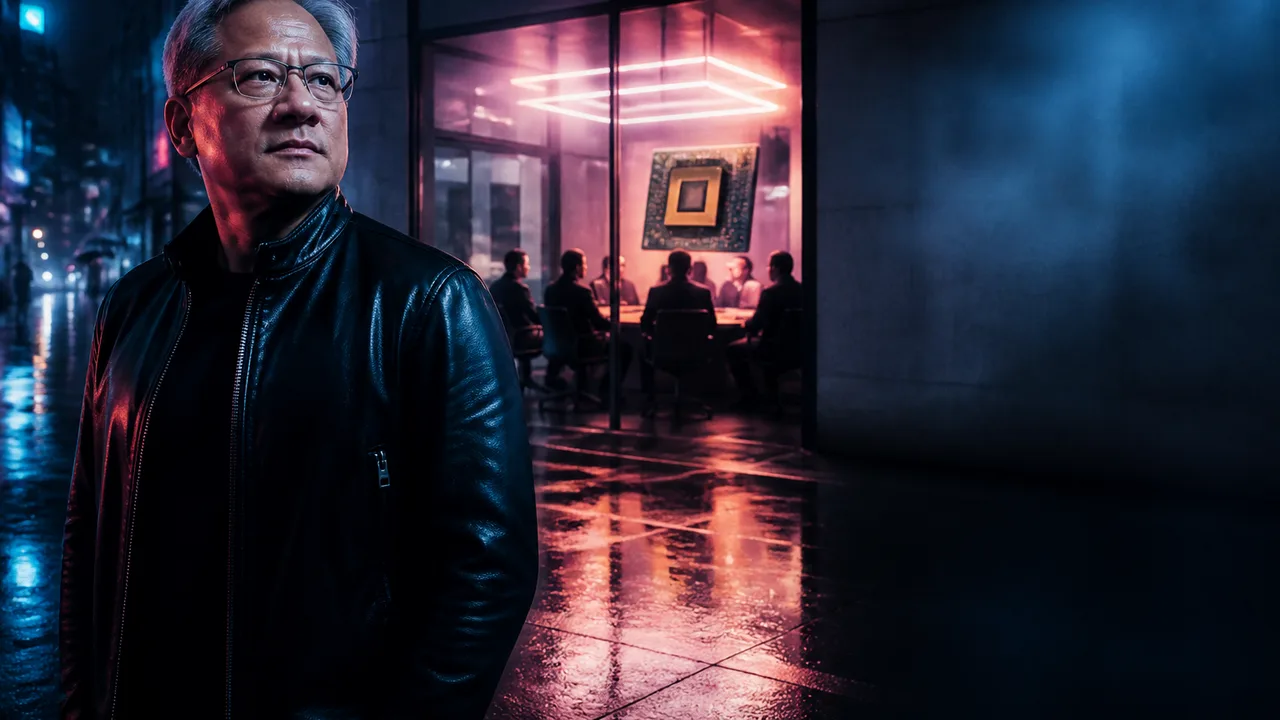
Nvidia CEO Jensen Huang is at the center of a claim with unusually high stakes for a company whose chips power much of the AI boom. A circulating report says Nvidia’s board is investigating Huang over an alleged relationship with a suspected Chinese spy, though the claim lacks disclosed supporting detail or independent confirmation. In the same account, Yale’s Jeffrey Sonnenfeld put Huang’s chances of keeping his job at roughly even odds. That number is his judgment about a possible outcome; it is not a board decision.
The story combines three questions that deserve separate answers. What happened between Huang and the person described in the allegation? Did that person seek or gain access to sensitive information? How, if at all, has Nvidia’s board responded? Treating those questions as one big spy-movie plot would be fast. It would also make it harder to understand the company’s actual exposure.
The Allegation Has Several Moving Parts
The phrase “suspected Chinese spy” carries a lot of weight. It says little on its own about who holds that suspicion, what conduct prompted it or whether the person had access to anything connected to Nvidia. An alleged relationship with that person raises questions about Huang’s judgment and potential vulnerability. It does not, by itself, answer whether anyone sought company information or whether Huang disclosed it.
Those possibilities would call for different responses. A board reviewing a chief executive’s personal conduct might focus on disclosure obligations and trust. A board examining a possible security breach would need to understand what information the CEO could access, who else may have encountered the person and whether any safeguards failed. If foreign intelligence activity were substantiated, public authorities could have their own questions. None of those paths can be collapsed into the allegation that started the discussion.
That’s also why a possible inquiry should be understood as a process rather than a finding. Directors can investigate because they need facts before deciding whether anything went wrong. They can also decide an allegation warrants no further action, require changes to security practices or consider leadership consequences. Each outcome would depend on what an inquiry actually finds.
Why Nvidia’s Board is Under the Microscope
Huang is closely identified with Nvidia, and Nvidia sits at the center of demand for AI computing hardware. A leadership question at this company would reach beyond an executive office: customers rely on its products, employees look to its leadership, investors track its direction and governments pay attention to where advanced chips go. A sudden change at the top could force all of them to reassess plans. That potential disruption gives directors a reason to be careful about both their decisions and their timing.
The strongest case for board scrutiny is straightforward. Directors owe the company an assessment that does not turn on Huang’s prominence or on the awkwardness of investigating its best-known leader. They would need to determine the scope of any relevant conduct, whether company interests were put at risk and whether the CEO can continue to lead effectively. Even if the concern ultimately proves unfounded, a credible review could help people inside and outside Nvidia understand how the board reached its decision.
There’s a cost on the other side, too. A poorly defined inquiry can leave employees and business partners trying to guess whether a personal allegation, a security concern or a leadership dispute is driving events. Publicly prejudging an executive could compound that damage. Good governance here would mean taking a serious concern seriously while keeping the person, the alleged conduct and any demonstrated company risk distinct.
Sonnenfeld’s roughly 50-50 assessment captures the uncertainty surrounding Huang’s tenure, but odds are especially easy to misread in a fast-moving story. They offer a view of how a leadership decision might unfold. They cannot tell investors what directors know, what they are reviewing or when they might act. A percentage can sound crisp enough to trade on while the underlying questions remain open.
The China Question Changes the Stakes
Nvidia’s chips sit inside an already tense technology relationship between the United States and China. US policy has restricted exports of certain advanced semiconductors to China, making chip access a matter of business strategy and national security. That context explains why an allegation involving a suspected foreign intelligence operative would attract attention beyond Nvidia’s shareholders.
Huang also faces bipartisan congressional scrutiny over the reported China link. Lawmakers can seek answers about risks to sensitive technology and the adequacy of corporate safeguards without waiting for directors to resolve a personnel question. Congressional interest, however, follows a different purpose from a board’s review. One is concerned with public policy and national security; the other must decide what serves the company.
The practical security questions are narrower than the most dramatic headline. Did anyone seek nonpublic information? Could anyone have accessed it? What internal controls would have limited exposure? Those are questions for fact-finding, not assumptions about what occurred. They also connect this case to a problem many technology companies face: senior leaders hold broad access and maintain extensive networks outside the office. Security practices have to account for both realities without treating every personal connection as evidence of compromise.
The same care applies to the person described as a suspected spy. A suspicion may prompt a company to examine contacts and access. Establishing an intelligence role requires evidence about that person’s actions, not a label repeated often enough to start sounding settled.
Founder Status Meets Board Independence
A founder-led company gets a lot from continuity. Customers know who sets its direction; employees know whose decisions shaped its culture. Huang’s association with Nvidia makes the prospect of a leadership change especially consequential. It may also make the board’s independence a focus of attention. Can directors examine a concern involving the person most closely associated with the company while preserving trust in whatever decision follows?
The answer cannot come from a generic rule that famous founders stay or go. Directors would have to weigh the conduct at issue, any risk to Nvidia and the consequences of each possible response. The strongest argument for keeping Huang would rest on facts that support continued confidence in his leadership. The strongest argument for a change would likewise require facts, rather than the volume of attention surrounding the allegation.
For people trying to follow this story, the useful markers are concrete: a board confirmation or explanation of its process, a defined account of the conduct under review, credible findings about any security exposure and a stated leadership decision if one comes. A congressional development would tell readers more about the public-policy response, though it would need to be read on its own terms.
Nvidia’s board may eventually face a hard choice about its most recognizable executive. First, it has to establish what choice the facts actually require.
More Like This
This Creator Got Shadowbanned on YouTube in 25 Days—On Purpose
A vidIQ creator deliberately shadowbanned their channel with AI-generated content to expose how YouTube's algorithm actually works. The results are wild.

Flock Cameras Track Far More Than License Plates
Flock Safety's AI-powered cameras are spreading fast across U.S. cities—and they're capturing far more than license plates. Here's what's at stake.

Renewables Hit 30% of US Electricity in Early 2026
EIA data shows renewables reached 30% of US electricity in early 2026, up from 27.8% a year ago. Here's what that number actually means—and what it doesn't.

Apple's Reference Image Builds a Photo Evidence Chain
Apple's Reference Image proposal could preserve photo provenance through edits and platforms, but its value depends on adoption and careful trust rules.

China's AI Firms Take Platinum Seats in PyTorch Governance
Alibaba Cloud and Cambricon join the PyTorch Foundation as Platinum members. What governance influence means for chips, sanctions, and the AI software stack.
Nvidia's Groq Deal: A New Play in AI Chips
Nvidia's strategic Groq deal reshapes AI chip game, raising open-source and equity concerns.

Chinese Bots Targeted AI Data Centers. Real People Did Too.
X found 200 Chinese bot accounts targeting AI data center debates. OpenAI and Republicans ran with it. Wired and others say the outrage was already real.

UK's Phantom Data Centers Are Straining the Power Grid
Speculative 'phantom' data centers are clogging the UK's grid connection queue. Ofgem is pushing back—but the fix isn't simple when AI ambition is this loud.