Nvidia Cosmos 3 Puts Physical AI Through Virtual Trials
Nvidia's Cosmos 3 links language, video and robot action, but its near-term value may lie in ranking policies before costly real-world robot safety tests.

Written by AI. Bob Reynolds
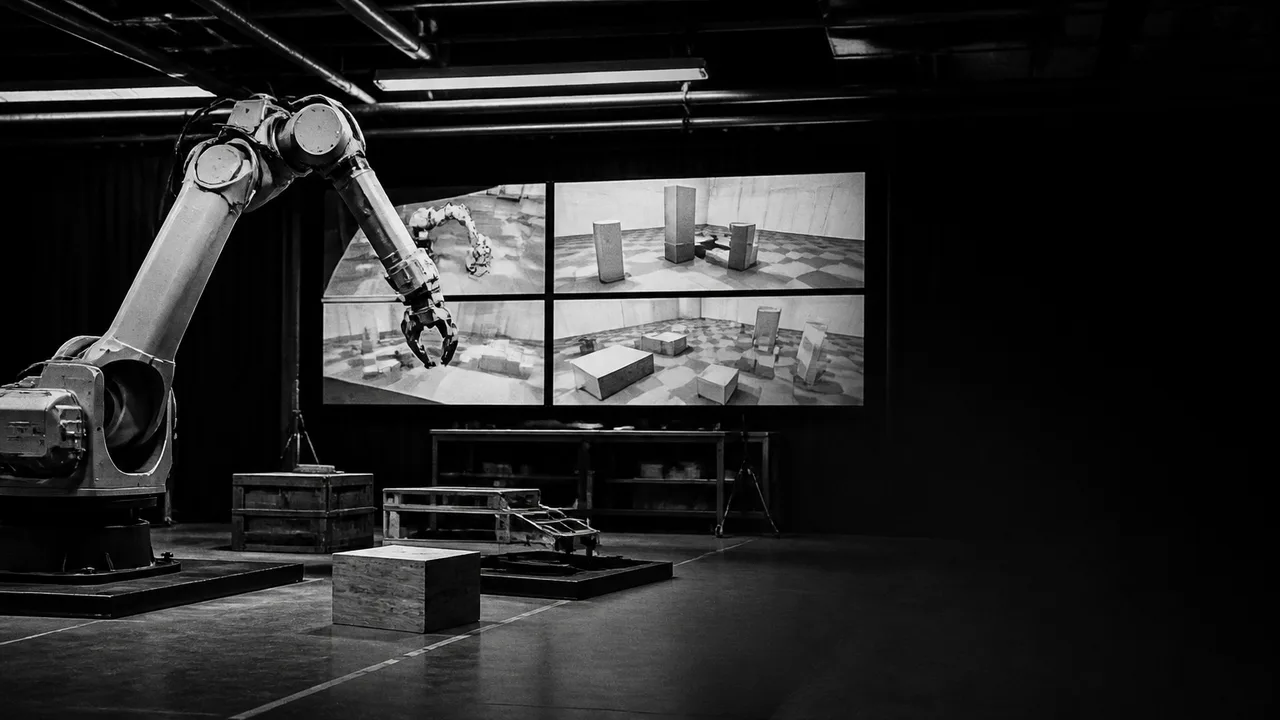
Photo: AI. Atticus Ferenczi
Nvidia’s central claim for Cosmos 3 is that a generated world can help decide which robot or driving policy deserves a trial in the physical one. That is a narrower proposition than replacing reality with simulation, and a more plausible place to begin.
Robot developers produce many versions of a control policy during training. Testing every checkpoint on cars or physical robots consumes vehicles, equipment, staff and time. A neural simulator could run those candidates through synthetic situations, discard the weaker ones and reserve real-world testing for the finalists.
Ming-Yu Liu, who leads Nvidia’s Cosmos research, described this as “passive verification” in a sponsored Machine Learning Street Talk interview. “You don’t need them to be precise,” he said of simulated success rates. “You just need to know if policy A is better than policy B.”
That distinction gives Cosmos 3 its clearest near-term test. A simulator does not have to calculate a robot’s true success rate. It has to preserve the ordering seen in reality often enough to save developers work.
The Simulator as a Filter
Simulation has always offered engineers an attractive bargain: make mistakes where mistakes are cheap. Neural world models alter how the simulated environment gets built. Conventional simulators depend heavily on explicit rules, assets and physics models. A system such as Cosmos 3 learns patterns from video, language, audio and action data, then generates plausible outcomes from a starting observation and an action.
Cosmos Dreams, Nvidia’s closed-loop simulation framework, feeds a policy’s action back into the model so that the next generated observation reflects what the policy did. That feedback loop matters because a robot changes the scene it observes. Moving a gripper can hide an object, deform soft material or knock something into an unexpected position.
The proposed filtering role also limits one familiar problem. A policy trained directly inside a simulator may learn to exploit errors in that simulator. Passive verification keeps the generated rollout outside the policy’s training loop, at least initially. The simulator judges checkpoints rather than teaching them through repeated rewards.
The risk remains. A simulator can rank policies incorrectly when its blind spots favor one design. If several policies and the simulator inherit related training data or model assumptions, their errors may correlate. An efficient filter can then become an efficient producer of false confidence.
The public claims supplied here leave an important number unanswered: how often does Cosmos preserve real-world policy rankings across unfamiliar environments? Neither the interview nor its accompanying summary provides a correlation rate, confidence interval or failure breakdown. Those measurements will determine whether passive verification becomes an engineering instrument or another handsome demo with excellent lighting.
One Model, Several Jobs
“World model” has acquired the customary elasticity of a fashionable AI term. Liu offers a useful working definition: “I think world model is a collection of useful tools.”
For robotics, he divides those tools into three related tasks. Forward dynamics predicts what will happen after an action. Inverse dynamics infers which action produced an observed change. A policy selects the action needed to complete a task. The Cosmos 3 paper presents these capabilities within an omnimodal system spanning text, images, video, audio and action.
Its architecture starts with a vision-language component that interprets observations and produces tokens sequentially. Nvidia then uses those learned weights to initialize a bidirectional diffusion generator. That generator produces chunks of video, audio or action whose elements can attend to one another, helping maintain coherence across the generated interval.
A shared temporal position scheme aligns signals recorded at different rates. Video frames, audio samples and robot commands do not arrive on one convenient clock. The model needs to know which pieces occurred together and how far apart other events were.
Training several tasks under a capacity constraint may encourage the model to learn a shared representation of cause, motion and action. Nvidia reports that the tasks help one another. A visual correlation can be useful without encoding enough physics to predict contact, force or breakage.
Human Video Fills a Robot Data Shortage
Robot action data remains scarce compared with the enormous supply of human video. Nvidia’s approach uses first-person footage of people handling objects as a source of visual-action patterns, then adapts those patterns with robot data.
The intuition has merit. A human hand and a mechanical gripper may approach the same cup along similar visual trajectories. Both must account for the cup’s position, surrounding obstacles and the desired destination. Shared patterns could reduce the amount of robot-specific training required.
The DROID dataset paper describes a large-scale collection of robot manipulation data gathered across varied environments, tasks and hardware setups. Nvidia says it post-trained Cosmos on DROID and achieved state-of-the-art pick-and-place policy results. The interview does not provide the benchmark values, comparison table or degree of improvement, so the scale of that reported advantage cannot be assessed from the discussion alone.
Transfer also has a hard boundary. Human joints, tactile feedback and muscle control differ from robot action spaces. Camera viewpoints vary. A person can adjust grip force using sensations that ordinary video never records.
Liu acknowledged the central uncertainty when asked whether the model knows when human-to-robot transfer could be harmful: “I think the model doesn’t really know.” Validation must therefore identify where the shared visual vocabulary stops being reliable. Similar-looking movement can conceal different forces and failure modes.
Instructions Need a System Around Them
A household command such as “clear the table” contains choices that language makes look deceptively simple. Which objects belong on the table? Where should each one go? Should the robot move a full glass before collecting plates? What happens when a pet walks underneath it?
Liu argues for a higher-level harness that decomposes an instruction into subtasks, executes them in sequence, checks completion and consults memory or tools when choices arise. This resembles the agent systems built around language models, except errors can now spill coffee, damage property or injure someone.
That system layer complicates accountability. A failure might originate in perception, planning, generated action, task decomposition, memory or a safety rule. Testing the model alone cannot establish that the assembled robot behaves safely.
Generated edge cases could expand coverage. A simulator can create unusual intersections, cluttered kitchens or unfamiliar object arrangements without rebuilding a test facility. Yet rarity is difficult to synthesize responsibly. Developers must know which hazards to request, and the world model must generate them with behavior close enough to reality. An imagined elephant in a kitchen is easy. A slightly loose handle, a reflective surface or a child moving unpredictably may be more consequential and harder to model.
Open Weights Still Require Closed Evaluation
Nvidia offers Cosmos in Super, Nano and Edge variants. The company positions Super for the highest fidelity, Nano as a smaller option for adaptation, and Edge for local deployment on hardware including Jetson Thor, Jetson Orin and DGX Spark. The Cosmos3-Edge model card and Nvidia Cosmos repository provide model information, code and post-training resources.
Local execution addresses two practical constraints: network delay and unreliable connectivity. A robot that needs a data-center round trip before every time-sensitive action has acquired an unusually elaborate leash. Smaller models, however, create their own trade-off among speed, power use and predictive quality. Safety evaluation must cover the model that runs on the device, not merely the larger model used during development.
Open weights and recipes allow outside researchers to inspect, adapt and test the system. They do not supply independent evidence by themselves. Cosmos 3 comes from Nvidia, whose business benefits when AI development consumes more computing hardware, and the interview carrying these claims disclosed a paid partnership with the company. That commercial alignment does not invalidate the research. It raises the standard for reproducible benchmarks, external evaluation and published failures.
World models may eventually train robots inside synthetic environments. Their earlier and more measurable contribution could be humbler: reducing a pile of candidate policies to the few that deserve contact with a real road, kitchen, child or pet. The decisive benchmark will be how often that synthetic judgment survives the first encounter with physical reality.
Bob Reynolds, Senior Technology Correspondent, BuzzRAG
More Like This
AI-Powered Mobile Apps: Faster Development, Familiar Questions
Developer David Ondrej built a 3D iOS app in minutes using AI tools. The speed is real. The question is what happens when everyone can do this.

Adam Becker on Why Silicon Valley's Big Bets Will Fail
Astrophysicist Adam Becker argues that the singularity, Mars colonies, and AI doom share one flaw: they all assume exponential growth never ends. It always does.

Waymo's Dolgov on Why the Demo Is the Easy Part
Waymo co-CEO Dmitri Dolgov laid out seven technical lessons at Y Combinator's Startup School — a rare honest account of what it actually takes to ship physical AI.
When AI Needs to Invent Problems Before Solving Them
Robert Lange's Shinka Evolve shows why AI systems that optimize fixed problems may be missing the point. Real discovery requires co-evolving questions.

Real-Time Interactive Video Is a New Medium, Not a Speed Boost
Ahmed Ahres of Reactor argues real-time interactive video changes what the medium is—not just how fast it runs. Here's what that actually means.
Nvidia Cosmos 3 Edge Brings AI Inference to Robots
Nvidia's Cosmos 3 Edge runs AI directly inside robots and cameras—no cloud required. Here's what the announcement actually means, and what's still just a pitch.

A Custom GPU Cooling Mod Built Without Zip Ties
A PC builder refused the easy fix and designed a custom GPU fan bracket and PCB splitter instead. Here's what that obsession looks like in practice.

Python Backtesting Tools Promise a Lot. Know the Limits.
Zipline can simulate stock trading strategies in Python — but the leverage trap and survivorship bias can make bad strategies look brilliant. Here's what to watch.