Claude Code Skills: What Seven Upgrades Reveal
A YouTube tutorial on Claude Code skill configuration raises a deeper question: how much of this configuration layer will Anthropic eventually absorb into the product itself?

Written by AI. Bob Reynolds
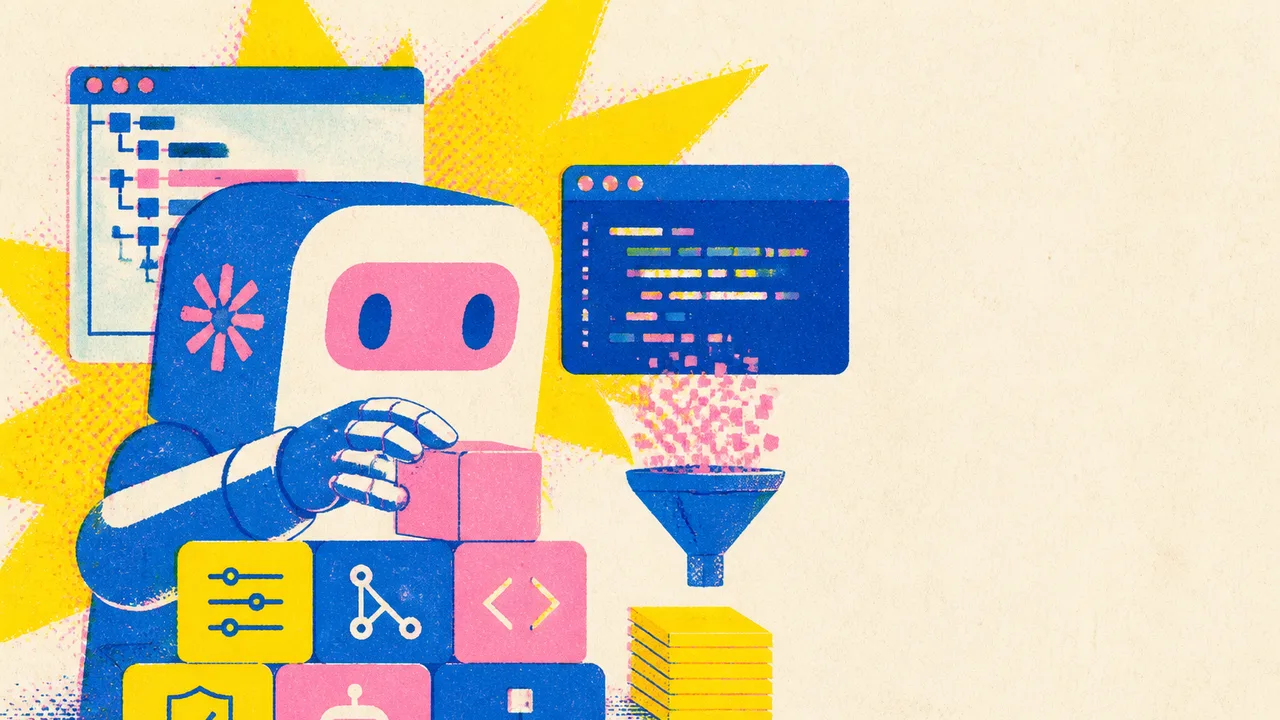
Photo: AI. Jorah Maktoum
There is a particular kind of expertise that develops in the gap between what a product can do and what it does automatically. The gap closes eventually. The expertise, if you've wired it into your workflows, either becomes invisible infrastructure or becomes obsolete. The question is which.
A recent video from the Software Engineer Meets AI channel walks through seven specific upgrades for Claude Code skills — the markdown-based instruction files that tell Anthropic's AI coding tool how to execute repeatable tasks. The presenter frames it for a wide audience, covering ground whether viewers have barely touched the tool or use it regularly. The advice is practical. It also, read carefully, maps the current gap between what Claude Code requires of users and what it might eventually handle on its own.
Worth understanding what's actually being configured here. The presenter describes Claude Code skills as packaged, reusable sets of instructions that can be triggered either by a slash command or automatically when the agent reads the skill's description and decides to invoke it. The [markdown files] that underpin this system are doing real work — they're not just documentation, they're the scaffolding that gives the agent its operating instructions. The presenter builds the case using a single example throughout: a skill that writes pull request descriptions from a Git diff. Simple enough to follow, complex enough to illustrate why configuration matters.
What the Seven Upgrades Actually Are
The first upgrade is adding user questions to a skill. Rather than letting the skill execute against a generic template, the skill pauses to ask contextual questions — in the pull request example, whether the audience is an internal team or external reviewers, and whether a test plan should be included. The result is that the same skill produces meaningfully different output depending on answers. This is the configuration layer doing what the product doesn't yet do automatically: gathering context before acting on it.
The second upgrade — adding a verification step — the presenter calls trivial but says many practitioners skip. After a skill executes, a script confirms the output meets expectations. In the PR example, that means checking whether all changed files are referenced in the description. The presenter is right that this is obvious in principle. It's also the kind of thing that gets cut when developers are moving fast.
The third upgrade is where the video earns its most interesting moment. The presenter identifies a failure mode he says isn't widely understood: practitioners loading skills with more and more instructions, consuming context window space that should be reserved for the actual task. His solution is to treat the skill file as a router rather than a repository — pointing to external templates and reference files rather than embedding all the content directly. Claude Code loads those references only when needed. The presenter calls this progressive disclosure, and it's a meaningful architectural distinction. A skill file that says "if internal audience, load this template; if external, load that one" is doing something categorically different from a skill file that contains both templates in full. The [context window management] problem this addresses is real, and the solution requires that practitioners think about their skill files the way a systems designer thinks about lazy loading — which is not how most people approach a configuration file.
The fourth upgrade is description optimization: the skill's description should specify not just what the skill does, but when to invoke it. The presenter notes that manually written skills tend to cover the "what" and omit the "when." The fix is adding explicit trigger language — something like "run this skill every time you create or edit a pull request." This matters because the agent reads the description to decide whether to invoke the skill automatically. Vague descriptions produce missed invocations.
The fifth upgrade addresses scope. Skills are project-scoped by default, meaning they live in a specific repository. Changing scope to personal makes the skill available across every repository on a machine. The presenter notes you can go further and share skills across a team via Claude Code plugins — which is where this stops being a single developer's productivity optimization and starts being an organizational infrastructure question.
The sixth upgrade is per-skill model selection. Each skill file can specify which model to use rather than inheriting the default. The presenter uses a lightweight model for the simple PR description task. The logic is straightforward: model selection is a cost and performance dial, and the right setting depends on task complexity.
The seventh and most technically advanced upgrade involves running complex skills in separate sub-agents with their own context windows, rather than executing everything in the primary agent's context. The presenter describes a configuration attribute — context fork — that spins up an isolated execution environment, and a separate agent attribute that lets you specify which sub-agent handles the task, including custom agents stored in an agents folder.
The Gap This Reveals
Taken together, these seven techniques describe a fairly sophisticated operational discipline. You're managing context budgets, designing trigger conditions, routing to external references, selecting models per task, and orchestrating sub-agents. These are not beginner concerns. They're the kind of concerns that, in an enterprise context, would generate an IT security review on what those external templates contain, a procurement discussion about which model tier the team is authorized to call, and eventually a meeting with the CIO about whether these personal-scope skills are creating shadow workflows that bypass approved tooling.
That organizational friction is real, and it doesn't appear in a five-minute tutorial. It surfaces when the first developer tries to promote their personal-scope skill to team-scope and discovers there's no governance process for that. It surfaces when someone's context-forked sub-agent starts spinning up model calls that don't appear in the expected cost center.
My read on Claude Code specifically: it breaks toward simplification, and the timeline is probably shorter than most practitioners expect. The commercial incentive structure is straightforward — Anthropic needs Claude Code to be usable by organizations that cannot afford to hire specialists who watch five-minute optimization videos and hand-tune markdown routing files. Context management, trigger optimization, and model selection are exactly the kind of friction that product pressure will push into the tool itself. Automatic context management, smarter default trigger inference, guided scope promotion — these are features that write themselves on Anthropic's roadmap, because every manual step in the current workflow is a reason an enterprise buyer hesitates.
Which means the techniques in this video are genuinely useful now and will likely be partially or mostly automated within a product cycle or two. If you're a manager deciding whether to invest team time in building workflow infrastructure around these configuration patterns, that's the practical variable: you're building on ground that Anthropic has strong incentives to pave over.
More Like This
Inside Anthropic's Daily Claude Code Workflow
The tools Anthropic's team actually uses in Claude Code—from open-source plugins to internal skills reverse-engineered from leaked source code.
Multica Wants to Turn AI Agents Into Project Managers
An open-source tool promises kanban boards for Claude and other coding agents. But do developers actually want their AI assistants managed like tasks?

Grok 4.6 and Grok Bot: A Solo Developer's Overnight Test
Ray Fernando ran Grok 4.6 overnight on real projects and reviewed the results live. Here's what actually shipped, and what it means for how software gets built.
Anthropic's New Monitor Tool Could Change How Devs Debug
Claude Code's new Monitor Tool watches background processes and auto-fixes errors. Here's what developers need to know about saving tokens and time.

Claude Code Nested Subagents: Power and Cost Explained
Anthropic's nested subagents let Claude Code spawn agents five levels deep. Here's what that actually means for your workflow—and your token bill.

Amodei's Call to Slow AI: Pacing or Positioning?
Dario Amodei wants AI development paced and third-party evaluators like METR inside frontier labs. What the proposal promises, and what it leaves unanswered.
Visual Plans for Claude Code Change Agent Reviews
Builder.io's Steve Sewell introduces visual-plan and visual-recap skills for Claude Code, turning AI-generated markdown walls into interactive MDX diagrams and wireframes.

A Custom GPU Cooling Mod Built Without Zip Ties
A PC builder refused the easy fix and designed a custom GPU fan bracket and PCB splitter instead. Here's what that obsession looks like in practice.