Claude Code Nested Subagents: Power and Cost Explained
Anthropic's nested subagents let Claude Code spawn agents five levels deep. Here's what that actually means for your workflow—and your token bill.

Written by AI. Marcus Chen-Ramirez
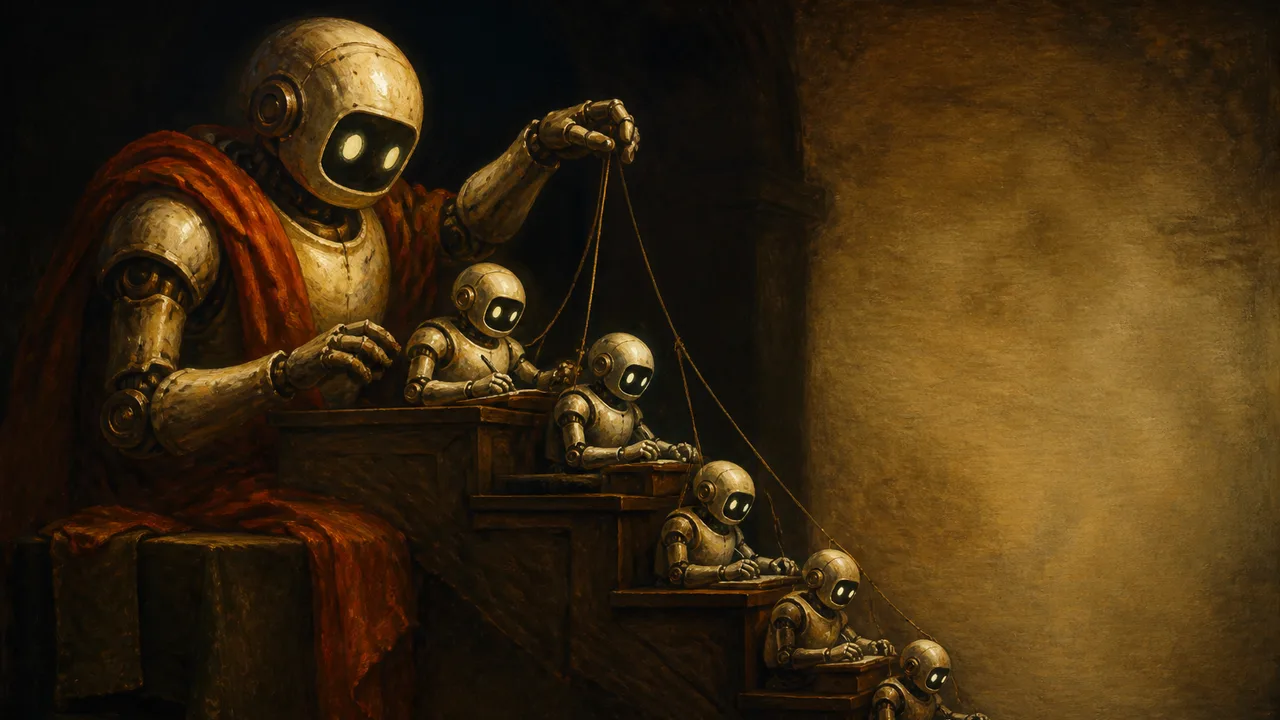
Photo: AI. Henrik Solberg
There's a particular kind of feature announcement that makes AI developers simultaneously excited and nervous. It's the kind where the capability is genuinely impressive, the architectural implications are real, and the bill at the end of the month is potentially terrifying. Anthropic's latest addition to Claude Code—nested subagents, or what the developer community is already calling "Subagents 2.0"—fits that description precisely.
The short version: Claude Code can now spawn subagents that spawn their own subagents, up to five levels deep. That's not a minor quality-of-life tweak. It's a structural change to how you can organize AI-assisted work.
What Subagents Actually Do (and Why It Matters)
To understand why nesting is significant, you first need to understand the problem subagents solve in the first place.
Every model running inside Claude Code operates within a context window—a hard ceiling on how many tokens it can process at once. When you're deep into a session, asking questions, running edits, and accumulating conversation history, that window fills up. A session that's consumed 60% of its context window before you've even gotten to the complex part of your task isn't a hypothetical—it's Tuesday.
Subagents sidestep this by isolating work. Spin up a subagent, and it gets its own fresh context window. Your main session stays focused and relatively lean; the subagent does its thing and returns a result. The developer behind the Software Engineer Meets AI channel put it cleanly: "The main benefit of a sub agent is the separation of context window. Each sub agent has its own context window. So my main chat is not polluted and it is focused on my current task."
That's the elegant version of the story. The practical version is that you now have a way to run parallel research, parallel code analysis, or parallel anything—without the cognitive overhead spilling back into your primary session.
The nested subagents upgrade takes this one step further: those subagents can now do the same thing themselves.
The Depth Parameter and What It Unlocks
Anthropic introduced a concept called depth to describe how many levels down the spawning goes. A subagent created directly by your main session is depth one. A subagent created by that subagent is depth two. The maximum is five.
The demo in the video is a useful concrete illustration. The prompt: run a competitor analysis on Claude Code, Codex, and Cursor. Spawn three top-level subagents, one per competitor. Each of those spawns two more—one for features, one for pricing. That's a depth of two, producing nine agents running simultaneously, each with its own context and focus.
Watch that demo and it's hard not to be at least a little impressed. Three competitors, six sub-analyses, structured and parallel, all from a single prompt. What would have been a multi-session, context-juggling exercise becomes something you can architect and fire off in one shot.
The agent collaboration costs that come with this kind of parallel work, though, are worth taking seriously before you get carried away.
The Bill at the End of the Month
Here's where "genuinely impressive" shades into "proceed with actual caution."
Every agent at every level is consuming tokens. The main session generates tokens. Each subagent generates tokens. Each subagent's subagents generate tokens. In a depth-two architecture with nine active agents, you're not running one conversation—you're running nine. And if you're using Anthropic's most capable model (Claude Opus), each of those conversations carries a significantly higher per-token cost than its more modest siblings.
As the presenter notes: "Just imagine how many tokens it will consume if I'll use the Opus model. So we need to be cautious about using this feature."
That's an understatement worth sitting with. The nesting capability has no built-in depth governor—you can't currently configure a session-level maximum. Without explicit instructions in your prompt, Claude will spawn as deep and as wide as it decides is useful. That's a lot of discretion to hand to a system that has no particular incentive to economize. The hidden session costs that already catch users off guard with standard Claude Code sessions become substantially more unpredictable here.
This isn't an abstract concern. It's the kind of feature where a developer fires off an ambitious prompt, goes to make coffee, and comes back to discover that their agent tree decided depth four was the right call. The math is not friendly.
Three Controls Worth Understanding
The video surfaces three practical levers for managing nested subagents, and they're worth understanding before you start experimenting.
Anonymous vs. custom subagents. Custom subagents are defined in markdown configuration files, and they only gain the ability to spawn their own children if you explicitly give them the agent tool. Want a custom subagent that stays a leaf node? Remove that tool from its config. Anonymous subagents—the kind created dynamically by a prompt—are less controllable, but you can instruct Claude Code at the prompt level not to spawn additional subagents. Neither mechanism is fully airtight, but they give you more grip than you'd have otherwise.
Parallel over depth when you want predictability. The presenter's most emphatic practical advice: if control matters, stay flat. Running subagents in parallel (depth one, multiple agents) is easier to reason about, easier to debug, and easier to cost-estimate than a branching tree. Debugging a problem in a depth-three subagent is, as he notes, "very tough." Parallel architectures let you inspect any agent's work directly without tracing the provenance of a deeply nested spawn.
Plan the architecture before you execute. This one sounds obvious but gets skipped constantly. Knowing in advance how many levels you need, which branches do what, and where results flow back to the main session will save you both tokens and confusion. "Plan, plan, and plan," the presenter says—it reads like emphasis born from experience rather than theory.
What This Feature Signals
Zoom out a little and the nested subagents announcement is part of a broader trajectory. Anthropic is systematically building out the scaffolding for AI agents that don't just respond to requests but actively decompose problems, delegate subtasks, and manage their own execution trees. That's a different product than a smart autocomplete. It's closer to an autonomous project manager that happens to write code.
The token cost tradeoffs in parallel agent architectures have already prompted real discussions about what this kind of power actually costs in practice—and who it's realistically accessible to. Nested subagents push that question further. At depth five, you could theoretically have dozens of simultaneous agents all billing against the same account. That's either extraordinary leverage or an extraordinary expense, depending entirely on whether the work being done actually needed that architecture.
The capability is real. The use cases—complex parallel research, multi-component code analysis, structured data gathering across many dimensions—are legitimate. And the lack of built-in guardrails is a genuine design choice that puts the cost burden squarely on the developer. Anthropic is giving you the shovel; how deep you dig is your problem.
The interesting question isn't whether nested subagents are powerful. They clearly are. It's whether developers will learn to architect agent trees with the same discipline they'd bring to writing efficient code—or whether the ease of just asking Claude to figure it out will keep producing unexpectedly large invoices and workflows nobody fully understands.
Marcus Chen-Ramirez covers AI, software development, and the intersection of technology and society for Buzzrag.
More Like This
Anthropic's Claude Design Tool: What Actually Changed
Anthropic released Claude Design for UI prototyping. We tested it to see if it escapes the 'vibe-coded' look that plagues AI-generated interfaces.
Anthropic's Cloud Tasks Point to 'Software Factory' Future
Anthropic's new remote task scheduling for Claude Code suggests AI development is heading toward autonomous 'software factories' running 24/7.
Claude Code's Memory Problem and Its DIY Fix
Anthropic's /dream feature fixes Claude Code's memory decay, but most users can't access it. Here's how the system works and how to fix it yourself.
Boris Reveals Claude Code Secrets for AI Mastery
Explore Claude Code insights from its creator Boris for maximizing AI-driven coding workflows.
Claude Code Skills: What Seven Upgrades Reveal
A YouTube tutorial on Claude Code skill configuration raises a deeper question: how much of this configuration layer will Anthropic eventually absorb into the product itself?
AI Coding Agents That Run Their Own Loops
Developer Theo explores a shift in AI coding workflows: instead of prompting agents yourself, you design loops that let agents prompt each other autonomously.
Visual Plans for Claude Code Change Agent Reviews
Builder.io's Steve Sewell introduces visual-plan and visual-recap skills for Claude Code, turning AI-generated markdown walls into interactive MDX diagrams and wireframes.
35 Open-Source Tools Shaping AI Dev in 2025
GitHub's latest trending repos show developers wrestling with token costs, agent reliability, and AI tooling fragmentation—here's what's actually worth your attention.