New York's 'Ban the Scan' Debate Reaches Sports Arenas
New York's proposed Ban the Scan bill puts Madison Square Garden's facial recognition under scrutiny, raising questions about arena security, privacy and entry rules.

Written by AI. Elena Vasquez-Moreno
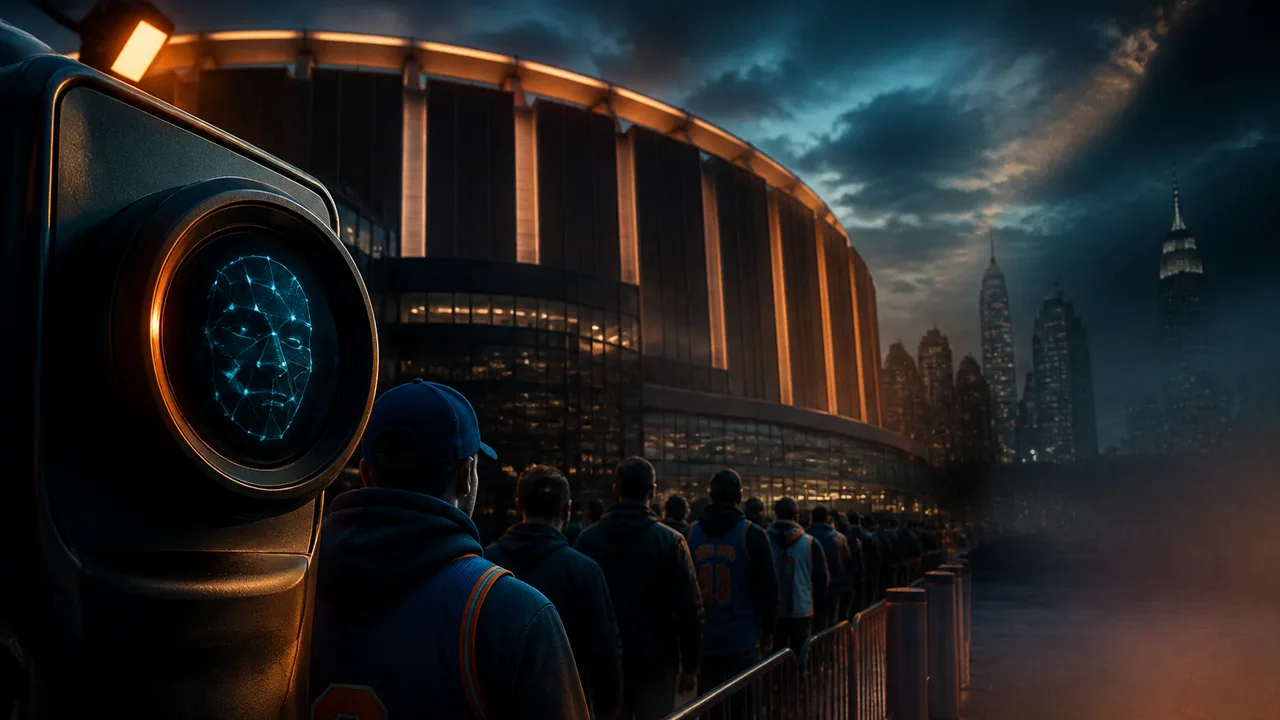
Madison Square Garden can sell a ticket to a Knicks game, scan it at the door and still face a separate question: Should the arena also be allowed to scan the ticket holder’s face? New York City Council member Shahana Hanif is pressing a proposed “Ban the Scan” bill that puts facial recognition at the Garden inside a citywide debate over biometric screening. Mayor Zohran Mamdani supports the effort, while the measure’s final language and timetable remain unsettled.
The Garden gives the argument a conspicuous address. It hosts professional sports and entertainment in a city where a rule written for privately operated venues could affect how thousands of people enter an arena on a single night. New York City lawmakers are pushing restrictions on scanning at MSG, and Mamdani has criticized the Garden’s owner over its surveillance technology. The policy question extends beyond this building: how much discretion should an operator have to identify people at the gate when the gate is also the entrance to a major public-facing event?
The Ticket and the Face
A ticket tells an arena that someone has permission to enter under its terms of sale. Facial recognition adds an attempt to identify the person carrying it. That can be useful if an operator needs to enforce an exclusion or find someone it considers a security risk. It can also turn a routine entrance into a checkpoint governed by a list the customer may never see.
Those functions require separate scrutiny. An arena could use a camera to compare faces against a limited watchlist, or it could build a broader record of people coming through its doors. Those are different practices with different privacy consequences. A useful city rule would need to say which conduct it covers: capturing an image, generating a biometric identifier, matching against a database, retaining data, sharing it, or using a match to refuse admission. “Ban the scan” is a clear slogan. An arena needs instructions for what its staff may do when a camera flags a face five minutes before tipoff.
The Garden’s use of facial recognition has attracted attention well beyond sports; the practice at the venue has been examined. At a sports arena, the concern is especially easy to grasp. Fans arrive with tickets bought days or months earlier, often alongside children or guests. A disputed match at the entrance leaves little time to resolve who made the decision, what information produced it or whether anyone can override it.
An erroneous match is one possibility. An accurate match can produce a dispute, too, if the underlying exclusion is outdated or contested. Accuracy answers whether the system identified a person correctly; it does not answer whether the operator should have kept that person on a list or denied entry. A policy built only around better software would leave the second question with the venue.
The Security Case Deserves a Hearing
Arena operators have a legitimate reason to know when someone barred for threatening conduct tries to return. Large events compress the work of checking tickets, directing crowds and responding to incidents into a short window. A face-matching tool might help security staff identify someone they are already looking for before that person reaches a crowded concourse.
The strongest case for the tool is narrow: a defined threat, a limited list, a process for checking matches and a way to correct mistakes. The public case for broader scanning would require broader evidence. What problem is it solving? How often does it identify the right person? What happens after a match? Without answers, “security” can cover anything from a targeted search to an operator’s preference for knowing who is in the building.
Restrictions also have operational costs. If a venue cannot use facial recognition to enforce exclusions, it may need to rely more heavily on staff at entrances, other identification checks or different security procedures. Those alternatives cost money and can create their own friction. A city evaluating a ban should ask operators what work the technology performs now and whether a less intrusive method can perform it. Operators, in turn, should be expected to distinguish a security requirement from a convenient management tool.
That inquiry cannot end with the person at the turnstile. Employees may have to act on a machine-generated alert while a line builds behind the customer. Clear instructions about review and escalation protect staff as well as patrons. A system that delivers a decision without a reason asks a gate worker to defend a policy they did not write.
Who Controls the Gate?
The sports-business angle starts with control. A venue operator buys or contracts for technology, sets entry policies and bears some of the costs when those policies change. Fans buy access to an event, but the operator controls the last few feet between the street and the seat. A biometric match increases the information available to the party already holding that leverage.
If New York restricts scanning, operators could face costs for changing software, retraining staff and establishing other ways to handle exclusions. If the city instead permits limited use with oversight, operators might have to document their practices, review matches and manage deletion or complaints. The size of those costs depends on the rule the council writes. No credible per-ticket figure follows from the proposal alone, and there is no basis to convert this debate into a claimed hit to team revenue.
Nor does a venue’s technology bill settle the public question. A company may reasonably count compliance as an expense; a ticket holder may reasonably count biometric collection as a cost of attending. Those costs fall on different people and do not appear on the same ledger. The city’s job is to decide which uses justify imposing them.
A workable framework would also address the handoff between an arena and the businesses around it. Teams, promoters, ticketing companies, security contractors and the venue operator can all have roles in getting someone through the door. The council should specify who is responsible for a biometric decision and whom a rejected customer can contact. Otherwise, accountability can move between companies faster than a fan can move through the line.
Consent needs similar precision. Buying a ticket may show that a customer accepted entry conditions, but an arena is a poor place to negotiate them: the customer has already paid, traveled and arrived for an event at a fixed time. If scanning is a condition of admission, a notice alone does not give a fan a practical way to decline and still see the game. If an alternative entry method is allowed, operators need to explain how it works and whether it imposes a different burden on the people who choose it.
What the Council Has to Decide
The next legislative steps will reveal whether New York aims to prohibit facial recognition at venues, allow exceptions for defined security purposes or regulate how operators collect and use biometric data. Each choice answers a different question. A prohibition limits the tool itself. An exception puts pressure on the definition of a security threat. Oversight leaves the tool in place but requires rules about its use and consequences.
The Garden is an effective test because its entrance makes the policy tangible. The same face can belong to a season-ticket holder, an employee, a performer’s guest or someone an operator has chosen to exclude. A city rule should make clear who can be scanned, who can challenge a match and who has the authority to say no at the door. On game night, that authority is worth more than a slogan.
More Like This

Stephen A. Smith Tests Sports Media's Political Reach
Stephen A. Smith's 2028 speculation shows how sports media can convert recurring attention into political capital, while creating new risks for ESPN and its audience.

Rays Stadium, US Open Records and Prediction Markets
The Rays finally got their votes. The US Open set a prize record. And prediction markets got a legal gut-punch. Here's what it all means financially.

How an MLB Lockout Could Expand the Bananas' Market
A possible MLB lockout could give the Savannah Bananas more attention, venue leverage and ticket demand, while testing whether fans stay after MLB returns.

NFL Plans Heightened Security for Saints-Steelers in Paris
The NFL plans extra security for the Saints-Steelers game in Paris amid unrest. Here is what the decision means for fans, local authorities and event costs.
Saints-Steelers Paris Game Set to Proceed Amid Protests
The Saints and Steelers remain set to play in Paris after Saturday protests. The NFL's plans raise questions about security, costs and host-city obligations.
OpenAI Drops Data Center NDAs After Voter Backlash
OpenAI says it will stop using NDAs with public officials on future data center sites after election backlash. What changes for communities weighing AI projects?

US Open's $108M Prize Fund and the Cost of Staying No. 1
The US Open's record $108M prize pool and $800M renovation bet reveal how tennis's richest major is spending to stay dominant—and who's picking up the tab.

Main Street Sports Sues Comcast and Charter Over Fees
Main Street Sports Group is suing Comcast and Charter over unpaid RSN licensing fees—a lawsuit that exposes the financial fault lines in sports broadcasting.