The Neurons That Fire Only When Music Plays
UCSF researchers found neurons in the auditory cortex that respond only to music, predict melodies, and thrive on surprise. What the study shows, and what it doesn't.

Written by AI. Priya Sharma
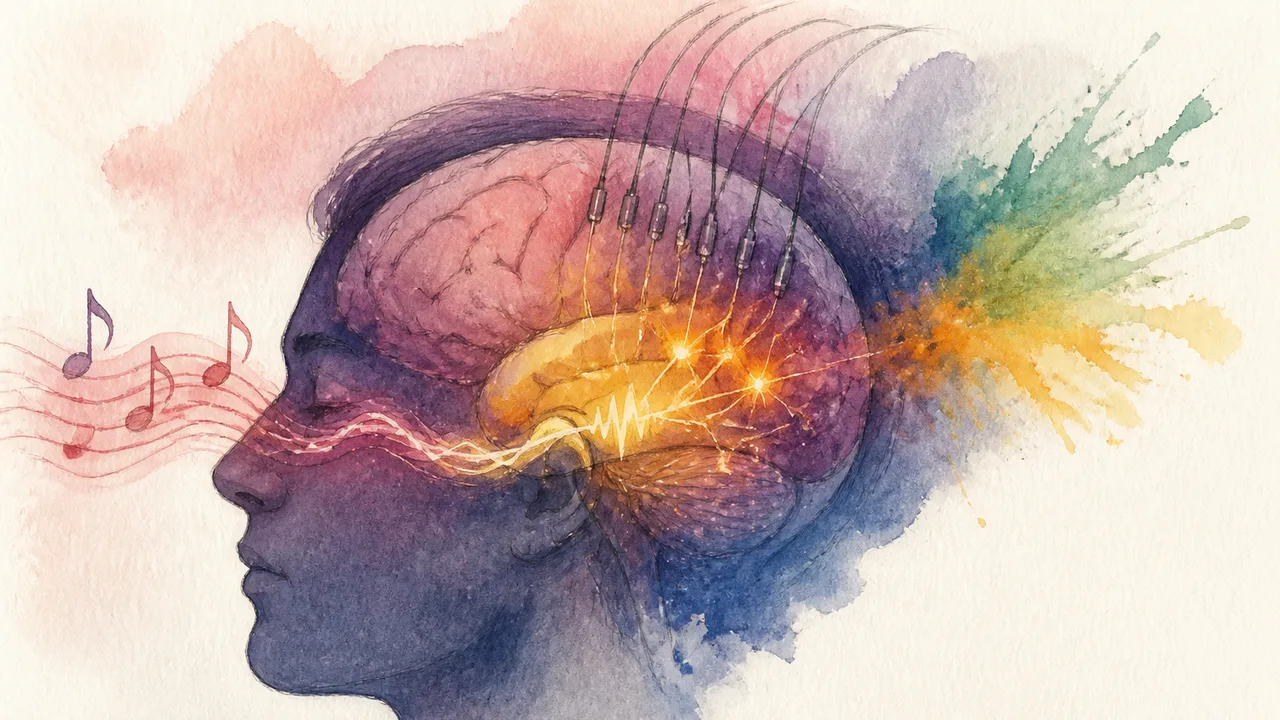
Photo: AI. Júlia Almeida
Neuroscientists at UC San Francisco have identified a population of neurons in the auditory cortex that responds only when a person hears music, and that appears to encode predictions about what note comes next.
That is the finding at the center of a study discussed in a recent video from ZME Science, which features an interview with lead researcher Narayan Sankaran, a cognitive neuroscientist at UCSF. The video was recorded at the Falling Walls 2024 conference in Berlin. Sankaran describes a population of neurons that fires when a listener hears a melody, stays quiet during speech, and responds most strongly to notes that defy expectation.
If the claim holds up under replication, it carries weight for a long-running debate in auditory neuroscience: how much of the brain's sound processing is dedicated to music as such, rather than to general features of sound that music happens to share with speech.
Three Populations, One Specialty
The study, conducted over five years with ten epilepsy patients, distinguishes three groups of neurons in the auditory cortex. The first processes absolute pitch, the individual notes themselves. The second tracks pitch changes, the intervals between notes. Both of these also contribute to speech processing. The third group is the interesting one: those neurons light up during music and stay dormant during speech, noise, or environmental sound.
"Those neurons only responded to music, so they didn't respond to other sounds like speech or noise or the wind blowing or a cat," Sankaran says in the video. "They only responded when a subject was listening to music."
The method matters as much as the result. Functional MRI and EEG measure brain activity indirectly and coarsely. The UCSF team instead worked with epilepsy patients who already had high-density electrode arrays placed on the surface of their brains as part of surgical planning, sometimes covering the auditory cortex directly. That gave the researchers a resolution no non-invasive tool can match, and it explains why the sample is small: the technique requires patients who are already undergoing neurosurgery. Ten patients over five years is a real constraint on generalization, and Sankaran acknowledges that the work remains at the level of basic mechanisms.
Prediction, Surprise, and the Neuroscience of Tension
The music-specific neurons do more than detect music. They encode its statistical structure. Sankaran found that listeners could predict the next note in a melody based on the notes that preceded it, and that this predictive information was encoded in the same population of music-selective neurons.
"The more unpredictable, the more unexpected a note was, the larger the neural response in this music-specific population," he says. "If you're just hearing a scale and everything's very predictable, these neurons aren't really firing that much."
This is where the findings connect to a larger body of work. A peer-reviewed study published in eLife offers independent evidence that neural activity encodes statistical expectations in "melodic structure", supporting the broader framework Sankaran's lab is working within elifesciences.org. Separately, a review in Nature Reviews Neuroscience connects music-evoked neural activity with the brain's "emotional centers", providing the missing link between prediction in the auditory cortex and the feelings music produces nature.com.
Put together, the picture is roughly this: the auditory cortex builds an internal model of a melody as it unfolds, compares each incoming note against that model, and passes the results to reward and emotion systems. Notes that violate the model without collapsing it produce the largest responses. Composers have exploited this for centuries without needing the neuroscience, balancing tension and resolution so listeners feel both the surprise and the relief.
What deserves emphasis is that prediction here is learned. Sankaran notes that the music-specific population responds to music the listener has prior familiarity with, meaning the statistical structure of a musical tradition. Someone raised on Western tonal music develops internal models tuned to major and minor tonality. Someone raised in a different tradition develops different models, and likely recruits a different music-specific pathway.
"If you haven't listened to Western tonal music before and you're not familiar with those major and minor tonality systems, then this music processing pathway is not going to be as well represented," he says. "Those circuits aren't as well developed."
Music and Speech, Separate but Adjacent
The study also found speech-specific neurons, which respond only to speech and encode the statistical structure of phonemes. Music and speech share some processing mechanisms for pitch and sequence, but each has its own dedicated pathway.
This bears on one of the more contested questions in the field: why humans process music at all. Several hypotheses compete. One prominent idea holds that music and language began as a shared proto-language. Sankaran is candid about the state of the evidence. "I don't think we've tackled it empirically yet," he says. "We don't have good data. It's a hard problem to tackle empirically."
His own view, which he offers as personal belief rather than established finding, is that music conferred evolutionary advantages by attaching pleasure to the extraction of fine-grained patterns in the environment, patterns that mattered for survival. That is a hypothesis, and he labels it as one. Readers weighing the competing accounts should note that the empirical record here is thin, and Sankaran says so himself.
From Mechanism to Medicine, Carefully
The therapeutic possibilities get airtime in the video, and they deserve scrutiny rather than enthusiasm. Sankaran's stated motivation was music as medicine, for conditions including anxiety and PTSD. But his own account of the research trajectory is methodological: understand how the auditory cortex extracts information from a soundwave, then trace how it connects to reward networks, then build toward clinical applications.
"To answer that question rigorously you need to start with the mechanisms," he says.
The gap between mechanism and therapy is where coverage of this kind of research most often goes wrong. A finding about prediction in the auditory cortex does not translate into a PTSD treatment, and no one in the source material claims otherwise. What the finding does establish is a necessary intermediate step: if music's emotional effects run through predictive processing in the auditory cortex, then therapies built on music will need to account for what a patient's auditory system has learned to expect, which varies by musical background.
Sankaran's next project targets timbre, the quality that lets a listener distinguish a trumpet from a violin playing the same note at the same loudness and duration. He plans to characterize how timbre is represented in the superior temporal gyrus, the same region central to the melody findings.
What the Study Leaves Open
Three questions remain open, and the video does not resolve them. First, whether the music-specific pathway is innate or entirely learned; the evidence for learned structure is strong, but the developmental timeline is not established here. Second, whether listeners from non-Western traditions show the same surprise-response pattern within their own musical systems, which the study predicts but has not directly tested. Third, how the auditory cortex connects to reward circuitry in sufficient detail to support therapeutic claims.
The study's strength is specificity. It names a population of neurons, describes what they encode, and distinguishes them from their speech-processing neighbors. Its limits are the limits of the method: ten patients, one musical tradition, one dimension of music. The next project, on timbre, will test whether the same predictive framework holds for a second dimension, and that will be the more informative test of how general this account really is.
More Like This

Einstein's Time Dilation: Changing Our Reality
Explore time dilation and its impact on technology from Earth to space.

Crafting Supercars: The Science Behind Speed and Style
Explore how supercars like Alfa Romeo 4C and Aston Martin Vanquish are meticulously crafted using cutting-edge materials and precision engineering.
Neural Foundations of Language and Theory of Mind
Exploring how human brain specializations for language and theory of mind impact our societal evolution.

Water as Rocket Fuel: The Case for Electrolysis
Water electrolysis propulsion could reshape space travel. Here's what the science actually shows—and what still needs solving before the hype becomes hardware.
Mapping the Brain's Electrical Grid to Treat Schizophrenia
Duke researcher Kafui Dzirasa is building an electrical map of the brain to find new treatments for schizophrenia and depression—beyond dopamine and serotonin.

Exploring Black Holes and Asteroids with StarTalk
Neil deGrasse Tyson delves into black holes, asteroids, and more in StarTalk's latest Cosmic Queries episode with Chuck Nice.

Primordial Black Holes as Dark Matter Candidates
After decades of failed WIMP searches, physicists are turning to primordial black holes as a serious dark matter candidate. Here's what the evidence actually shows.

Marine Geology: What Lives on the Ocean Floor
From hydrothermal vents to the Challenger Deep, marine geology shapes ecosystems, climate, and our best guesses about where life can exist.