How the Nest Thermostat Launched the Smart Home Era
Tony Fadell's Nest Learning Thermostat didn't just fix an ugly device—it sparked the smart home era. A look at what it got right, wrong, and what Google killed.

Written by AI. Dev Kapoor
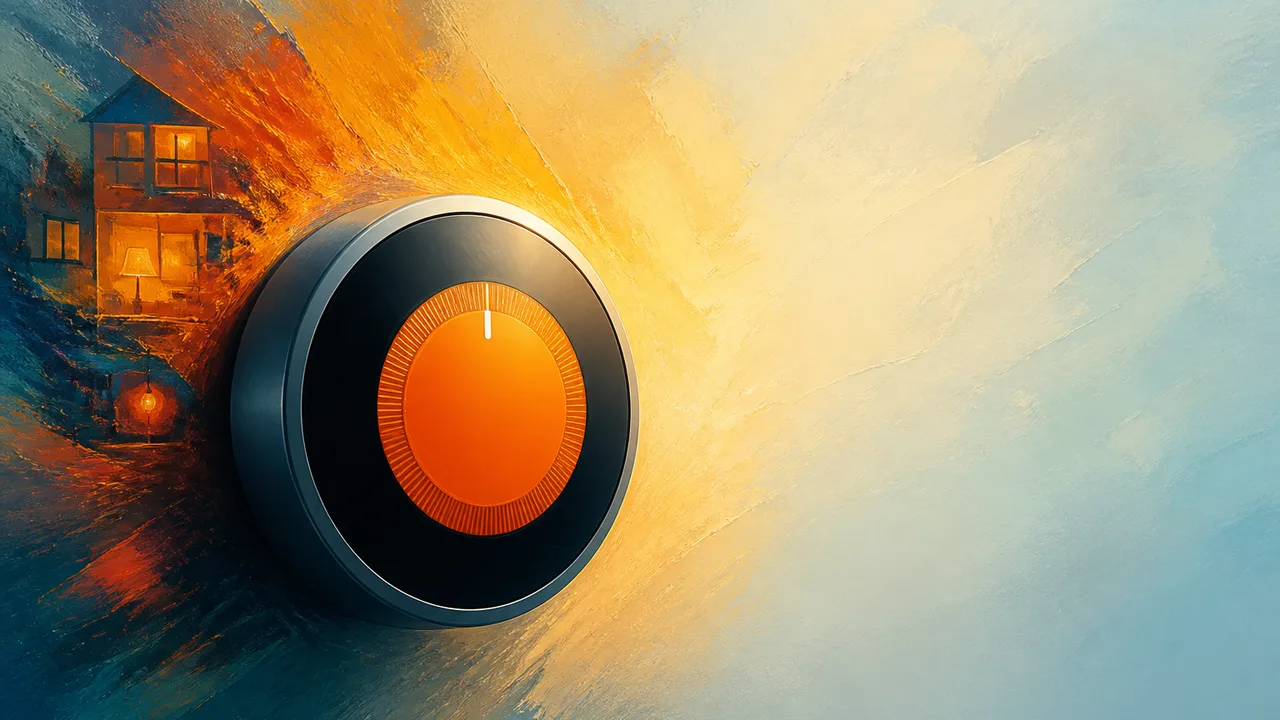
Photo: AI. Yuna Blackwood
The thermostat on your wall right now is, in all likelihood, a design philosophy from the Eisenhower administration. Beige. Plastic. Inscrutable. The kind of object you interact with exactly twice a year—once when it gets cold and once when it gets hot—and spend neither occasion feeling good about.
That's the world Tony Fadell, one of the principal architects of the iPod and iPhone, decided to fix in 2008. And the full story of what happened next, covered in a recent episode of Version History featuring David Pierce, Nilay Patel, and Jennifer Pattison Tuohy, is simultaneously a story about great product thinking, a study in the limits of automation promises, and a cautionary tale about what happens when a focused startup gets swallowed by a platform company with too many competing priorities and not enough patience to finish ideas.
The Founding Myth (and What's Actually True)
Every successful startup eventually gets its creation myth polished into a keynote slide, and Nest is no exception. Fadell has told several versions of his thermostat epiphany over the years—hotel rooms with bad thermostats on his world travels, the general frustration of the unloved home gadget. Patel, who has covered the story since the very beginning, is gently skeptical of the travelogue version: "I don't really believe any of that. But okay, Tony."
The more grounded origin involves Fadell building an expensive green home at Lake Tahoe and discovering that his $15,000 geothermal heating system was controlled by a $350 thermostat that, in his words, "had technology literally from the '80s inside." The cognitive dissonance of premium infrastructure paired with garbage interface is real, even if the romantic version involves more world travel than it probably did.
His co-founder Matt Rogers came at it differently—Rogers wanted to fix the entire smart home from the jump. Fadell's discipline was in pulling him back to a single, winnable product. As Patel put it: "I can make a product with a beginning, a middle, and an end—that's very Tony. And you don't have to know about my other plans. This product will make you want me to have other plans." That's essentially the Apple playbook transcribed to a new product category: solve one thing so well that the next thing sells itself.
The thermostat also had a structural advantage the team recognized early. As Patel observes, thermostats had become an "accidental standard"—not because anyone planned it, but because the industry was too lazy to diverge. Every house had more or less the same wiring, the same voltage, the same physical mounting situation. Nest could ride that standard rather than fight it.
The Object Itself
On October 1st, 2011, the Nest Learning Thermostat went on sale for $249. The press called it "the iPod of thermostats," a comparison Fadell reportedly hated—he didn't want it to look like a thermostat at all—but that nonetheless captured something true about the object.
Tuohy's description of the hardware is worth sitting with: a heavy, round, stainless-steel-ringed hockey puck with a color display that showed orange when heating and blue when cooling. It used a physical dial rather than a touchscreen (a choice that aged extremely well; every smart home touchscreen eventually becomes an unresponsive grief machine). The display showed big, readable numbers. The information architecture of the thing told you, at a glance, what was happening in your house. That's a design achievement that sounds simple and is actually quite hard.
There was also a screwdriver in the box. This is the detail that I find most revealing. Nest's user research showed that half the time people spent installing the thermostat was spent finding the tools to install it. So instead of just building a thermostat, they built a thermostat plus a small, beautiful, multi-head screwdriver that looked more like a design object than a hardware-store afterthought. Ring eventually copied this. The copy was worse. The Nest screwdriver became a beloved household object—people still use them for everything. Google stopped including it. That tells you almost everything you need to know about what changed.
The Promises, and the Reckoning
Nest's core pitch had two pillars: the device would learn your schedule and save you money. Both of these turned out to be more complicated than the marketing implied.
The learning feature, in the early days, was a black box. You didn't know what it was doing, you had limited ability to override it, and the schedule interface actively discouraged you from trying—Tuohy describes the Nest schedule UI as "torches and spikes." The home-and-away detection was tied initially to a single phone, which meant that if one household member left, the system could decide nobody was home and start aggressively shutting things down. For a startup that had hired a MacArthur Fellow to run its AI division, the lived experience of the learning features was often less "genius machine understanding your life" and more "thermostat is being a little controlling about this."
The money savings claim was also walked back. Nest launched claiming 20% savings on heating and cooling bills. Studies eventually put the real figure at roughly 10-12% on heating and up to 15% on cooling. What's genuinely interesting about that number, though, is that the Department of Energy calculates you'd save about the same amount just by properly programming a standard programmable thermostat. The actual innovation, then, wasn't that the AI was smarter—it was that more than half of people with programmable thermostats had never bothered to program them. Nest solved the adoption problem, not the intelligence problem. That's still a real thing to solve. It's just a different story.
Honeywell, Patents, and the Best Thing That Could Have Happened
Almost immediately after launch, Honeywell sued Nest for patent infringement. The lawsuit dragged on until 2016. Nest's response, essentially: "Your patents are nonsense. You patented all this technology and never built any of it."
What makes this lawsuit interesting isn't the legal particulars—it's the market dynamics it revealed. Honeywell had a monopoly so comfortable that they had no real reason to ship innovations they'd patented. Nest arrives, takes a sliver of market share, and the dormant IP gets weaponized. Patel's read is that Nest actually welcomed this: being sued by the industry's dominant incumbent is a form of market validation that money can't buy. By the time the suit settled, Nest was a Google company and the urgency to fight to the bitter end had apparently dissipated—though one suspects Fadell personally would have argued thermostat patents in open court until the building closed.
The Google Problem
In 2013, Google acquired Nest for $3.2 billion. This is where the story becomes instructive in a way that extends well beyond thermostats.
Patel's assessment is not subtle: "Google just ruined this company." The diagnosis from inside Nest (via smart home reviewer Tuohy, who spoke with early team members) is that the acquisition brought Nest into a corporate environment full of competing internal projects with no cross-pollination, culture clash at every level, and a general inability to finish ideas. The product roadmap, according to people who were there, "started to fall off the cliff."
There's also the small detail that Google, during the acquisition period, apparently floated the idea of putting ads on the Nest thermostat. This is mentioned almost as a punchline in the Version History discussion, which is the correct way to treat it.
The ideas that made Nest distinctive—the complete, considered product, the thing in the box that anticipates your needs, the hardware that feels like it deserves a place on your wall—those things don't survive culture clash. Google had, and has, plenty of access to good ideas. What it struggled to provide was the discipline to turn a good idea into a finished thing and leave it alone long enough to matter.
Fadell has written about this extensively in his book Build, which Patel describes as "half really smart management advice and half just absolutely dunking on Google's culture"—and apparently you can't tell which you're getting until you turn the page.
What It Left Behind
The Nest Learning Thermostat received software updates from its 2011 launch until 2025. Fourteen years is an extraordinary support commitment for a consumer hardware product, and whether that's adequate or impressive probably depends on your priors about what companies owe their customers. The first-generation device still works without internet connectivity, which was a deliberate design decision—and one that Google, to its credit, didn't undo.
What Nest did that no one had done quite so cleanly before was demonstrate that the smart home could start somewhere specific, somewhere useful, somewhere with a clear before-and-after. Not the TV, not the light switch, not some grand unified theory of connected living. A thermostat. Unloved, ugly, controlling one of the most expensive systems in your home. "It could have been the smart home center," Tuohy observes, "it ended up just being a really good thermostat."
Whether that's a failure or a success depends on what you thought you were building. If you were Tony Fadell, trying to fix one broken thing at a time, that's a win. If you were a platform company that paid $3.2 billion expecting a beachhead into the connected home, it's a more complicated accounting.
The honest question hanging over this whole story is whether the vision Fadell and Rogers had—the thermostat as first domino in a genuinely integrated smart home—was ever really achievable, or whether the problem of making your house smart was always going to be harder than making your thermostat smart. More than a decade later, with Alexa and Google Home and Apple HomeKit all still fighting for the living room, the answer looks more like "harder" than anyone wanted to admit in 2011.
More Like This
When Hackers Build Cameras That Freeze Reality
A maker built a custom camera rig that makes spinning saw blades appear motionless. The technical choices reveal what consumer cameras hide from us.
How Google's VP Builds Products at Billion-User Scale
Robby Stein reveals the metrics and methods behind Google's AI Mode launch, from 500 testers to 75 million users. Lessons from Instagram apply at scale.
The macOS TCP Bug That Detonates at 49 Days
A uint32 cast in macOS's TCP clock code means any Mac left running past 49 days hits a networking wall. Here's exactly how it breaks—and why it matters.
Apple TV and HomePod Mini Refresh Tied to Siri Overhaul
Apple is reportedly set to refresh Apple TV 4K and HomePod mini in 2025, with new chips and a next-gen Siri at the center of its smart home strategy.

They Turned Down $550K. Here's What That Actually Cost.
GigaML's Varun Vummadi turned down a $550K job to build an AI startup. The real story isn't the money — it's what the pivot taught him about finding what customers actually pay for.
Bridging the Gap: C++ Workshop Tackles Industry Reality
Amir Kirsh's workshop addresses the persistent divide between academic C++ and production code—and questions whether one-day training can solve it.

An RL Agent for ETL Pipeline Self-Healing
Anna Marie Benzon's RL-guided ETL pipeline agent cuts mean recovery time to ~5 minutes—but its real insight is knowing when not to act automatically.

When Small AI Models Beat Frontier Ones on Your Tasks
RL Nabors walks through a real eval framework for replacing frontier model calls with local SLMs—and the results are more nuanced than the pitch suggests.