NASA's MAX POWER Expo Brings Airshow Back to Kennedy
NASA's MAX POWER expo lands at Kennedy Space Center on November 7–8, 2026, blending an airshow with aerospace tech displays and public access to the Shuttle Landing Facility.

Written by AI. Nadia Marchetti
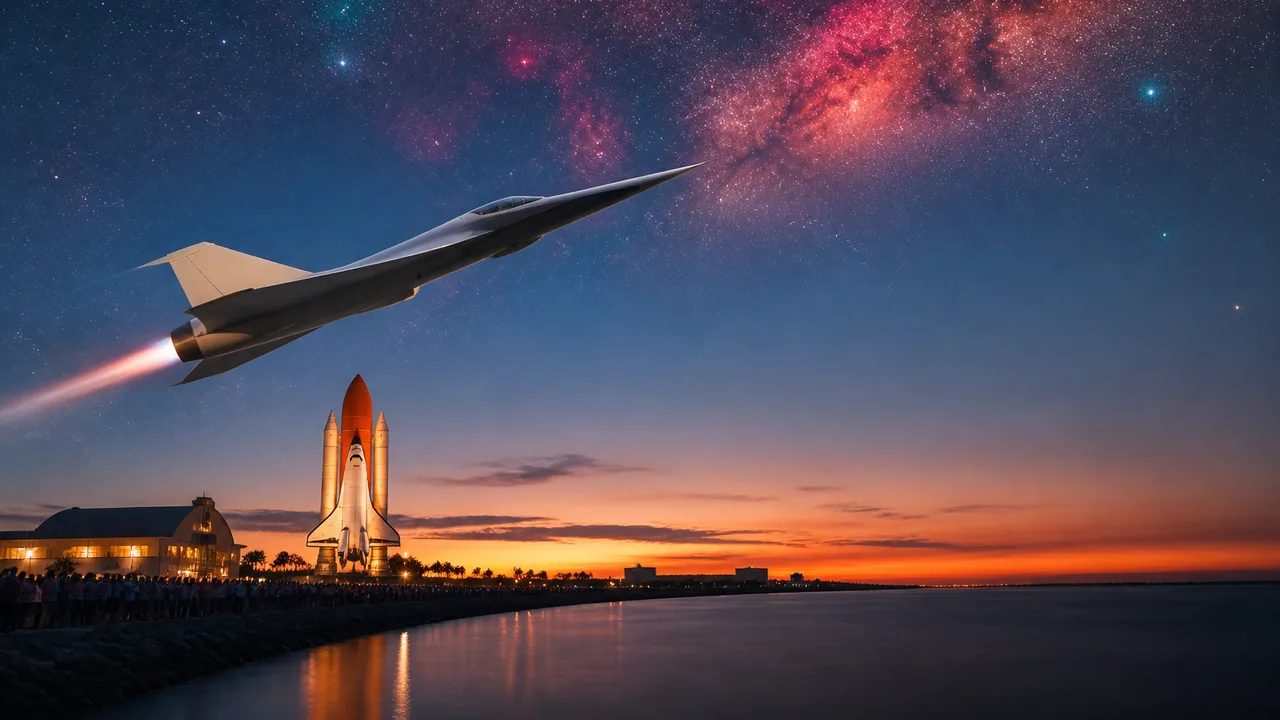
There is a certain kind of confidence required to name a federal agency's public outreach event MAX POWER — all caps, no apology — and invite the world to "strap yourself in and feel the Gs." It's the confidence of an institution that knows it's sitting on genuinely spectacular hardware and has decided, perhaps correctly, that earnest spectacle beats careful understatement.
That's the bet NASA is making with its newest event: MAX POWER, a two-day aerospace expo and airshow scheduled for November 7–8, 2026, at Kennedy Space Center in Florida. According to NASA's official announcement, the agency is billing it as "America's newest and most exciting aerospace technology expo and airshow" — a description that is either a bold claim or simply accurate, depending on how you weigh the competition.
The hook is the venue. As collectSPACE reports, this will mark only the fourth time in Kennedy Space Center's history that it has hosted a public airshow on its grounds. The site in question is the Shuttle Landing Facility — the 15,000-foot concrete runway where space shuttles once rolled to a stop after returning from orbit. It's one of the longest runways in the world, built to accommodate spacecraft traveling at 220 miles per hour with no second chances at landing. Turning it into a public event ground is not a small logistical decision, and the choice communicates something: NASA wants this to feel consequential, not merely promotional.
What's Actually on Display
The featured technology draw, per Space.com, is NASA's X-59 quiet supersonic aircraft — a needle-nosed experimental plane that flew for the first time on March 20, 2026. The X-59 is the centerpiece of NASA's Quesst mission, designed to crack one of commercial aviation's most stubborn problems: the sonic boom. Conventional supersonic flight over land has been banned in the United States since 1973 precisely because the boom is intolerable to people on the ground. The X-59 is engineered to reduce that boom to something closer to a distant thump — what NASA researchers call a "sonic thud." If it works as intended, it could eventually reopen the regulatory door to supersonic passenger travel over American soil.
Having the X-59 at MAX POWER isn't just a crowd-pleaser. It's a demonstration that NASA's aeronautics research — often overshadowed in public imagination by rocket launches and Mars missions — is doing work with direct civilian implications. The plane's appearance at a public event this early in its flight history suggests the agency is eager to build a constituency for the program before the inevitable political budget debates arrive.
Beyond the X-59, NASA's event page describes MAX POWER as a celebration of "flight and space exploration," with an aerospace technology expo alongside the airshow component. Florida Today confirms the event will include public activities alongside the tech displays. The specific roster of exhibitors, additional aircraft, and keynote speakers hasn't been fully detailed in the sources available — that information, where it exists, lives in announcements still to come.
The Optics of "MAX POWER"
It would be easy to dismiss the name as a marketing gimmick — a reference to "The Simpsons" character that doubles as aerospace machismo, designed to go viral in an attention economy that rewards the loudest signal. And maybe that's exactly what it is. But the name also does something useful: it signals that this event is not a dry symposium for credentialed insiders. The target audience is broader than that.
NASA has been navigating an interesting tension for years. On one side: the agency's traditional constituency of scientists, engineers, policy wonks, and the genuinely space-obsessed. On the other: a general public whose attention the agency needs but can't take for granted, especially as private aerospace companies like SpaceX have mastered the art of spectacle-as-substance. Rocket landings livestreamed to millions, starships exploding in controlled fashion over the Gulf — the commercial sector has, whatever else you think of it, figured out how to make aerospace feel immediate and participatory.
MAX POWER looks like NASA's attempt to meet that moment without surrendering its identity. The Shuttle Landing Facility is not a neutral backdrop — it's a site freighted with history, a place where American spaceflight literally touched down. Bringing the public onto that ground, within sight of actual NASA aircraft, is a different kind of engagement than a museum exhibit or a press release. Whether the execution matches the ambition is something only November will confirm.
Kennedy's Rare Public History
The collectSPACE reporting on this being only the fourth public airshow at Kennedy Space Center is worth sitting with for a moment. Kennedy is a working launch facility — not a theme park, not a fairground. Its security perimeter, its operational demands, and its sheer physical scale (the property covers roughly 140,000 acres) make mass public access genuinely complicated. That NASA is choosing to do this now, and choosing to do it at the Shuttle Landing Facility specifically, suggests a deliberate calculation about what this moment requires.
That calculation almost certainly involves the broader political and budgetary environment. NASA's budget is perennially contested in Congress, and public enthusiasm is one of the few reliable levers the agency has when those debates happen. Events like MAX POWER don't just build goodwill in the abstract — they create constituents. The kid who sees the X-59 fly over the Shuttle Landing Facility in November 2026 is the adult who calls their senator about NASA funding in 2036. That's not cynicism; it's how science advocacy has always worked.
WESH quotes the NASA Administrator using the phrase "American air and space innovation" — language that does political work as well as descriptive work, positioning the event in the broader context of aerospace competition and national capability. The framing is deliberate, and it's worth noting without necessarily endorsing it as the whole story.
What We Don't Yet Know
The sources are clear on the what and the when. They're thin on the texture of the event itself — pricing, ticketing logistics, the full exhibitor list, whether the public can get up close to the X-59 or only watch it from a distance. NASA's event page exists but appears to be building out as the November dates approach. Given that the announcement dropped in mid-August 2026, details are still arriving.
What's also genuinely unknown is how MAX POWER fits into NASA's longer-term public engagement strategy. Is this a one-off, or the beginning of a recurring event series? The "America's newest" framing in NASA's official release implies ambition beyond a single edition — but one announcement doesn't make a series.
The X-59 flew for the first time just five months before this event. Watching a technology that was still theoretical not long ago make its public airshow debut at one of the most historically significant airstrips on Earth — at an event called MAX POWER, no less — is either the best possible advertisement for what aerospace can do, or an extraordinarily well-timed coincidence.
Probably both, if we're being honest.
More Like This
SpaceX Starship Flight 13 Aborts at Launch
SpaceX's Starship Flight 13 aborted at the last second when engines failed to ignite. What the scrub reveals about iterative testing, redundancy, and real stakes.
Starlink Satellites Are Now Scanning Earth's Atmosphere
Kyoto University researchers repurposed 1,200 Starlink satellites as an accidental atmospheric scanner. Here's what that means for science—and who controls it.

The Most Sensitive Dark Matter Detector Might Find Nothing
LUX-ZEPLIN sits a kilometer underground, waiting for dark matter. But success might look like silence—and that would tell us something huge.

Heavy Spoilers Builds an Office, Ditches the Algorithm
YouTube creator Paul from Heavy Spoilers explains why he built a garden office, changed his logo, and chose depth over views in content strategy.
NASA's Moon Base Landers Are Being Built Right Now
NASA's August 2026 moon base update shows real hardware in real facilities — five companies, four landers, and a plan requiring 20+ lunar landings to pull off.
Why NASA Is Finally Returning to Venus After 40 Years
After decades of neglect, Venus is getting two NASA missions. Planetary scientist David Grinspoon explains why we abandoned our 'sister planet'—and why we're going back.

Avi Loeb on Methane, Microbes, and Interstellar Objects
Avi Loeb tells Brian Keating that JWST methane data from 3I/ATLAS is puzzling enough to warrant a microbe hypothesis—and explains why a dark comet might be Soviet.

Pluto's Planet Status Debate, Explained
A 10-year-old's letter to NASA reignited Pluto's planet debate. Here's what the science actually says—and why the answer is messier than you'd expect.