Minisforum MS-03 Review: A Worthy MS-01 Successor?
The Minisforum MS-03 brings triple 10GbE, PCIe 5.0 NVMe, and a power-efficient Intel Core Ultra 9 to the home lab. Here's what the trade-offs actually look like.

Written by AI. Tyler Nakamura
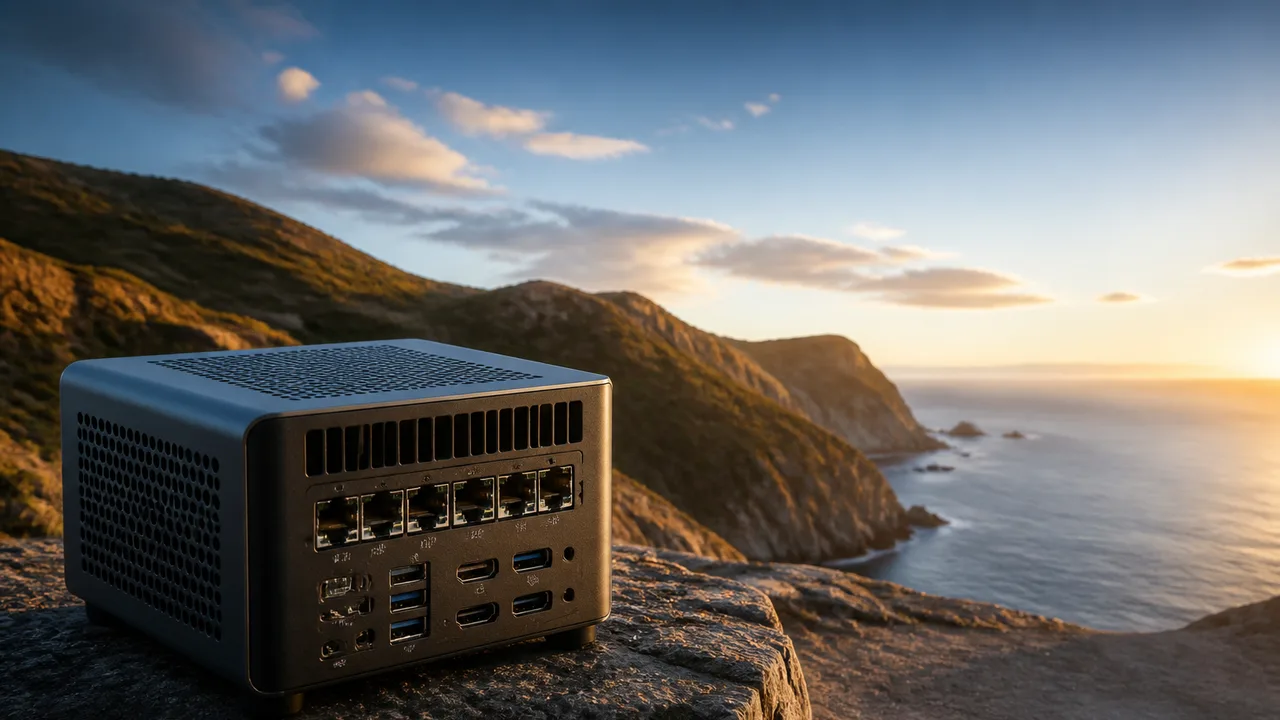
Photo: AI. Asha Kingsley
There's a specific kind of frustration that home lab people know well: you want real server capabilities — 10GbE networking, multiple NVMe slots, PCIe expansion — but you don't want a rack-mount unit that sounds like a jet engine and doubles your electricity bill. The Minisforum MS-01 carved out a niche by solving exactly that problem in a tiny box, and it developed a genuine following among Proxmox enthusiasts who built multi-node clusters out of them.
Now there's the MS-03, and the obvious question is whether it deserves to inherit that reputation or just coast on it.
VirtualizationHowto's reviewer, who built a five-node MS-01 Proxmox cluster and knows these machines intimately, put the MS-03 through its paces. The review unit was provided by Minisforum, though the reviewer is clear that the company had no editorial input. What follows is a look at what the testing actually revealed — including where the MS-03 earns its upgrade tag, and where the fine print matters.
The processor story is mostly good news
The MS-03 runs on Intel's Core Ultra 9 386H, part of the Core Ultra Series 3 family (previously known by the Panther Lake codename). It's a 16-core, 16-thread chip — and that last part is worth pausing on. Unlike the Core i9-13900H in the MS-01, the 386H doesn't use hyperthreading. You get 16 physical cores and 16 threads, full stop. Whether that's a meaningful trade-off depends on your workloads, but it's a notable architectural difference from the previous generation.
According to the reviewer's benchmark comparisons, the newer chip is roughly 24% faster than the Core i9-13900H. But the more interesting number is on the power side. The MS-01 systems were pulling around 120 watts at full CPU load. The MS-03? The reviewer measured approximately 75.9 watts at the wall under full load — without disabling boost frequencies.
"That is an absolutely insane improvement when you consider that we're also getting 24% more CPU performance," the reviewer notes.
At idle, with minimal network connections active, the MS-03 dropped to just over 13 watts. For a machine you're planning to run continuously, those numbers compound quickly across a multi-node cluster.
Minisforum allows the processor to operate in a "quiet mode" as well, trading some performance headroom for lower power draw and noise — something the reviewer flags as genuinely useful for always-on home lab use, where chasing peak benchmark scores isn't the point.
Networking: three 10GbE connections in a mini PC
This is where the MS-03 actually expands on what the MS-01 offered, rather than just refreshing it. The machine ships with two Intel X710 10GbE SFP+ interfaces — the same controllers that earned praise in the MS-01 for rock-solid Linux stability — plus a Realtek RTL8127 10GbE RJ45 port and an Intel i226-LM 2.5GbE interface.
That's three 10-gigabit connections and one 2.5-gigabit connection in a box you could fit in a backpack. The reviewer installed Proxmox and confirmed all four interfaces were recognized without any configuration issues.
The practical implications are interesting. You could dedicate the 2.5GbE port to Proxmox management traffic, use one SFP+ interface for VM traffic, the second for storage or live migration, and still have the 10GbE copper port free for backups or NAS connectivity. That's a flexibility level that used to require purpose-built server hardware.
The one flag worth noting: the Realtek-based 10GbE port is new to this platform, and the reviewer wants to see how it holds up under sustained Linux and Proxmox workloads over time. The Intel X710s have a long track record in this community; the Realtek controller is an unknown quantity for now.
Storage: two great slots, one asterisk
Three M.2 NVMe slots sounds like a clean win, and the first two genuinely are — they run at PCIe 5.0 x4, which is about as fast as consumer NVMe storage gets right now. The third slot is where you need to read the fine print: it's PCIe 4.0, but running at x1 speed. That's a significant bandwidth constraint compared to the first two slots.
The reviewer is pragmatic about it: "I don't think that it's going to make that third slot absolutely useless. If you use it the right way, I could see using the first two PCIe 5.0 drives for something like my primary VM storage and then use that third NVMe slot for something like ISOs, container templates, backups, logs."
That's sensible, but it does mean you can't simply install three identical drives and expect uniform performance — especially relevant if you're considering a ZFS configuration that assumes balanced storage across all drives.
The U.2 support carries over from the MS-01, with Minisforum including an M.2-to-U.2 adapter in the box. That's a meaningful inclusion for anyone who wants to use enterprise NVMe drives rather than consumer M.2 SSDs.
The PCIe expansion slot: a genuine regression
Here's a tension the review surfaces directly, and it's worth taking seriously. The MS-03 has a physical PCIe x16 slot, but it operates electrically at PCIe 4.0 x4. The MS-01's expansion slot ran at PCIe 4.0 x8 — twice the bandwidth available to add-in cards.
The reviewer acknowledges they personally don't use the expansion slot in their own setup, and that PCIe 4.0 x4 still covers most home lab use cases: network adapters, HBAs, storage controllers, accelerator cards. But if you were planning to push higher-bandwidth cards through that slot, the MS-03 is a step backward from its predecessor on this specific metric.
Physical constraints apply too — cards must be half-height, single-slot, and within specific dimensions. That was true of the MS-01 as well, but it's a continued limitation for anyone eyeing more capable GPU options.
For a different take on what aggressive PCIe expansion looks like in a mini PC form factor, the MS-02 Ultra goes considerably further — three PCIe slots and 62.5Gbps networking — though that's a different product category and price bracket entirely.
Cooling and noise: context-dependent
Fan behavior on the MS-03 is more reactive than the MS-01, according to the reviewer. Under sustained CPU load, the fans become clearly audible. At idle and under light workloads, the machine is effectively silent.
"Under normal workloads, I can't really hear it," the reviewer says, while noting that sustained benchmarking is a different story. The reviewer plans to experiment with BIOS power settings to find a quieter equilibrium — quiet mode being the obvious starting point.
For an always-on home lab server that isn't being pegged at full utilization constantly, this probably isn't a deal-breaker. For a machine on your desk in a quiet room where you occasionally throw heavy workloads at it, the fan ramp behavior is something to factor in.
The $999 question
The barebones MS-03 with the Core Ultra 9 386H is listed at around $999 at time of review. Memory and NVMe drives are extra, and DDR5 pricing means a fully-loaded node isn't cheap.
The reviewer frames this clearly: "At this price point, you have to decide whether you actually need the combination of 10 gig networking, PCIe expansion, multiple NVMe slots, vPro, and the newer processor. If all you need is a small box to run a few containers or lightweight VMs, there are much cheaper options out there."
That's the right frame. The MS-03 isn't competing with $300 mini PCs. It's competing with the idea of buying used rack servers or purpose-built virtualization hardware — and on that comparison, the value proposition looks considerably stronger. The power efficiency argument alone changes the long-term cost calculus for a cluster running continuously.
The reviewer's conclusion, for their specific use case: yes, if rebuilding from scratch today, they'd probably choose the MS-03 over the MS-01. The power and performance improvements are substantial enough to justify it, with the networking and storage upgrades rounding out the case.
The compromises — the x1 third NVMe slot, the halved PCIe expansion bandwidth, the unproven Realtek 10GbE controller — are real, but none of them are likely to be blockers for the audience this machine is built for.
What will matter most, as always, is whether the use case actually demands what the MS-03 brings to the table. For lightweight VM hosting, this is overkill with a $999 price tag. For a compact, power-efficient Proxmox cluster that punches well above its size class, the argument is considerably harder to dismiss.
More Like This

Google Pays $250K for 16-Year-Old Linux KVM Flaw
A 16-year-old Linux KVM flaw called Januscape earned a $250K bounty after enabling guest VM escapes on Intel and AMD systems. Here's what it means for cloud security.

Tiny Server, Big Potential: Beelink ME Pro Review
Explore the Beelink ME Pro, a compact storage server with modular design and surprising capabilities for data backup and media streaming.
ZimaCube 2 Pro Review: Great NAS, Brutal Market
The ZimaCube 2 Pro is a genuinely impressive NAS — 10GbE, PCIe slots, Thunderbolt. Too bad the storage market has other plans for your wallet.

This Tool Treats Your Home Lab Like Infrastructure Code
RackPeek documents home labs as YAML code in Git. Brandon Lee shows how this infrastructure-as-code approach beats static diagrams and spreadsheets.

30 Self-Hosted GitHub Projects Trending Right Now
From media automation to AI chat apps, here are 30 trending self-hosted GitHub projects that put you back in control of your data and infrastructure.
Minisforum N5 Max Review: NAS Meets AI Workstation
The Minisforum N5 Max stuffs a five-bay NAS, AMD Ryzen AI Max+ 395, and dual 10GbE into one box. Here's what that actually means in practice.

Meta Puts Ray-Ban Smart Glasses Behind a Paywall
Meta is rate-limiting its Ray-Ban smart glasses AI features and charging $20/month for extended use. Here's what that actually means for buyers.
Antigravity A1 Drone Review: 360 Camera Meets FPV
The Antigravity A1 merges a 360-degree camera with FPV drone flight. Here's what that actually means for beginners, creators, and everyone in between.