Middle-earth's Switch 2 Return Is a Catalog Revival
The Middle-earth Shadow Bundle brings Monolith's Nemesis games to Switch 2, with missing online modes, preorder savings and unanswered port questions.

Written by AI. Sarah O'Brien
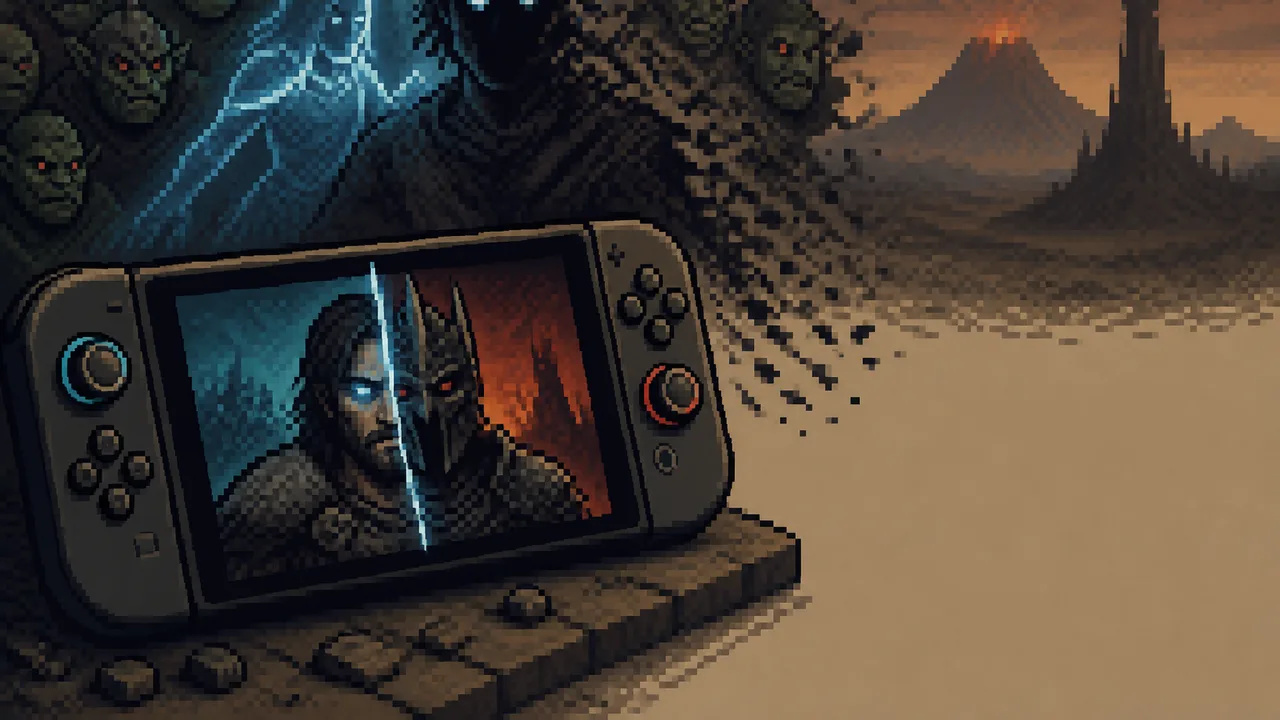
Aspyr will bring Middle-earth: Shadow of Mordor and Middle-earth: Shadow of War to Nintendo hardware for the first time on September 30, 2026.
The surprise Switch 2 release is easy to read as a comeback. Both games return with their major expansions, and the Nemesis System gets another platform on which to manufacture grudges between players and remarkably persistent Orcs. Yet Monolith Productions, the studio that created the games, closed in 2025. Aspyr is handling these ports, and nothing in the announcement establishes that Warner Bros. plans to continue the series.
The evidence supports a narrower reading: Warner Bros. has opened two catalog titles on a new platform. That still has value, especially for Nintendo players who missed them, but it sets different expectations from a franchise revival.
What Switch 2 Owners Are Getting
The Middle-earth: Shadow Bundle includes Shadow of Mordor Game of the Year Edition and Shadow of War Definitive Edition. Both games can also be purchased separately. Kotaku verified the eShop listings, which appeared before Aspyr released its announcement trailer.
Shadow of Mordor costs $19.99, while Shadow of War costs $49.99. The bundle costs $69.99. Before launch, the individual games are discounted to $9.99 and $24.99, with the bundle at $34.99. Buying the discounted games separately totals $34.98, so the bundle supplies convenience rather than a further saving. All three offers rise to their standard prices at launch.
The editions are substantial. Shadow of Mordor includes the Lord of the Hunt and Bright Lord story missions, additional Warband missions, runes and skins. Shadow of War includes the Desolation of Mordor and Blade of Galadriel story expansions, the Slaughter and Outlaw Tribe expansions, and the Sword of Dominion weapon.
That content suits the Nemesis System because it works through accumulated encounters. Orcs can survive fights, remember Talion, acquire strengths or fears, rise through military ranks and eventually become allies. Shadow of War expands those relationships into armies and fortress assaults. This systemic design benefits from time and repetition; it was always more interesting than another checklist of towers and collectibles.
The Switch 2 edition also arrives with a conspicuous subtraction. According to the published feature listing, Shadow of War moves its Garrison offline, allowing undeployed Orc followers to travel between regions without a network connection. Online Conquests, Vendettas, Fight Pits, Chests and Training Orders are unavailable.
For preservation, that is a trade rather than a clean victory. Moving the Garrison offline reduces dependence on a remote service and leaves one more function usable without a publisher maintaining servers. Removing the other modes produces a more self-contained edition, but it also means Switch 2 receives an incomplete record of how Shadow of War once operated. A game can become more durable while losing part of its history. Digital preservation is full of these slightly grubby bargains.
Twelve Years Changed the Meaning of the Release
Shadow of Mordor originally launched on September 30, 2014. Its Switch 2 version therefore arrives exactly 12 years later, while the 2017 sequel reaches Nintendo in 2026. Previous editions appeared on PC, Xbox and PlayStation, but neither game had reached a Nintendo platform.
The first game established the Nemesis System as the series identity. Its authored story concerned Talion and Celebrimbor, but the stories players repeated usually involved an Orc who escaped, returned with scars, killed Talion at an inconvenient moment and acquired a title grander than his competence. Those generated rivalries gave individual campaigns their own petty workplace politics, except management settled performance reviews with axes.
Shadow of War enlarged that machinery and also acquired historical baggage. Its launch became associated with monetization and online systems; later patches removed the monetization elements. The Definitive Edition consequently represents a later state of the game, after one of its most criticized design layers had been taken out. New Switch 2 players are receiving the expanded version, although the missing network modes make it a further revision rather than a frozen copy of either the 2017 launch build or the complete later service.
Monolith’s closure changes how this release should be interpreted. Game Rant notes that the studio closed in 2025, leaving the future of both the Shadow series and its defining system uncertain. Aspyr can adapt the existing games, but a port provides no evidence that the original development team, series or design lineage has returned.
That gap between surviving work and vanished institutional knowledge is familiar in preservation. Source code and commercial rights can remain under corporate control while the people who understood why hundreds of interlocking systems behaved as they did disperse. The Switch 2 ports extend access to the finished games. They cannot preserve Monolith as a working creative organization.
Aspyr’s Closest Precedent Calls for Patience
Aspyr recently brought another licensed Middle-earth game back through The Lord of the Rings: War in the North Legacy Edition. It offers the most relevant comparison because the same porting company handled another older game from the same licensed universe for Switch hardware.
The result was uneven. Nintendo Life says its review of War in the North Legacy Edition awarded it 5/10, praising its combat and presentation while criticizing repetitive design, bugs and glitches. That record supplies a sensible reason to wait for testing of the Shadow ports, particularly because the announcement materials do not establish their frame rate, resolution or stability.
The comparison has limits. War in the North is a different game built on different technology, and one troubled port cannot predict the condition of two later Monolith titles. Aspyr also has experience moving older catalog games to modern platforms. The precedent prevents the company name from serving as a substitute for performance evidence.
Reviews should answer several practical questions: whether frame pacing holds during fortress assaults, how quickly the games load, whether handheld play compromises image quality, and how the reorganized offline systems affect progression. Until independent testing supplies those answers, the 50 percent preorder reduction asks buyers to exchange certainty for price.
Access Has Expanded, Though Only on One New Platform
The announcement has also prompted requests for current PlayStation versions. Push Square observed disappointed responses from PS5 owners and notes that the PS4 editions remain capped at 30 frames per second when played through backward compatibility. Comment sections cannot measure market demand, but they do show that Nintendo owners are not the only players interested in refreshed access.
The present release remains a Switch 2 project. Warner Bros. and Aspyr have announced no other versions, and the existence of one port does not establish that more will follow. Licensed games often depend on agreements invisible to players, making a seemingly obvious rerelease more complicated than recompiling some code and dusting off the box art.
The purchase case rests on the single-player Nemesis campaigns, the major expansions and an offline Garrison. The old online modes are absent, while Aspyr’s recent Middle-earth work gives cautious buyers ample reason to wait for performance testing. That makes the preorder discount a price on uncertainty, not a verdict on port quality.
The Middle-earth: Shadow Bundle gives Monolith’s work another route to players, which is useful preservation through access. It also demonstrates how much can go missing between an original release and its return: network functions, launch context, and the studio that knew how the machinery was built.
More Like This
What Minecraft 26.2 Removes and What You Can Keep
Minecraft 26.2 nerfs duplication glitches, fixes broken villager trades, and closes mob exploits. Here's what changes and what carries over.
WoW Midnight's Economy and the Memory Stored in Icons
A WoW streamer's gold-making stream revealed something unexpected: twenty years of item iconography living as folk knowledge inside a player community.