Mexico's Interoceanic Corridor: Trade Route or Troubled Bet?
Mexico's $5 billion Interoceanic Corridor promises a rail alternative to the Panama Canal. The costs, in land and lives, are already mounting.

Written by AI. Raj Mehta
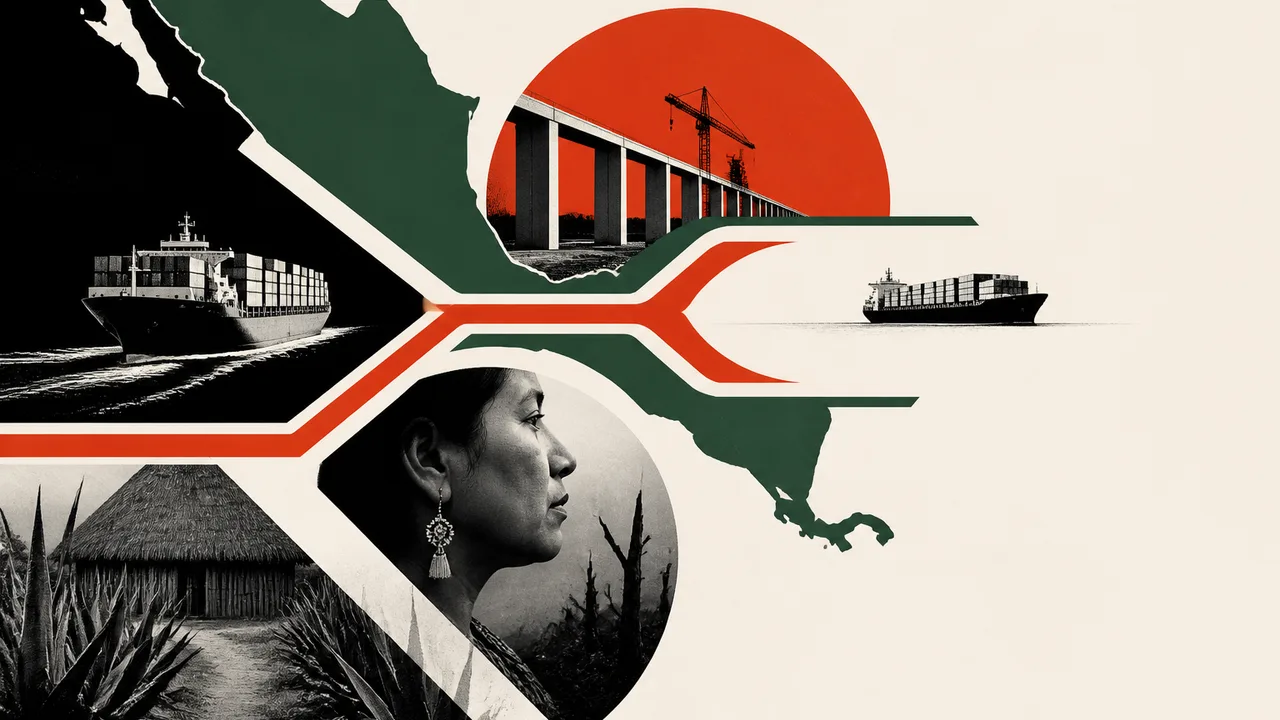
Photo: AI. Ondine Ferretti
In 1882, Ferdinand de Lesseps stood in front of investors and told them his French company would cut a canal through Panama. The pitch was confident. The engineering was catastrophic. Around 20,000 workers died. The company went bankrupt. The canal that eventually opened in 1914 was an American project built on French wreckage.
That history sits visibly in the background of Mexico's Interoceanic Corridor of the Isthmus of Tehuantepec, a $5 billion infrastructure program that aims to move cargo by rail across the narrowest strip of Mexican land, connecting the port of Coatzacoalcos on the Gulf of Mexico with Salina Cruz on the Pacific. The pitch, in its broadest form, is that shippers who currently route through the Panama Canal might find a faster, cheaper land-based alternative here. Whether that pitch survives contact with engineering, ecology, and the people who already live on this land is the question worth considering.
The Corridor's Logic
The case for the project is not frivolous. In 2023, a severe drought caused water levels in the Panama Canal to fall sharply, forcing transit restrictions that delayed vessels by up to 20 days and cost shipping companies millions of dollars in rescheduled cargo. The vulnerability of a single water-dependent chokepoint to climate variability is now a documented supply-chain risk, not a hypothetical one.
The Isthmus of Tehuantepec offers a geographic answer to that problem. At roughly 186 miles long and relatively flat compared to the mountainous terrain surrounding it, the isthmus has attracted the attention of every major colonial and commercial power that ever tried to control trans-oceanic trade. Hernan Cortes wrote to Holy Roman Emperor Charles V in the 16th century urging that the two seas "separated by only a narrow strip of land" be united. It took five centuries, but the Mexican government has finally moved on that idea at scale.
Former President Andres Manuel Lopez Obrador inaugurated what the project terms Line Z of the interoceanic railway on December 22, 2023. The route connects Coatzacoalcos and Salina Cruz across a distance of approximately 309 kilometers and forms part of a wider three-line network. Port dredging, digital logistics infrastructure, and automated customs processing round out the modernization program. Project leaders claim the corridor will handle freight traffic of up to a million containers annually once fully operational, according to Interesting Engineering's reporting on the project.
Special economic zones layered along the corridor are intended to attract manufacturing and logistics investment to a part of southern Mexico that has long been bypassed by both domestic industry and foreign capital. As Ecoticias notes, officials present the corridor as "a modern dry canal that can rival the historic Panama Canal and help keep global trade moving even when water runs short." The logic is coherent. Whether the execution can match it is another matter entirely.
What the Infrastructure Actually Involves
It helps to be specific about what "rivaling the Panama Canal" actually means in operational terms, because the comparison requires some translation. The Panama Canal moves ships. The Tehuantepec corridor moves cargo. Ships dock, containers are offloaded, trains carry them across the isthmus, and the containers are reloaded onto ships at the other end. Every transfer adds time, cost, and complexity. The corridor's proponents argue that, for certain cargo types and trade routes, the math still works out favorably. Critics note that transshipment corridors have repeatedly underperformed projections in other parts of the world.
The corridor's real competition may not be the Panama Canal directly but rather the broader reorganization of global supply chains that nearshoring to Mexico has accelerated. If manufacturing investment follows the special economic zones, the corridor becomes something different from a transshipment route: a domestic logistics backbone connecting new industrial clusters to global markets. That version of the project has a more straightforward economic rationale. It also has a more complex political one.
The Costs That Don't Appear in Project Budgets
The Isthmus of Tehuantepec is home to tropical rainforests, mangroves, jaguars, ocelots, and a range of endangered flora and fauna. Construction at this scale brings deforestation, habitat fragmentation, and the kind of fossil-fuel-intensive machinery that degrades air, water, and soil quality in ways that outlast the construction phase. The Mexican government has proposed wildlife corridors and reforestation programs as mitigation. Environmental groups have been less than persuaded.
Slipmaps.com's analysis of the corridor notes that "environmental concerns, land disputes, and the need for substantial investment could slow progress," even while acknowledging strong government backing. That is a polite way of describing a genuine conflict of values that no infrastructure timeline resolves.
The human dimension is more acute still. The isthmus is home to several indigenous communities, including the Zapotec, the Mixe, the Ikoot, and the Chontal peoples, each with distinct languages, governance structures, and multigenerational relationships to the land that the corridor cuts through. These communities have organized protests and legal challenges against what they describe as the expropriation of communal land without adequate consultation.
The response from Mexican authorities has included the deployment of the National Guard near protest sites. Fifty-five isthmus residents are facing criminal charges related to their resistance activities, according to the Interesting Engineering video. And the situation has turned fatal: Zapotec activist Noel Lopez Juarez, a member of the Mixe civil resistance movement, was found dead in July 2023. The cause of death recorded in medical records was a blow to the head. No official determination of criminal responsibility has been made, but Lopez Juarez had been previously targeted for his opposition to land expropriation connected to the corridor project.
These are not footnotes to the infrastructure story. They are part of it. Projects of this scale in the Global South have a long and consistent record of promising economic transformation to the region while concentrating the costs on the people least positioned to absorb them.
The Question of Who Decides What Success Looks Like
Project leaders have said the corridor will do "everything the Panama Canal can do cheaper and faster." That is a large claim, and it rests on a set of assumptions about private investment, shipping company uptake, and geopolitical stability that are genuinely uncertain. The corridor's completion timeline has already faced pressure from legal battles and financing questions. Whether it ultimately attracts the freight volumes needed to justify its capital cost remains an open question, not a settled one.
What is settled is that the Isthmus of Tehuantepec has been a site of contested visions for five centuries. Cortes wanted it. France wanted it. The United States mapped it. And now Mexico's federal government is building on it, over the objections of the people whose ancestors were already there when Cortes was writing letters to emperors.
The corridor may well become a functioning trade route. It may reduce Panama Canal dependency during drought years. It may draw investment to a historically underdeveloped region. All of that is possible. But the communities currently facing criminal prosecution for defending their land will not experience those outcomes as unambiguous progress, and their account of what is happening here deserves at least as much weight as the logistics projections.
The real question is not whether Mexico can build a railway across 186 miles of isthmus. It clearly can. The question is what kind of development model gets built into the infrastructure itself, and who gets to answer that.
More Like This
Brand Authority Is Pricing Power—and Finance Knows It
Ryan Deiss's five brand "authority triggers" map onto real financial metrics. A global markets reporter translates what that actually means for valuations and beyond.

GameStop's $56B eBay Bid: What the Math Actually Says
GameStop bid $56B for eBay despite a $12B market cap. We broke down the financing—shares that don't exist, a non-binding bank letter, and a CEO incentive worth examining.

What 10 Million Cold Emails Reveal About Selling
Austin Schneider sent 10M cold emails and found 6 patterns that actually drive replies. Here's what globally-minded sellers need to know—and where the framework breaks.
Lima's Neighborhoods and the Inequality Dividing Them
A street-level look at Lima, Peru's capital, where gang-controlled districts and wealthy enclaves exist just blocks apart—and government neglect connects them both.
Suriname's $10.5B Oil Bet: New Dawn or Same Old Story?
Suriname is betting a $10.5B offshore oil project will end years of recession. Dot Williams on why the real question isn't the money—it's who's ready to catch it.
France Tests Low-Cost Rail Signalling for Rural Lines
France's NS2F consortium is trialling digital signalling tech to cut rural rail costs by 30%. Here's what's at stake for the towns trains forgot.

McDonald's Rare Footprint Across Africa, Explained
McDonald's operates in just four African countries. Corruption, cold-chain failures, and the wrong potato explain more than you'd expect.

Kevin Warsh's First FOMC Meeting Signals a Quieter Fed
Kevin Warsh held rates steady at his first FOMC meeting, but his communication overhaul and hawkish signals are already reshaping global markets.