Many 4K Blu-rays Are Upscaled From 2K Sources
Many 4K Blu-rays are upscaled from 2K digital intermediates, not true native 4K. Here's what that means for your money and whether UHD discs are still worth buying.

Written by AI. Tyler Nakamura
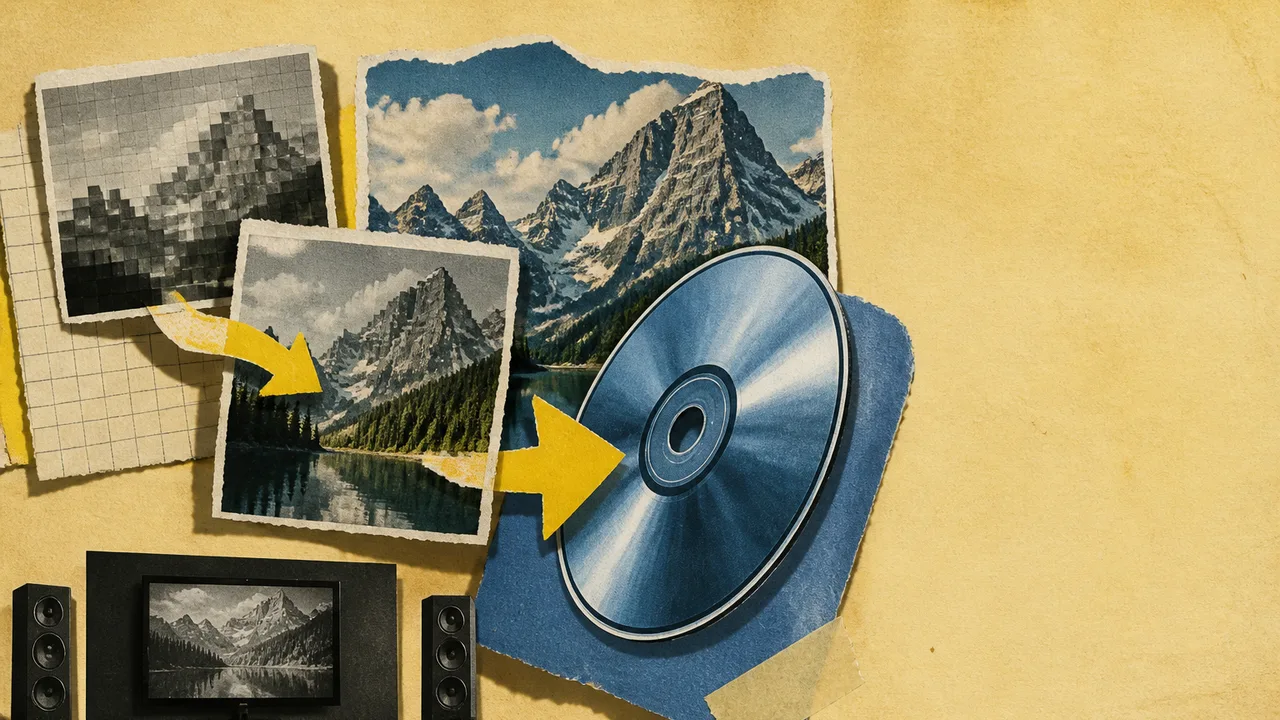
You save up, you grab the UHD edition off the shelf, you pay the premium — and somewhere in the process nobody mentioned that what's encoded on that disc started life as a 2K image.
That's the situation a lot of people are waking up to right now, and the reaction in enthusiast communities has ranged from "well, obviously" to genuine frustration. Both reactions make sense. The practice is widespread, it's technically defensible, and the industry has never been particularly eager to advertise it.
What "2K Digital Intermediate" Actually Means
When a film gets finished — color graded, effects composited, mastered — that process happens on what's called a digital intermediate, or DI. The resolution of that DI is the effective ceiling on how sharp the final image can ever look, regardless of what you slap on the packaging.
According to MakeUseOf, many production teams stuck with digital cameras that couldn't shoot in 4K, and workflows that produced 2K digital intermediates as a result. The consequence: most 4K UHD Blu-ray discs are actually encoded from those 2K sources, then upscaled to meet the UHD spec. Tracking sites like Blu-ray.com and Digiraw.com exist specifically to document which titles are native 4K and which ones aren't — which tells you something about how non-obvious this information is to most buyers.
The newer stuff is different, and that's worth saying clearly. As AV Gadgets notes, many movies are now shot with 4K UHD releases in mind, partly because most major theatrical venues shifted to digital projection years ago — theaters needed 4K anyway, and productions followed. So for recent blockbusters, native 4K is increasingly the norm. The upscaling problem is mostly a back-catalog problem: beloved films from the 2000s through the early 2010s that were finished in 2K and are now being re-released in UHD packaging at premium prices.
The Upscaling Itself Isn't the Real Problem
Here's where it gets more interesting than a simple gotcha story. The upscaling technology isn't the villain here — it's how it's been deployed.
How-To Geek reports — confirmed: no byline — that "it's not just a single button press and hey-presto, here's your 4K Star Trek. So, the technology is not fundamentally an issue, it's how it's been used to create some 4K content, especially 4K Blu-rays, that should not have passed quality control."
That's the crux of it. Done carefully — frame-by-frame attention, professional AI upscaling tools, human review — the gap between a quality 2K upscale and native 4K can be surprisingly small. The problem is when studios treat it as a cheap checkbox: run the 2K master through a quick upscale pipeline, hit the UHD spec on paper, ship it. Enthusiast communities have documented releases where the upscaling job introduced artifacts, softness, or just looked wrong next to the standard Blu-ray edition of the same film. The same title, two discs, and the cheaper one looked better. That's a quality control failure, not an inevitable outcome of the technology.
So What Are You Actually Paying For?
The most deflating realization for anyone who's gone deep on this: the thing that makes UHD discs genuinely worth the premium for a lot of people has almost nothing to do with resolution.
The thing the resolution conversation keeps stepping on is everything else those discs carry. HDR — whether Dolby Vision, HDR10+, or standard HDR10 — is doing more work on a capable display than the jump from 2K to 4K pixels. The contrast range, the highlight detail, the black levels: that's HDR. Then there's the audio. Dolby Atmos and DTS:X object-based audio on a UHD disc is carrying bitrates that streaming can't match. And compression: a disc isn't subject to the same bandwidth constraints as a stream, so you're getting a fatter, cleaner encode regardless of the source resolution.
For audiophiles, home theater builders, and people with mid-to-high-end displays, these factors are real and significant. The r/Bluray community makes this point practically: on a decent display, a true 4K UHD disc and a 4K UHD player is the right combination to extract all of that. The resolution question is just one layer of a stack.
What's harder to accept is that the marketing leads with the one thing that's sometimes the weakest part of the value proposition. "4K Ultra HD" is on the box. The Atmos logo is small. The HDR badge is tucked in a corner. If studios were selling these discs honestly, the pitch would be: best available audio, HDR that streaming can't match, and yes, sometimes native 4K but not always. That would be accurate. It would also be harder to charge a premium for.
Who Should Still Buy UHD Discs
If you're building or maintaining a real home theater setup — good display, capable AV receiver, dedicated player — UHD discs still make sense, and the upscaling issue doesn't change that calculus much. The AVS Forum perspective is pragmatic: if you're buying UHD discs, get a proper 4K UHD player; if you're not, your TV's upscaling is fine. The format still delivers things streaming doesn't.
But if you're buying specifically chasing pixel count on back-catalog titles, knowing which transfers were done with care versus which ones were rushed matters enormously. The enthusiast community has done the legwork here — Blu-ray.com's database tracks DI resolution by title, and the forums are full of side-by-side transfer comparisons. The Prometheus 4K UHD release, for instance, has been cited in enthusiast discussions as a case where viewers found the standard Blu-ray grade preferable to the UHD release's contrast handling. Before dropping premium money on an older title's UHD upgrade, five minutes in those databases is worth more than any box art claim.
The Label Problem Isn't Going Anywhere on Its Own
There's no regulatory body requiring studios to disclose DI resolution on packaging. The "4K Ultra HD" logo is a format spec administered by the Blu-ray Disc Association — it certifies that the disc meets certain technical parameters, including 3840×2160 output resolution, HDR, and wide color gamut. It does not certify that the source material was captured or finished in 4K. Those are different things, and the logo doesn't distinguish between them.
The tracking sites and community databases exist because the industry hasn't volunteered this information. That's not a conspiracy — it's just how marketing works. But it does mean the burden of research falls entirely on the buyer, which is a rough position to be in when you're standing in a store deciding whether the $30 UHD disc is worth it over the $12 standard Blu-ray.
The newer production pipeline will gradually make this less of an issue for new releases. What it won't fix is the back catalog, which is exactly where studios have the most reissues to sell and the least incentive to be specific about what you're actually getting.
More Like This
Do You Really Need an $80 HDMI Cable? Maybe Not
Tech reviewer Adam tests a premium HDMI 2.1 cable. We examine what you're actually paying for and whether most users need it.

World's Fastest Drone Reclaims Record with V4
Discover how Peregreen V4 reclaimed the world's fastest drone title with a speed of 657 km/h.

Google Pays $250K for 16-Year-Old Linux KVM Flaw
A 16-year-old Linux KVM flaw called Januscape earned a $250K bounty after enabling guest VM escapes on Intel and AMD systems. Here's what it means for cloud security.

This Tool Treats Your Home Lab Like Infrastructure Code
RackPeek documents home labs as YAML code in Git. Brandon Lee shows how this infrastructure-as-code approach beats static diagrams and spreadsheets.

30 Self-Hosted GitHub Projects Trending Right Now
From media automation to AI chat apps, here are 30 trending self-hosted GitHub projects that put you back in control of your data and infrastructure.

Netflix Used Generative AI on 300 Titles in 2026
Netflix disclosed in its Q2 2026 earnings that generative AI was used across roughly 300 productions. Here's what we know—and what's still murky.

Marina Wyss Went From $60K to $600K in 8 Years
Marina Wyss details the pay cuts, pivots, and 100+ job rejections that took her from $60K to $600K in AI—and what her creator business actually reveals.

AI Is Reshaping Services Jobs—Are You Ready?
Y Combinator thinks AI-native startups will rewrite tax, law, insurance, and healthcare. Here's what that means if you're early in your career in those fields.