Major Labels Want AI Music Off the Charts
Universal, Sony, and Warner are pushing to ban AI-generated songs from global charts. Here's what their proposal actually says — and who it really helps.

Written by AI. Tyler Nakamura
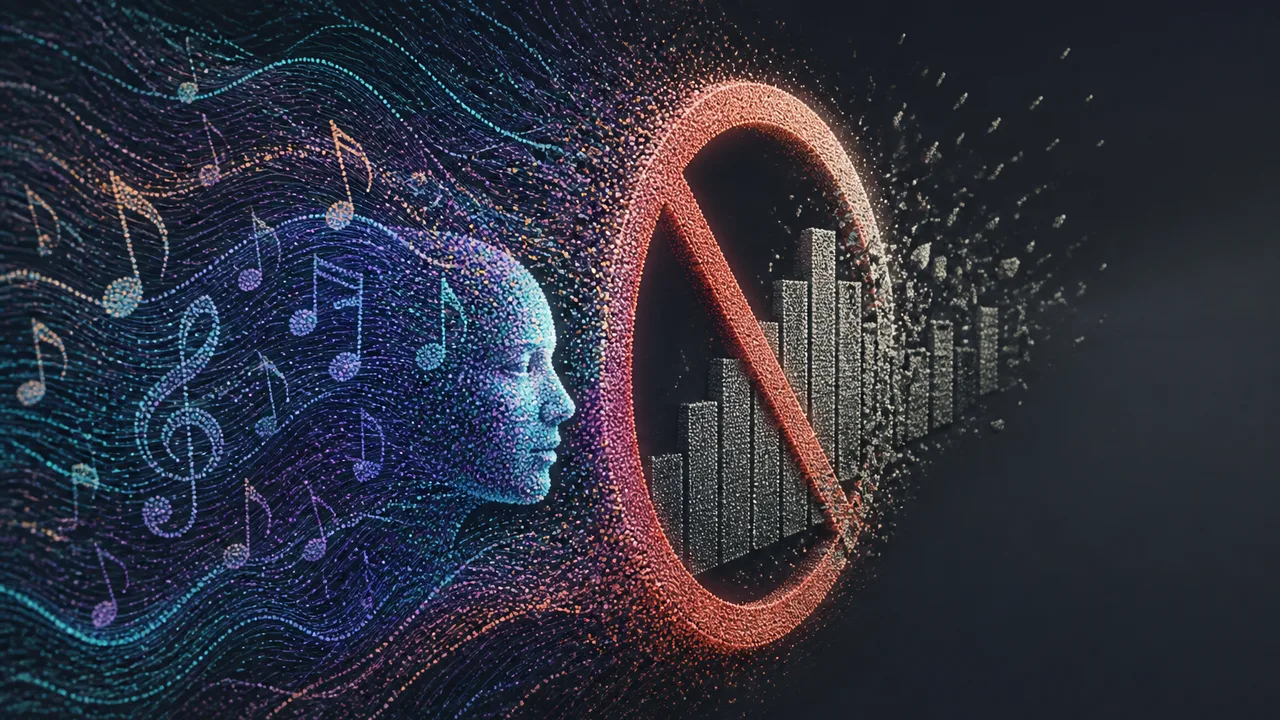
Charts are a scoreboard. And Universal Music Group, Sony Music, and Warner Music Group just proposed some very convenient new rules for who gets to play.
According to The Verge, the Big Three — alongside a coalition of major record companies — have put forward a proposal that would set chart eligibility requirements for AI-generated music globally. The ask, as Slashdot summarizes it, is that AI tracks must be "substantially human made," properly labeled, legally produced, and free from manipulation concerns. Per the Los Angeles Times, the guidelines also specify that any AI service used to create the music must be "properly authorized and lawful" and must not violate copyright law.
On the surface, sure, that sounds reasonable. Fraud is bad. Transparency is good. Nobody wants an AI slop farm gaming its way to a Billboard #1 on 300 million fake streams. I'm with them on that part.
But read it a little slower and something interesting falls out.
"Substantially human made" is doing a lot of work
That phrase — "substantially human made" — is the load-bearing wall of this whole proposal, and nobody's defined what it means yet. Does it mean a human wrote the lyrics? Sang the melody? Pushed the export button? Chose the key of G? Digital Trends notes the standard is human-created and legally made, but the threshold is conspicuously fuzzy.
That vagueness isn't neutral. Whoever gets to define "substantially" gets to decide who wins.
And the people proposing the rule? They're the ones best positioned to comply with it. Major labels have legal teams, compliance infrastructure, and the industry relationships to navigate whatever certification or verification process eventually gets built around this. An indie artist working out of their bedroom does not.
Here's where it gets real for actual creators
Let me make this concrete, because it directly affects people I watch making music online every day.
Say you're a producer who's been posting beats to SoundCloud for three years. You used Suno or Udio to sketch out a chord progression, then rebuilt it from scratch with your own samples, rewrote the melody, mixed and mastered everything yourself. Is that "substantially human made"? Genuinely unclear. Under this proposal, you'd need to figure out whether the AI service you used is "properly authorized and lawful" — language the Hollywood Reporter flags as a key condition — which in practice means knowing the legal status of every tool in your workflow. Most bedroom producers can't do that without a lawyer. Most bedroom producers don't have a lawyer.
So the proposal creates a world where a major-label artist who uses AI in a hundred undisclosed ways throughout production is probably fine (their label's legal team handles it), while an independent artist who disclosed their AI use on a track they mostly made themselves might not qualify. That's not protecting human creativity. That's protecting the pipeline that already exists.
It also creates a quiet incentive to just... not disclose. If labeling your AI use makes you ineligible, and the rule is enforced unevenly, some artists will simply stop telling anyone. That's the opposite of the transparency this proposal claims to want.
So what's actually going on here?
Look, I'm not saying the labels are acting in pure bad faith. The fraud problem is real. Engadget reports the proposal specifically targets AI tracks that raise concerns about streaming or chart manipulation — and that's a legitimate threat to the integrity of charts that human artists depend on. Chart position can influence radio play, playlist placement, and label attention. Protecting that signal from noise and fraud matters.
But it's also worth being clear-eyed: this is a business interest argument wearing an artistic integrity argument's clothing, and the fit isn't perfect.
The "properly authorized and lawful" requirement is the tell. It's not just about human creativity — it's about licensed AI use. Which means AI tools that the major labels have deals with, or approve of, would presumably check the box. AI tools that compete with those arrangements, or that emerged from scraping copyrighted music without licenses, would not. The proposal essentially encodes the majors' preferred AI ecosystem into the definition of chart-eligible music. That's a business position dressed up as a cultural one.
I'm not saying that's wrong — licensing AI training data is a conversation worth having. But it's different from preserving human artistry, and the proposal is using both arguments simultaneously without separating them.
The independent artist angle the labels aren't talking about
What's missing from this conversation entirely is the independent artist who's not a fraud, not farming streams, and just wants to know if their music counts.
The AI tools that have exploded in popularity — Suno, Udio, and their successors — are consumer products. They're in the hands of the same people who watch production tutorials on YouTube and mix tracks in their apartments. When the majors set the eligibility rules for charts, they're setting them for everyone, including people who can't hire someone to parse what "properly authorized and lawful" means for their specific use case.
The proposal's criteria around copyright compliance and legal AI services could plausibly disqualify a significant chunk of independent music made with commonly available tools — not because it's fraudulent, not because it lacks human creative input, but because the legal status of those tools is contested and nobody's resolved it yet. That's not a small thing. Independent artists don't have the infrastructure to navigate ambiguity at scale. The labels do.
If the goal is actually to protect human artists, the proposal needs a safe harbor for independent creators who disclose AI use and aren't gaming anything. Right now, there's no sign of one.
What I'd actually want to see
I'm genuinely glad someone is drawing lines around chart fraud and AI manipulation. That's overdue. But a proposal written entirely by the parties who benefit most from its ambiguity is not automatically the right line to draw.
The strongest version of this idea — the one that actually does what it claims — would define "substantially human made" with specificity, create a clear disclosure path that doesn't immediately disqualify artists who are honest about their process, and put enforcement in the hands of something genuinely independent from the labels proposing the rules.
What we have right now is a draft from people with enormous financial stakes in the outcome. The Hollywood Reporter notes these rules would apply to charts around the world — which means if this framework gets adopted, it shapes the global competitive landscape for music, not just the American one.
That's a lot of weight to put on a phrase nobody's defined yet.
"Substantially human made" is either a principled standard or a vague gate — and right now, the people holding the keys get to decide which one it is.
— Tyler Nakamura, Consumer Tech & Gadgets Correspondent, BuzzRAG
More Like This
This Tool Treats Your Home Lab Like Infrastructure Code
RackPeek documents home labs as YAML code in Git. Brandon Lee shows how this infrastructure-as-code approach beats static diagrams and spreadsheets.

AI Training Data: The Legal Vacuum No One Is Filling
AI companies built trillion-dollar products on data they never paid for. Courts are starting to push back—and Congress still hasn't shown up.

Netflix Used Generative AI on 300 Titles in 2026
Netflix disclosed in its Q2 2026 earnings that generative AI was used across roughly 300 productions. Here's what we know—and what's still murky.
30 Self-Hosted GitHub Projects Trending Right Now
From media automation to AI chat apps, here are 30 trending self-hosted GitHub projects that put you back in control of your data and infrastructure.

World's Fastest Drone Reclaims Record with V4
Discover how Peregreen V4 reclaimed the world's fastest drone title with a speed of 657 km/h.

Google Pays $250K for 16-Year-Old Linux KVM Flaw
A 16-year-old Linux KVM flaw called Januscape earned a $250K bounty after enabling guest VM escapes on Intel and AMD systems. Here's what it means for cloud security.

YouTube Creators Are Reshaping Hollywood's Talent Pipeline
Backrooms, Obsession, and The Amazing Digital Circus prove YouTubers can open movies. But Hollywood is already preparing to misunderstand why it worked.

iOS 27 AirPods Features: Custom EQ and More
iOS 27 brings custom EQ, heart rate gym sync, and precision finding to AirPods Pro 3. Here's what changed, what's still beta, and who it's actually for.