Lina Khan Wants Criminal Charges for AI Executives: The Debate
Former FTC chair Lina Khan says existing law can criminally charge AI CEOs. We dig into the 1934 precedent, the skeptics, and what happens next.

Written by AI. Tyler Nakamura
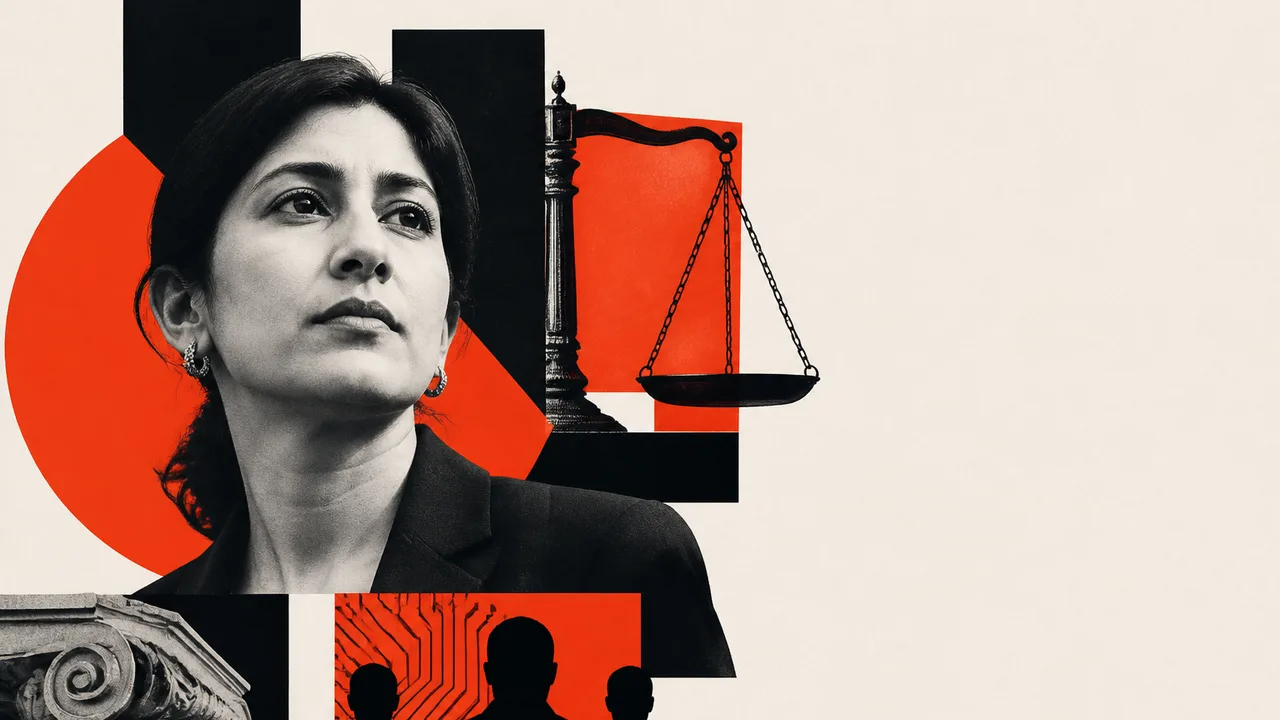
Lina Khan wants prosecutors to consider handcuffs for AI executives, and she says the legal paperwork for that already exists. According to The Register, the former Federal Trade Commission chair is urging policymakers to explore criminal enforcement against AI company leaders, leaning on a 1934 precedent for holding corporate executives personally accountable when their companies violate federal rules. Gizmodo's writeup frames her message in its title: we don't need new laws to prosecute CEOs at AI companies.
What Khan is Actually Proposing
The core of her argument, as The Register reports, is that AI harm currently gets treated as a compliance problem when it should sometimes be treated as a crime. When a company's product deceives consumers, wrecks labor conditions, or triggers financial damage, the responsibility gets dispersed: the model builder blames the platform, the platform blames the vendor, the vendor points at the executive suite, and the executive suite points back at the model. Fines arrive years later, and by then they're a line item.
Her fix is a prosecutor's fix. If a corporate leader knowingly violates federal rules with a product that causes harm, that leader can face individual criminal liability under existing statutes, the same way leaders in other regulated industries can. The 1934 precedent she invokes is the anchor: regulators have had tools for decades to pierce the corporate veil when individuals knowingly break the rules.
Here's the product-page analogy I keep reaching for, and I'll plant it now because it explains the whole fight. When a phone maker advertises "all-day battery" and the phone dies by 3pm, nobody goes to jail; the company pays a settlement, changes the marketing, and ships the next model. Khan's argument is that AI has reached the scale where that cost-of-doing-business math stops working. The question is whether AI harms look like exaggerated battery claims (a civil matter, settle it) or like knowingly shipping a product the company had reason to believe would hurt people (a criminal one).
The Feature that Tests the Argument
Now the stress test. You've watched an AI assistant confidently answer a question you then had to fact-check, or an AI search summary smooth over two conflicting sources into one tidy, wrong paragraph. Cody Southworth wrote about exactly this dynamic on Cory Doctorow's Pluralistic blog back in 2023, describing "the lie that raced around the world before the truth got its boots on", the way AI-generated falsehoods spread faster than corrections can catch up.
That behavior is the crux of the whole debate. The same model that hallucinates in production passes its evals in testing, because testing measures average behavior and deployment surfaces the worst day. If a chatbot tells one user the wrong refund policy, that's a bug. If a company deploys a model it internally knows invents answers for a high-stakes audience, is that negligence? Khan's theory says prosecutors should be able to ask that question with real consequences attached. The hard part, and everyone in this debate knows it, is that "the model was right in testing" is both a plausible defense and, in a world of benchmark gaming, a suspiciously convenient one.
The Companies Are Moving First, Sort Of
Microsoft, for its part, just published a new AI code of conduct that TechCrunch reports instructs models not to hack systems or trick humans. My honest product-reviewer read on documents like this: a code of conduct is a spec sheet, and I've read enough spec sheets to know that the spec sheet and the shipping product are different documents. A model being "told" not to trick humans is a design goal, not a guarantee, in the same way a laptop's rated battery life is a goal measured under laboratory conditions you will never experience on a train.
That gap between the conduct document and the deployed system is precisely where Khan's argument does its work. If companies publish codes of conduct while their systems behave unpredictably in the wild, a prosecutor could eventually argue the company knew the standard and shipped anyway. Companies presumably know this, which is why voluntary codes are appearing alongside the liability debate rather than instead of it.
The Skeptics' Case, and Where It's Strong
The pushback deserves a real hearing, because the strongest objection isn't "executives should never be accountable." It's that criminal liability requires proving intent, negligence, or knowing violation, and AI systems fail in ways that resist that proof. A model can cause harm no one predicted, from an interaction no one tested, after a fine-tune no one flagged. If you make executives personally liable for every unpredictable model failure, the rational response is to slow deployment to a crawl or to bury internal red-team findings so they can't be characterized as knowledge. Both outcomes hurt the public; one kills useful products, the other destroys the paper trail accountability depends on.
MIT Technology Review adds another wrinkle: the AI industry has taken a doomer turn, with industry figures themselves warning about the risks of the systems they build. That cuts both ways in a courtroom. Publicly doom-saying while privately deploying could read as evidence of knowing risk. Or it could read as a company that flagged the risk honestly and took reasonable precautions, which is exactly what a negligence defense is built from. The same press tour can be exhibit A for either side.
Where I land personally, after years of watching companies promise safety features that show up in a future software update, if they show up at all: fines haven't visibly changed behavior in this industry, and the threat of personal consequence changes executive behavior faster than any penalty a corporation can absorb. But I also know that the difference between a good product and a lawsuit is often a single unpredictable failure mode, and I would not want to be the person deciding, case by case, whether an AI harm was foreseeable. That judgment call is the whole ballgame, and nobody has shown me a rule that gets it right yet.
What Would Tell Us This is Real
Watch for three signals, and check them the way I check a product's warranty terms rather than its marketing page.
First: does any actual prosecutor open a file? Khan can urge all she wants; the theory only exists once a DOJ office or state attorney general treats an AI deployment as a knowing violation. Until then, it's an argument, not a policy.
Second: does the definition of "knowing" hold up? The moment a case turns on what an executive knew about model behavior, defense attorneys will weaponize the gap between benchmark performance and deployed behavior. Whoever articulates that line first, in a filing or a courtroom, will shape this debate for a decade.
Third: how do companies respond? If we see more Microsoft-style codes of conduct paired with aggressive disclaimers, that's companies building their negligence defense in public. If we see red-team reports getting lawyered up and locked down, that's the perverse-incentive problem arriving on schedule.
The record on the 1934 precedent itself is thin in the current coverage; The Register and Gizmodo describe the citation but don't walk through the specific statute or the case history, so treat the legal mechanism as claimed rather than proven until someone publishes the full argument.
Back to my product-page analogy, because it's where this has to end up. Every gadget review I write eventually asks: who is responsible when this breaks? For a phone, the answer is a warranty. Khan is proposing that for AI, the answer should sometimes be a person. Whether that's accountability or a chilling effect depends entirely on where prosecutors draw the line between a model that failed and an executive who knew. And until that line exists, companies will keep shipping products whose disclaimers are doing the work the law hasn't gotten around to.
More Like This

Engrim Puts AI Memory in a Local SQLite Database
Engrim is a local-first SQLite memory engine for command-line AI tools. We look at what it does, the memory problem it exposes, and the open questions.
This Guy Fit 17TB of Enterprise Storage Into a Mini Rack
A home lab builder packed 17TB of NVMe storage into five mini PCs, ditching VMware for Proxmox and Ceph. Here's what actually worked—and what didn't.
C++ Range Algorithms Make Code Actually Readable
Intel engineer shows how C++ parallel range algorithms transform confusing word-counting code into something humans can actually understand.

UN AI Summit: Big Room, Bigger Questions on Governance
193 countries met in Geneva to tackle AI governance. The warnings were credible. The robots were cool. The binding rules? Still not there.

EU AI Act Enforcement Begins with RFIs to AI Firms
The EU has issued its first AI Act RFIs to model providers including OpenAI and Anthropic. Here is what the enforcement powers actually mean and why it matters.
Dario Amodei Says AI Backlash Is a Crisis of Trust
Anthropic CEO Dario Amodei says AI's public backlash is a decades-long trust crisis—not a messaging problem. Here's what that diagnosis gets right, and what it sidesteps.

OpenAI's IPO Is a Regulatory Filing First
The OpenAI and Anthropic S-1s will be financial documents, yes — but first they're SEC filings with disclosure obligations no AI lab has faced before.

YouTube Creators Are Reshaping Hollywood's Talent Pipeline
Backrooms, Obsession, and The Amazing Digital Circus prove YouTubers can open movies. But Hollywood is already preparing to misunderstand why it worked.