LEGO Pricing Trends: What the Data Actually Shows
LEGO sets cost more than ever — but the data tells a more complicated story about piece sizes, adult collectors, and shifting product strategy.

Written by AI. Priyanka Desai
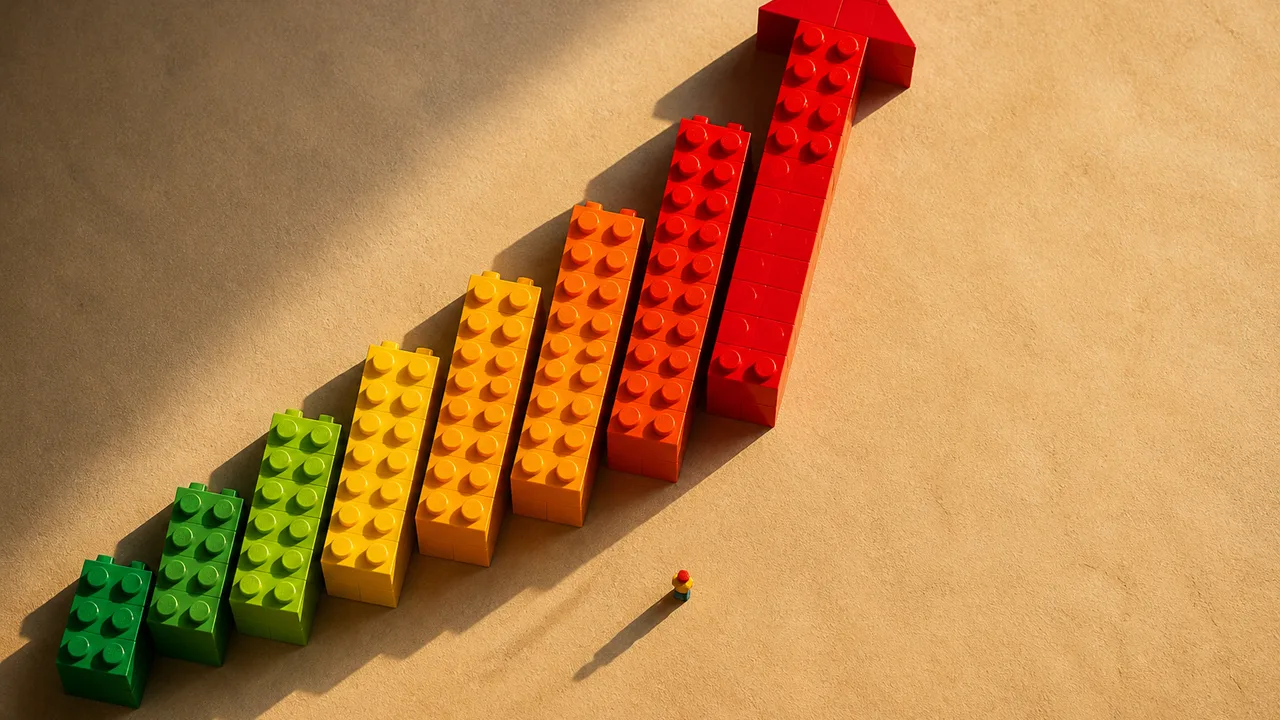
Photo: AI. Rio Sanchez
The complaint is everywhere in LEGO forums: sets cost too much, the hobby has priced out regular fans, and something has fundamentally changed. It's a grievance with real emotional weight — and it's also, depending on which numbers you look at, both correct and misleading at the same time.
SpitBrix, a YouTube channel dedicated to LEGO analysis, recently spent nearly 14 minutes stress-testing this question with actual pricing data spanning decades. The result is one of the more rigorous data breakdowns the LEGO community has seen on this topic — and the answer it arrives at is genuinely more complicated than either the outrage or the dismissal would suggest.
The numbers that seem damning
Start with the raw average price of a LEGO set over time. In 2000, that figure was $7 — averaged across all 402 sets LEGO released that year. By 2010 it had climbed to $34. By 2020, $52. As of 2025, SpitBrix puts it at $78.
That's an eleven-fold increase in 25 years. Even accounting for inflation — which converts that $7 into roughly $14 in 2025 dollars — you're still looking at a gap you can't close with CPI math alone. Inflation explains some of the rise. It doesn't explain most of it.
So the forum posters aren't hallucinating. The number on the price tag has gone up, dramatically and persistently. The question is what's actually driving it.
The number that complicates everything
Here's where the analysis gets genuinely interesting. Strip away the average price and look instead at price per piece — the cost of each individual brick in a set — and the picture changes almost completely.
LEGO has held the line at roughly 10 cents per piece in nominal dollars since at least the mid-1980s. The evidence SpitBrix marshals for this is hard to dismiss. According to Brick Fanatics, 1991's Launch and Load Seaport holds the distinction of being the first LEGO System set to break 1,000 pieces — and it sold for $90, landing at just under 10 cents a piece. Jump to 2003, and the AT-AT Walker arrived with 1,004 parts at exactly $100. Fast-forward to 2024: the Arctic Truck (1,057 pieces, $120), the Chopper (1,039 pieces, $100), the Cosmic Book and Game Store (1,005 pieces, $100), the Good Fortune set (1,021 pieces, $90). The 10-cents-per-piece anchor has held across three decades and multiple product lines with almost uncanny consistency.
"At least by this standard," SpitBrix notes, "the price of LEGO sets has really remained remarkably stable."
So if individual pieces cost the same, why does the average set price keep climbing?
A strategy shift, not a price hike
The most structurally important finding in SpitBrix's analysis is about product mix, not unit pricing. In 2000, LEGO released 402 sets — and only four of them exceeded 1,000 pieces. In 2025, LEGO released 850 sets, and 81 crossed that threshold. That's a shift from roughly 1% of the catalog to nearly 10%.
When a company moves more of its lineup into higher-count, higher-priced territory, the average price rises even if no individual set gets more expensive relative to its piece count. This is a composition effect, not a price increase — and it's the kind of thing that gets completely lost in the "LEGO costs too much now" discourse.
The adult collector market is the engine behind this shift. Around 2020, LEGO leaned hard into an audience it had largely underserved: adults with disposable income and a nostalgia-driven appetite for detailed, display-worthy builds. The black box product lines — sets explicitly marketed at ages 18 and up — gave this strategy a visual identity. And it worked. As SpitBrix frames it bluntly: "Who has more disposable income to purchase plastic bricks? A 10-year-old or a 30-year-old?"
This isn't a morally neutral observation. A strategy optimized for adult collectors with discretionary income does structurally crowd the shelf space — and the cultural conversation — in ways that can make the hobby feel inaccessible to the families and kids it historically served.
The license premium and the City surprise
No honest accounting of LEGO pricing skips the licensing question. When LEGO produces Star Wars, Harry Potter, or Marvel sets, it owes royalties to the IP owners. Those costs flow downstream to the consumer. SpitBrix documents this reaching extremes: a 107-piece LEGO Juniors set retailing for $40, which works out to roughly 37 cents per piece. That's not a design choice. That's a licensing cost getting passed along.
Across themes, licensed sets cluster in the 10–12 cent per piece range, while original themes like Ninjago land right around 10 cents. The gap exists, but it's narrower than you might expect — which is itself an interesting data point about how LEGO absorbs licensing costs rather than fully externalizing them.
The genuinely surprising finding in the theme-by-theme breakdown is LEGO City. The flagship line — the sets parents reach for, the line with more annual releases than almost any other — sits at around 12 cents per piece. SpitBrix describes this as genuinely shocking, and the historical data bears it out: looking across every LEGO theme ever released, City ranks as the fifth most expensive by price per piece. The more "premium" perception of licensed themes may be obscuring the fact that LEGO's most family-oriented line has long commanded a quiet premium of its own.
On the other end, LEGO Icons sets — the large, expensive architectural and cultural builds — actually deliver some of the best per-piece value in the current catalog, coming in under 10 cents a brick despite retail prices that regularly run into the hundreds.
The metric that price-per-piece can't capture
Here's the tension that SpitBrix surfaces and that deserves more attention than it usually gets: price per piece is a useful metric, but it's blind to piece size.
A 1x1 tile and a 2x4 brick are both "one piece." They are not the same amount of plastic. They do not cost the same to manufacture. And LEGO's average piece size has been declining for decades as sets have moved toward more intricate, detailed builds requiring smaller specialized elements.
The comparison SpitBrix draws between the 2000 Statue of Liberty set and the 2025 Van Gogh Sunflowers makes this concrete. Both sets carry a $200 retail price. Both have piece counts in the same ballpark — 2,882 and 2,615 respectively. But the Statue of Liberty, with its chunky, angular construction, weighs in at 6.5 kg according to SpitBrix's analysis. The Sunflowers set, per product data from MyBricks.net, weighs 3.7 kg. Same price tier. Same piece count tier. About 40% less physical material.
"Price per piece seems to be pretty constant," SpitBrix concludes, "but the size of those pieces are getting smaller."
This is the most defensible version of the "LEGO costs more" argument — not that the price per piece has risen, but that the piece itself has shrunk. You're paying the same rate for a smaller unit. That's a real change in value, even if it doesn't show up in the headline price-per-piece metric.
The tradeoff is genuine. Smaller, more varied pieces enable more impressive builds. A highly detailed floral mosaic requires a palette of tiny specialized elements that a blocky Statue of Liberty doesn't. The question of whether that trade — more visual complexity for less physical material — is worth it is genuinely subjective, and SpitBrix is careful not to answer it for you.
What the data can and can't tell you
What SpitBrix's analysis establishes cleanly: the nominal 10-cents-per-piece benchmark has held for decades; rising average prices are largely explained by a shift toward larger, more complex sets aimed at adult buyers; licensed themes carry a premium, but LEGO absorbs more of that cost than the criticism implies; and the surprising villain in the per-piece value story might be LEGO City, not Star Wars.
What it doesn't resolve: whether LEGO's pivot toward adult collectors has meaningfully changed the experience of shopping for sets as a parent or a kid. Whether the shrinking average piece size represents a genuine degradation in value or simply a different kind of value. And whether the 10-cents-per-piece anchor — which has held for 30 years — will keep holding as material costs, tooling complexity, and licensing deals all trend in the same direction.
"We are definitely getting a larger quantity of more expensive, larger, and more detailed sets," SpitBrix acknowledges. "Those individual pieces are getting much smaller, meaning that we're getting less plastic for our money."
That's a careful, honest summary. The data supports it. But the question of whether LEGO should be making these tradeoffs — and for whose benefit — isn't one that price-per-piece charts can answer.
By Priyanka Desai, Data & Visual Journalism Editor
More Like This

2026 Booker Prize Longlist: What 13 Novels Reveal
The 2026 Booker Prize longlist names 13 novels from 163 submissions, including two past winners and three debuts. Here's what the selection actually signals.

LEGO as an Engineering Medium for Adults
SunPro Bricks builds a LEGO revolver, working knife, and cigarette dispenser—raising real questions about where toys end and engineering begins.

Spider-Noir Breakdown: Easter Eggs & Ending Explained
Spider-Noir's color coding, WWI villain origins, and comic Easter eggs mapped and analyzed—what Lord and Miller actually built in 8 episodes on Prime Video.

Unpacking Orwell's Critique in 'Animal Farm'
Explore George Orwell's 'Animal Farm' as a critical lens on power dynamics and its relevance today.

Steam's Record Revenue and the Older Games Driving It
Steam is having its most profitable year ever — fueled by pricier games and players going back to old titles. Here's what that tension actually means.
LEGO Astro Bot PS1 Set Rumor Splits Two Communities
A rumored LEGO PlayStation set with an Astro Bot gift-with-purchase is sparking very different anxieties from two communities who don't usually share a conversation.

How Low-Budget Films Achieve High Production Value
Budget doesn't determine production value — craft does. Here's how filmmakers use light, sound, and design to make cheap movies look expensive.

Synagogues: Echoes of Faith and Architecture
Explore the architectural and historical journey of synagogues across the globe, reflecting Jewish resilience and cultural adaptation.