Learning Local Culture Without Setting Foot in a Museum
From grocery stores to barbershops, Mark Wolters argues everyday spaces teach travelers more about a culture than any museum ever could. He makes a strong case.

Written by AI. Mariel Fontaine
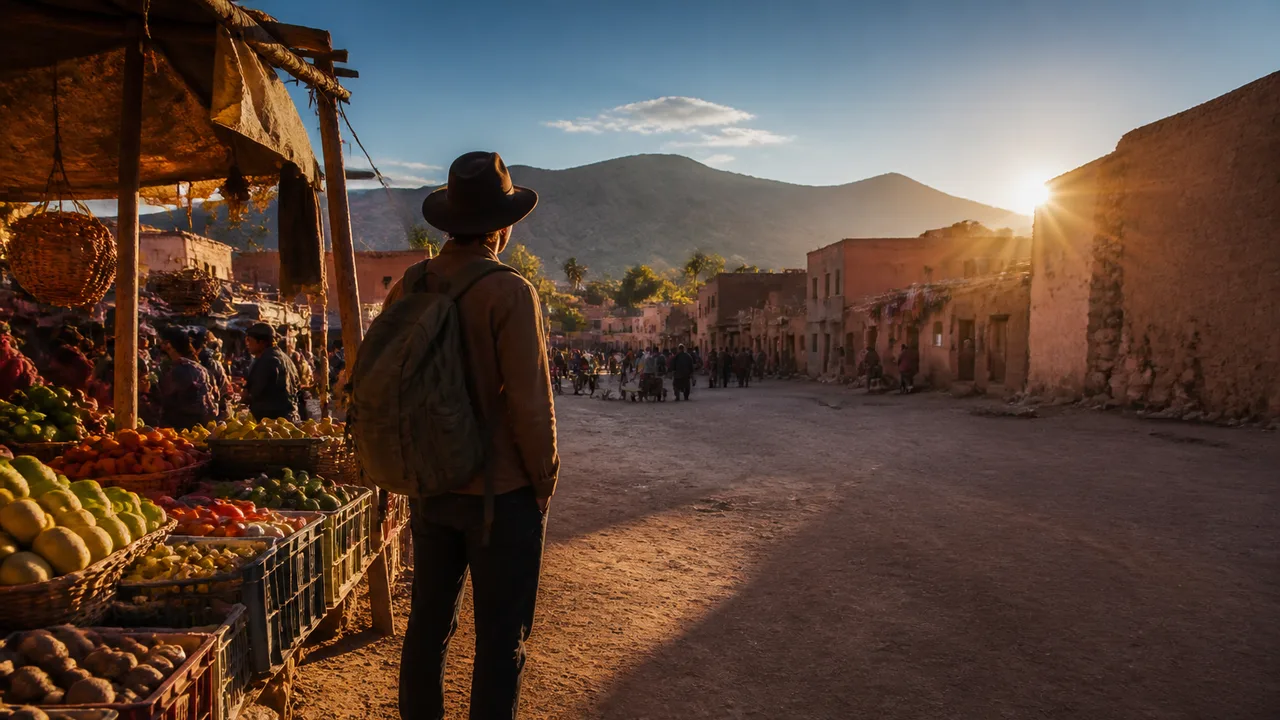
Photo: AI. Asha Kingsley
There is a version of travel that is essentially a checklist audit. Museum: checked. Cathedral: checked. Viewpoint with requisite photograph: checked. The itinerary gets executed, the flight home departs on schedule, and the traveler returns having verified that famous things are, in fact, famous. What they carry back, beyond the photographs, is often thinner than they'd hoped.
Mark Wolters, the travel creator behind the long-running Wolters World channel, addressed this gap in a recent video filmed outside Bratislava Castle — which is itself a pleasingly ironic backdrop for an argument against landmark-centric travel. His premise is practical rather than philosophical: museums and monuments teach you about a country's history, but they tell you relatively little about how people actually live right now. For that, he argues, you need to go where the people are.
The argument is not new. Anthropologists, travel writers, and a generation of "slow travel" advocates have been making versions of it for decades. What Wolters offers is something more granular — a specific set of everyday venues, and an honest account of what each one tends to reveal.
The Grocery Store as Cultural Decoder
His opening example lands well. "You will understand more about a culture by going to a grocery store than pretty much anywhere else," he says, and the evidence he marshals is quietly compelling. The sheer wall of cured ham in a Spanish supermarket. The dozens of pasta varieties in an Italian one. The salted bacalhau laid out in Portuguese stores — a single product that encodes centuries of fishing history, Catholic tradition, and colonial-era preservation techniques. None of this appears in a guidebook entry; all of it is there, available for the cost of entry, in any neighborhood supermarket.
The grocery store works as a cultural lens precisely because it wasn't designed to perform culture. The cheese aisle in Brittany isn't trying to teach you anything about regional identity — it just does, by being what it is.
The same logic extends to pharmacies, which Wolters singles out as an underrated source of both practical intelligence and social texture. "The pharmacy people, they know a lot in South America," he observes, with the specific authority of someone who has tested this. What he's pointing at is real: in many countries, the pharmacist functions as a primary health consultant rather than a dispenser of pre-prescribed medications — a structural difference in healthcare access that a brief visit makes viscerally obvious in ways that no travel guide adequately conveys.
The Case for Watching, Slowly
Several of Wolters' suggestions involve something most travelers are genuinely bad at: sitting still and observing. An outdoor café at a busy intersection, he argues, is one of the better classrooms available. His example is France, where he noticed that adults smoke stationary at café tables but almost never while walking — and where the only people eating on the move are children gnawing on baguettes in strollers.
This is the kind of microdetail that reveals something real: a cultural relationship with food, public space, and consumption that distinguishes French street life from, say, Manhattan or Mumbai. The observation costs nothing. It requires only attention and a willingness to stay in one place long enough for patterns to emerge.
Parks operate similarly. They're where people take children, walk dogs, practice tai chi, argue, make out, and generally behave in ways shaped by local norms rather than tourist expectations. The park in Chengdu where retirees play mahjong under plane trees is telling you something about how China structures leisure and aging. The park in Copenhagen where parents let toddlers roam freely is telling you something about Danish attitudes toward childhood risk and independence. Neither of these lessons is available at a heritage site.
Sports, Barbershops, and the Information Dense Spaces
Wolters' recommendation to attend a local sporting match is one of his more interesting suggestions, partly because it comes with an inherent honesty about what you're actually experiencing: collective emotion. "At sports matches, you see the crazy in people," he says, without apology. A cricket match in Lahore, a college football tailgate in Alabama, a third-division calcio game in Vicenza — each is an exercise in understanding what a community cares about enough to perform publicly, and how it performs it.
This connects to something researchers studying cultural tourism have long noted: high-affect, participatory environments tend to produce faster relationship-building between strangers than passive consumption of cultural artifacts does. You are more likely to have a genuine conversation with an Italian stranger at a Vicenza match than in front of a Titian painting, not because the painting is less meaningful, but because the match creates shared stakes in real time.
The barbershop and salon suggestion is the most idiosyncratic on his list, and probably the most honest about what cultural access actually requires. "You go to the salon back home, it's all the gossip, it's all the things going on," Wolters observes. He's describing a social institution that exists in some form across virtually every culture — a space where local information circulates freely, where service is intimate, and where the person performing the service has absolutely no reason to manage your perception of their city the way a tour guide does. The barbershop doesn't curate; it just talks.
The B&B Question
His final recommendation — staying at a bed and breakfast rather than a hotel or short-term rental — is the one that deserves the most friction. The logic is sound: B&B owners live on the premises, they know the town, and they have a personal investment in sharing it. Wolters describes evenings by the fireplace in Irish and Scottish guesthouses as genuinely instructive cultural encounters, and that tracks with how travelers commonly describe such stays.
The complication is scale. The global accommodation market has changed substantially. Airbnb has absorbed many of what were once family-run guesthouses, converting them into professional short-term rental operations managed remotely. The "local owner who lives there" is now the exception rather than the rule in many markets. Finding a genuinely owner-operated bed and breakfast in a popular destination requires more research than it once did — though it's far from impossible.
There's also a quiet irony in this particular advice appearing in a video with affiliate links to Booking.com and Expedia. Not a disqualifying one — Wolters is transparent about how the channel operates — but worth noticing. The recommendation is honest; the ecosystem around it is complicated.
What the Argument Gets Right
The core claim underlying all eight of Wolters' suggestions is this: the most instructive version of a place is usually its most mundane version. The one that wasn't designed with you in mind. A Roman restaurant where the owner's children are taking orders and a baby got passed around the table fourteen years ago isn't performing Italianness for visitors — it's just operating, and the visitor happens to be present.
"That local restaurant, the local owner, they're really going to make it a much more intimate setting for you to eat and enjoy the culture," Wolters says, "but also they're going to share why is this dish important to this town? Why is this restaurant important to this town? How has the town changed?"
Those are not questions a Hofbrauhaus can answer. They're not even questions a very good museum can answer, at least not the same way. Museums tell you what a society decided was worth preserving. Small restaurants, barbershops, and grocery stores tell you what it forgot to curate.
The distinction matters because it shifts the traveler's posture — from observer of a finished, framed thing to participant in something ongoing. Whether that shift produces genuine understanding, or simply a more satisfying illusion of it, is probably the more interesting question.
More Like This

The Psychology Behind Habits Linked to High Intelligence
Talking to yourself, craving solitude, obsessing over random topics—psychology research suggests these "weird" habits may signal a sharp, curious mind.
What Poles Actually Want Tourists to Know
From geography to drinking etiquette, here's what Polish locals wish visitors understood before arriving—and why it matters more than you think.

Amsterdam's Gable Stones: History Hiding in Plain Sight
Before street addresses, Amsterdam used carved stone tablets to navigate the city. Fourth Place explores what gable stones reveal about the people history forgot.
What to Expect When Staying in European Hotels
European hotels operate by different rules than North American ones. Here's what actually differs—room size, beds, breakfast pricing, accessibility, and more.

Classical Chinese Culture as Therapy for Modern Anxiety
Alain de Botton's School of Life video finds five ideas from classical Chinese art and poetry that speak directly to burnout, grief, and the pressure to perform happiness.

Route 66 and the Landscape of American Memory
Peter Adler's documentary on Route 66 reveals a road that stopped being infrastructure and became something stranger—a canvas for competing American mythologies.
What Hotel Staff Actually Tell You (And Who's Listening)
Hotel insiders speak candidly on a Travel + Leisure video — but what does "unfiltered" mean when the interviewer has advertisers? A close read of what they said and how.
European Train Travel Etiquette Every Tourist Should Know
From seat reservations to strike days, here's what experienced rail travelers know about navigating Europe's train systems without friction.