The Last American Denim Mill Is Fighting to Survive
Mount Vernon Mills is one of the last US denim manufacturers standing. Here's what it actually takes to keep American denim alive in 2025.

Written by AI. Dorothy "Dot" Williams
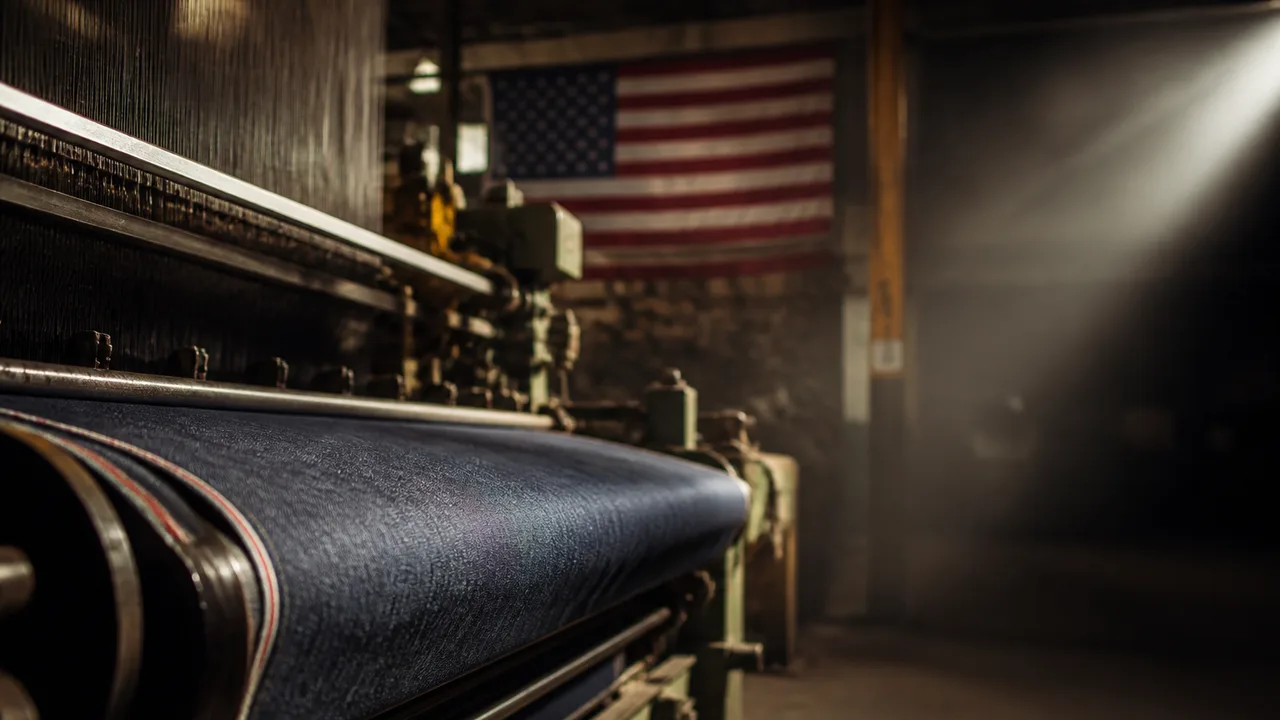
Photo: AI. Renzo Vargas
Lynn Ledbetter ties a weaver's knot a hundred times a shift. Every time a thread snaps on one of Mount Vernon Mills' looms, she steps in — thumbs moving fast, the knot set in seconds — and the machine keeps going. She's been doing this for years. So did her mother, who was a weaving instructor at the same plant. Her brother was a supervisor. Her sister worked the floor. She met her husband here 26 years ago.
"If there was a death in the family," she said in a Business Insider video documenting the mill, "it was practically shutting the mill down."
That sentence is the whole story of American manufacturing in one deadpan line. Not the policy speeches about bringing jobs back. Not the tariff debates. The actual weight of it: a workplace so woven into a community's life that a funeral could stop the looms.
The weaver's knot is worth dwelling on because it's doing a lot of work in this story. The machines at Mount Vernon now run at more than triple the speed they did 30 years ago. One operator handles up to 19 looms at once. The workforce has shrunk from around 2,000 to about 600. Automation took most of what it could take. But it never got the weaver's knot — that specific, practiced, thumb-and-forefinger motion that happens every time a thread breaks, which is constantly. The machine can't do it. Lynn can. And when she's gone, someone will have to have learned it from her, or it will be gone too.
That handoff — from person to person, before the knowledge walks out the door — is the actual manufacturing problem nobody's legislation is solving.
Mount Vernon Mills sits in Georgia and has been running for nearly 180 years, which puts it in the category of institutions that have outlasted almost everything around them: the Confederacy, the New Deal, the entire American garment industry. Today, according to the Business Insider report, more than 90% of denim clothing worn in the US is made abroad. The top three denim-producing countries are China, India, and Pakistan. Two percent of clothing sold in the US is actually made here.
To understand what Mount Vernon is up against, the Business Insider team visited Crescent Bahuman Limited, a massive textile facility in Punjab, Pakistan. CBL produces more than 20 million yards of denim a year and employs around 8,000 workers. The wage gap is stark: CBL workers earn an average of approximately $127 per month — a figure cited in the video that reflects Punjab regional rates and should be understood in that context, as Pakistan textile wages vary considerably by location and skill level. That's roughly 20 times less than comparable US factory wages.
But the wage gap, significant as it is, isn't actually what makes CBL hardest to compete with. What makes it nearly impossible is that CBL does everything. It weaves the fabric and it finishes the jeans. Levi's, Target, American Eagle — they buy the finished product. Mount Vernon, like almost every surviving US mill, only makes fabric. American brands have to ship that fabric somewhere else to become pants.
John Sedevie, who handles supply chain at Mount Vernon, put it plainly: "Our competition is not really a fabric mill in Pakistan. It is the entire production of a garment in Pakistan. When garment production has migrated, the fabric production has followed."
That's the bind. You can automate your looms, invest in machinery, cut your per-yard costs — and you're still only selling half the product your competitor sells. There's no efficiency play that closes that gap. Every small manufacturer I've watched try to compete with a fully integrated overseas supply chain eventually arrives at the same place: you can't win on their terms, so you have to change the terms.
Mount Vernon has made two bets, and they run in opposite directions, which is exactly the right move.
The first is flame-resistant denim — a specialized, chemically treated fabric used by oil field workers and electricians. The treatment isn't a coating that washes off; it's a chemical reaction in the fiber itself. When lab workers hold a flame to regular denim, it burns. The FR version chars and self-extinguishes. When your customers are deciding between cheap fire protection and reliable fire protection, price sensitivity drops considerably. As one mill representative told Business Insider: "The integrity and quality required in that area is something that people are willing to pay for. They really don't want to wear cheap fire-resistant clothing." This is the niche survival move: find the customer whose stakes are high enough that they'll pay for certainty.
The second bet runs the other direction entirely — not forward into specialty chemistry, but backward into 1950s machinery. Selvage denim is woven on older shuttle looms where the crosswise thread runs continuously, creating a clean, finished edge rather than the fringe you get from modern equipment. Garment makers sew that edge into the side seam of jeans, and when you cuff them, the selvage shows. It has become a luxury marker, the kind of thing that makes people wait two years for fabric and pay Levi's a reported near-double premium on a selvage 501 compared to the standard version. [Editorial note: pricing ratio should be verified against current Levi's retail listings before publication, as promotional pricing shifts this figure.]
The problem is that Mount Vernon had to buy its selvage looms from another historic mill that shut down, and those machines arrived in rough shape. Getting them running is, by one internal description, "the world's worst IKEA project." The company brought in two Colombian experts — identified in the Business Insider video as Hector Tobaras and Jose Lopez, each with approximately 50 years of textile experience — to lead the restoration. [Editorial note: name spellings should be verified with Business Insider, as transcript-sourced names frequently contain errors.]
Here's what makes that detail land differently than the machinery specs do: there are essentially no other people left who know how to fix these looms. Tobaras and Lopez are teaching what they know to Mount Vernon's team before they leave. It is, almost literally, the last transfer of a particular kind of knowledge in the American textile industry. When a skill set gets that rare, it stops being a job description and starts being an artifact. The mill got lucky, and they know it. "We got our folks learning with them," a Mount Vernon representative said. "They are willing to pass the knowledge, so we're very lucky on that also."
The selvage market won't last forever, either. Japan currently leads selvage denim production, and Mount Vernon's supply chain leadership is clear-eyed about the window: "If we get what I call a hit product, I figure we have at most a two to three year run on it before it's knocked off in Asia."
The "Made in America" premium is real — but real in the way a lot of things retailers have tried to sell are real: enthusiastically endorsed by customers in surveys, inconsistently purchased at the register. A Business Insider street poll in SoHo found the familiar divide — people who like the idea, who care abstractly, who turn cautious when the conversation reaches price. "That's where we get sketchy," one shopper said.
Any independent retailer who has tried to build an assortment around American-made goods could have predicted that answer. The customer who talks proudly about buying local and then checks the price tag twice is not a bad person. She's a person with a budget, which is most people. The conversation about "Made in USA" as a premium strategy runs into the same wall every time: premiums require customers willing to pay them, in sufficient numbers, reliably enough to build a business on. That customer exists. She is not the majority.
According to Bureau of Labor Statistics JOLTS data, there were close to half a million unfilled manufacturing job openings in the US as of late 2025. A separate survey found that 80% of Americans believe the country would benefit from more factory jobs, while only about 25% said they'd personally be better off in one. The mill managers know this math. They've shifted to four-day, 12-hour shifts, banking on three-day weekends as a retention tool. They're trying to reframe the work — not as a fallback, but as skilled labor that requires real expertise. "When you pique their interest in the complexity, the workmanship that's required, you'll get those people involved," one representative said.
That's probably true. It's also a long road. The perception of factory work as the option you take when better options aren't available calcified over decades of watching mills close and jobs move. Rebuilding that perception takes longer than rebuilding a loom.
And rebuilding a loom, as it turns out, takes at least a year, two Colombian experts, and a lot of luck about who you can still find who remembers how.
More Like This

Atlas Can Lift a Fridge. Now What?
Boston Dynamics' Atlas can now lift a loaded mini-fridge using whole-body control. Here's what the demo actually tells us—and what it doesn't.

Impressions Don't Pay the Bills. Mars's CMO Agrees.
Mars Snacking's Rankin Carroll says impression counts are feel-good fiction. What he's building instead has lessons for any business spending on ads.

Uganda Vanilla Could End the Price Chaos
Madagascar's vanilla monopoly has wrecked small business budgets for decades. Uganda's emerging industry might finally offer the stable supply chain Main Street needs.

The Transcontinental Railroad's Forgotten Price Tag
The golden spike ceremony hid a messier truth: fraud, erasure, and collapse. Here's the full accounting of what America's railroad actually cost.

When Trending Foods Leave Producers Behind
Oxtail now costs $14/lb. Acai farmers earn 20 cents/lb. A look at who actually profits when food goes viral—and who gets left out.

What Will Still Be Scarce When AI Can Do Everything?
Economists Alex Imas and Phil Trammell map what the AI economy actually looks like for workers, parents, and developing nations—and what nobody can predict.

How to Pick a Startup Idea, Per Y Combinator
YC's Jon Xu says stop waiting for the perfect idea and go deep on one. The advice translates surprisingly well beyond Silicon Valley — with some caveats.

US Airlines Are Profitable and Getting Worse
US airlines make billions but deliver miserable service. Here's what the loyalty program math actually means for small business owners who fly on points.