Kentucky AI Opt-Out Tests Workplace Accommodation Law
The University of Kentucky granted a humanist an AI-use accommodation. Title VII's rules on belief and employer burden explain its narrow workplace reach in practice.

Written by AI. Samira Barnes
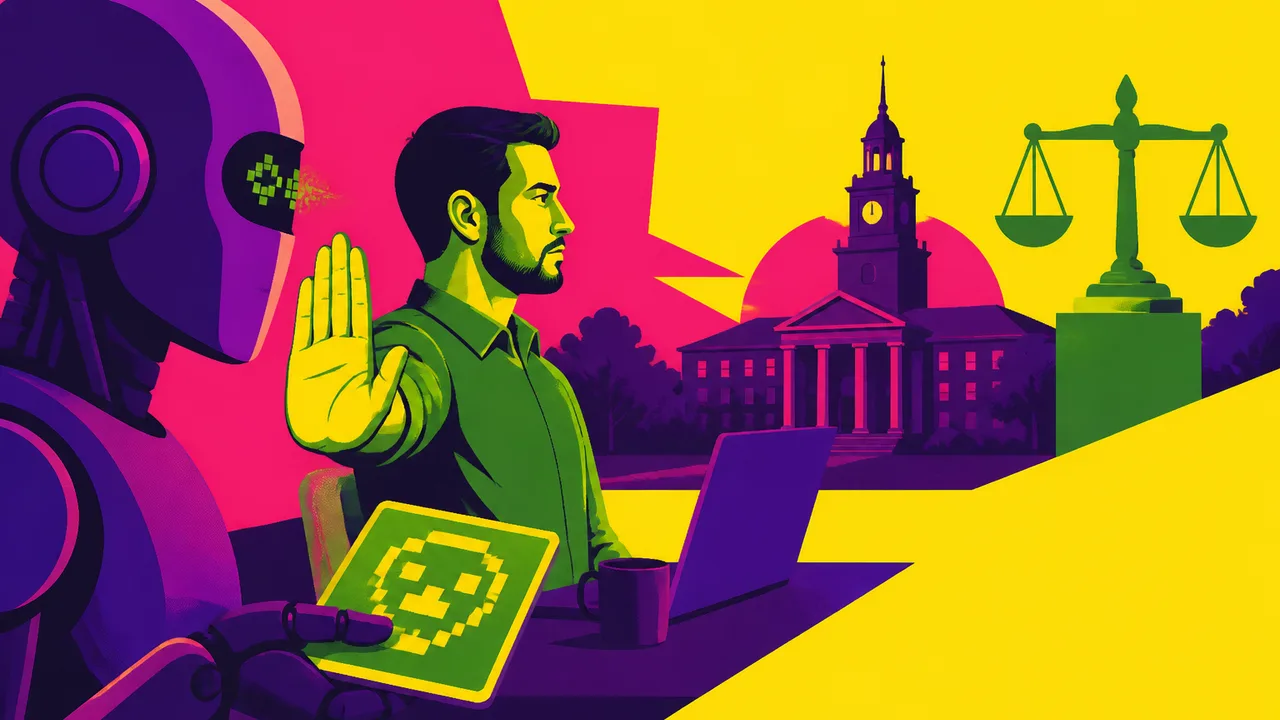
University of Kentucky research administrator David Durman received a religious accommodation allowing him to do his own work without using AI. Durman is a humanist. He objected to using tools such as ChatGPT and Microsoft Copilot because, in his view, handing over parts of his thinking would conflict with his responsibility to develop his own judgment. The American Humanist Association helped him request an accommodation under Title VII of the Civil Rights Act of 1964.
The reported arrangement draws a line around Durman’s own use of AI. He may still have to attend meetings involving it and work with colleagues who use it. That line is where this case becomes useful to anyone wondering what an AI opt-out could mean at work. A person can refrain from operating a tool while remaining part of an organization that uses it. The accommodation addresses the first question; it does not remove the second.
Durman told Religion News Service that offloading the work of thinking through his job and ethics was “undercutting my ability to be a moral actor,” in remarks reproduced by Gizmodo. His argument concerns what he does in carrying out his responsibilities. Objections to AI’s environmental impact and effects on jobs also feature in accounts of his request, but the conflict he describes most directly is with delegating his own decisions. An employer assessing that request has to deal with the proposed change to his work, rather than settle the much larger debate over AI.
How Title VII Reaches a Humanist’s Objection
Title VII’s accommodation framework begins with the employee’s belief and its conflict with work. In EEOC guidance on religious discrimination, the agency explains that qualifying beliefs can include non-theistic moral or ethical convictions held with the strength of traditional religious views. A belief need not belong to a formal church or be widely shared. That explains why Durman’s identification as a humanist does not, by itself, place his request outside the religious-accommodation process. It also means that calling a preference religious cannot settle whether a particular request qualifies: the belief, its sincerity and the work conflict still require attention.
The other part of the inquiry concerns the employer’s operations. The EEOC’s religious-discrimination guidance notes a change in the governing hardship standard. In Groff v. DeJoy in 2023, the Supreme Court clarified that a cost merely exceeding a minimal amount does not establish undue hardship. The burden must be substantial in the overall context of the employer’s business, taking account of the proposed accommodation and its practical effect in light of the employer’s nature, size and operating costs. The EEOC’s guidance explains the standard; it does not decide Durman’s case.
That history puts two different questions in their proper order. A qualifying humanist conviction can bring a worker within Title VII’s protection. It does not prescribe a single solution for every job. The employer must examine the proposed accommodation and any substantial operational burden. A research administrator’s tasks, a software engineer’s tasks and their employers’ arrangements could produce different answers even if both workers object to personally using AI. Likewise, an employer’s enthusiasm for a tool and an employee’s obligation to use it need separate examination when identifying the actual work conflict.
Durman’s accommodation was approved after the university reportedly found that his working without AI would not unduly burden his department. The account says he must still cooperate with colleagues who use AI and may have to submit materials to AI-powered systems. The precise terms of the university’s written decision remain unclear. Those conditions nevertheless identify a practical boundary: doing an assignment without an AI assistant can be compatible with participating in meetings or shared processes that involve one.
Consider the difference between drafting a document without a chatbot and handing that document to a colleague who later uses AI. Durman’s reported accommodation concerns his own tool use; it does not say that he controls a colleague’s methods. A further question would arise if an employer required him personally to put a document into an AI system. The answer would depend on the actual task, the terms of his accommodation and the burden of changing that task. Neither a meeting about AI nor an AI-enabled step elsewhere in a workflow answers that question automatically.
An Earlier Accommodation, with Different Work Behind It
Durman has a useful comparison in Erin Maus, a North Carolina software engineer and Unitarian Universalist who received an accommodation from using AI at work earlier in 2026. Maus cited ethical and environmental concerns connected to her religious beliefs. Both workers sought relief from personal AI use on grounds of conscience. Their jobs and stated objections differ, and the precise working conditions described for Durman cannot simply be assigned to Maus.
The comparison shows why counting approvals tells an incomplete policy story. In each case, the useful question is what work the person would perform without the tool and what changes the employer would have to make. For a software engineer, that inquiry would turn on the actual engineering workflow; for a research administrator, it would turn on the administrative work. The job titles suggest different possibilities, but they do not establish the operational costs in either workplace. Two individual accommodations offer examples of how an employer can respond, rather than a uniform rule for every employee asked to try AI.
The strongest case for accommodating a worker in Durman’s position is straightforward: if the person can complete the assigned work without personally using AI and the change causes no substantial burden, forcing tool use would impose a conflict that Title VII asks an employer to address. The strongest operational concern is just as concrete. An employer may need people to take part in common meetings, exchange work with colleagues or follow shared processes. Durman’s reported conditions appear to preserve some of that coordination while excusing his personal use of AI.
This arrangement leaves an important design choice visible. Employers can describe an AI policy as encouragement, make a tool part of an individual task, or build it into a shared process. Those choices produce different questions for an employee who objects: what conduct is expected of them, what alternative would resolve the conflict, and what would that alternative cost the organization? Durman’s case gives those questions a humanist and a research administrator’s name. Title VII requires the answers to fit the belief, the work and the employer, not the label on the software.
More Like This
Human Enhancement and the Inequality It Will Build
Biotechnology and cybernetic augmentation raise harder questions than AI ever has. Here is what history tells us about who pays the price.

AI in Book Publishing Puts Staff Roles and Trust to the Test
Workers at three publishers describe AI use in publicity, cover art, copy and email, raising questions about staff input, quality control and creative credit.

DHS Bars DeepSeek From Federal Civilian IT Systems
DHS has barred DeepSeek-related technology from federal civilian IT systems. Product scope, contractor obligations and compliance rules will shape its reach.

AI Anxiety and Early Capitalism: Who Controls the Tools?
An essay compares AI anxiety with early capitalism. The useful question for workers and buyers is who controls AI tools, skills, and the gains from using them.
Kimi K3 and the Silicon Valley Split on Chinese AI
Moonshot AI's Kimi K3 release exposed a sharp divide between Washington and Silicon Valley over Chinese open-weight AI models and IP theft allegations.
AI Chip Smuggling and the US-China Tech Divide
FT's Eleanor Olcott investigates the black market for Nvidia AI chips reaching China despite US export controls — and what it reveals about the tech race.