K, C, or E? The Economy's Shape Debate, Explained
Economists are retiring the K-shaped recovery consensus. The C and E models now compete to explain who's gaining and who's still losing ground post-pandemic.

Written by AI. Elena Vasquez-Moreno
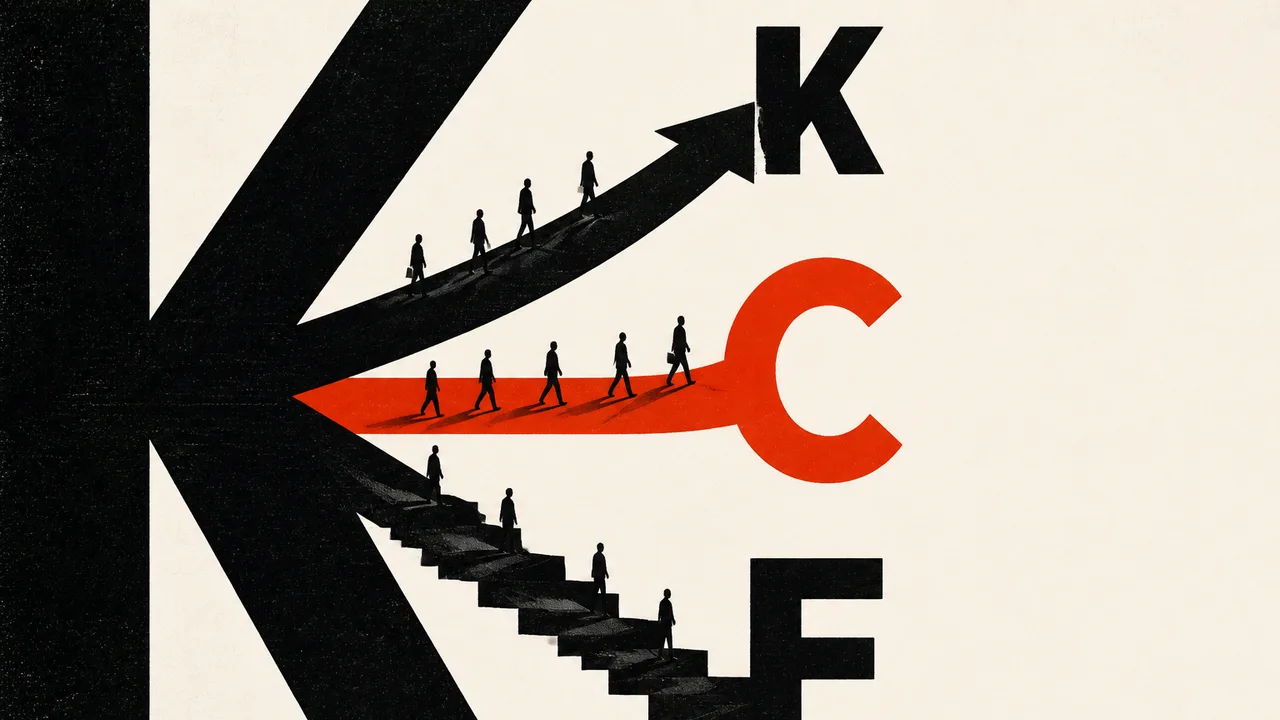
The sports business beat has a useful habit of cutting through macroeconomic abstraction. Consider what happened to North American major league revenues over the past few years: record gate receipts, record media deals, record franchise valuations. Meanwhile, the parking and concessions workers staffing those same venues have watched their real wages lag inflation. The premium-seat buyer and the hot-dog vendor operate in the same stadium and in what looks increasingly like different economies. Economists now have an alphabet's worth of letters trying to describe that gap, and they cannot agree on which one fits.
For most of the pandemic recovery period, the dominant framework was the K-shape. The logic was elegant and uncomfortable in equal measure: the upper arm of the K traced asset owners, knowledge workers, and anyone with a portfolio that benefited from low interest rates and remote-work flexibility; the lower arm traced service workers, renters, and hourly employees who absorbed the inflation surge without the offsetting wealth gains. According to reporting by CNBC and Defcon Warning System, letter shapes have been used for decades to summarize recovery trajectories, but the K earned particular traction because the divergence it described was vivid and measurable.
That consensus, as IndiaVision reports, is now dissolving. The newer candidates are C and E, and the fight over which one applies tells you something about how much economists and executives still disagree on what the data is actually showing.
The Case for C
The C-shaped argument is, in its most generous reading, a genuine convergence story. According to NewsHub, some economists and executives argue that lower-income consumers have been gaining ground, narrowing the gap that the K described so starkly. The C suggests a broad arc: a sharp contraction, followed by a recovery that eventually curves back toward something resembling pre-pandemic normalcy across income groups.
The data points that C-shape proponents tend to reach for include tighter labor markets at the low end of the wage distribution, where pandemic-era worker shortages pushed up entry-level pay in hospitality, logistics, and retail. If you believe those gains are durable rather than transient, and that inflation has retreated enough to preserve real purchasing power, the K starts to look like a snapshot of 2021 rather than a structural feature of the American economy.
The C is the optimist's letter, which is not a reason to dismiss it, but it is a reason to interrogate the assumptions underneath it.
The Case for E
The E-shape is harder to summarize because that is partly the point. Where the K described two divergent trajectories and the C describes eventual convergence, the E suggests the economy has fractured into three or more distinct paths simultaneously. Defcon Warning System notes that these letter debates are circulating in both academic circles and Wall Street trading rooms, and the E tends to attract people who think the K was always too binary.
In practice, the E-shape framework acknowledges that some lower-income workers did see real wage gains; that a middle tier of white-collar employees has experienced genuine stagnation as remote-work premiums compress and tech layoffs accumulate; and that the asset-owner class continued to compound wealth through equity appreciation and commercial real estate recovery. Three prongs, three different stories, none of them reducible to the other.
The E is also the letter that makes fiscal policy genuinely complicated. A K-shaped economy has a fairly obvious intervention: compress the gap at the bottom. An E-shaped economy requires targeted policy for at least three distinct populations with different political coalitions and different sensitivities to interest rates, tax changes, and transfer payments.
Why Nobody Can Settle This
Part of what makes this debate intractable is a measurement problem that sounds technical but carries real stakes. Economic data arrives with lags, gets revised repeatedly, and means different things depending on which indicators you weight. Consumer confidence surveys can flash distress while payroll numbers flash strength. Retail sales can hold up even as credit card delinquency rates climb, which describes a consumer who is spending down buffers rather than genuinely recovering.
The best illustration of how treacherous this can be: the University of Michigan Consumer Sentiment Index dropped sharply in early 2023 even as headline job numbers remained strong, a divergence that split forecasters badly and was not fully resolved by subsequent data revisions. Choosing which signal to trust is not a neutral act. It reflects assumptions about whose experience the economy is primarily delivering for.
IndiaVision captures the resulting atmosphere accurately: economists are "grappling with a more complex and less predictable landscape" than the K consensus allowed. The honest version of that observation is that the K was always a simplification, and the current disagreement reflects how much analytical work that simplification was quietly doing.
What the Sports Business Window Shows
The stadium economy is, admittedly, a narrow aperture on a large question. But it has the virtue of being concrete. Major league franchises have posted record revenues in recent cycles, driven by media rights escalation, naming-rights inflation, and premium hospitality spending by corporate clients whose entertainment budgets survived the post-pandemic correction intact. The asset class itself has appreciated at rates that outpace almost any benchmark you'd care to apply.
At the same time, league attendance data shows softness among the casual, cost-sensitive fan who buys a single-game ticket rather than a club membership. Sports gambling's explosive growth since the Supreme Court's 2018 Murphy v. NCAA decision tracks almost perfectly with the demographics of the upper arm of the K: the disposable-income holder with a phone and a brokerage account. The industry's marketing, built around sophisticated same-game parlays and live in-play wagering, is not chasing the parking-lot concessions worker. It knows exactly who has the float to absorb a losing week.
If you believe the C, you think that fan is gaining ground and will be back at full price within a few cycles. If you believe the E, you think the sports economy has already permanently repriced around its most profitable tier and built the revenue model accordingly.
What Policymakers Are Actually Navigating
The letter debate would be purely academic if fiscal and monetary policy didn't depend on getting the shape approximately right. Stimulus calibration, interest rate paths, transfer payment design, housing policy: all of these work differently depending on whether you believe the recovery has broadly converged or is running on three separate tracks with three separate political constituencies.
CNBC frames the debate as reflecting "ongoing uncertainty in economic forecasting," which is accurate but slightly undersells the tension. Uncertainty is a condition; what's happening now is more like a renegotiation of the analytical framework itself, with real disagreement about which data sources, which time horizons, and which income segments should anchor the picture.
Executives navigating capital allocation decisions face the same problem at a smaller scale. A C-shaped economy argues for broad consumer-facing investment; an E-shaped economy argues for tiering your product line hard and making deliberate bets on which prong your customers occupy. The wrong read is expensive either way.
The K held because it was legible. Its replacement will need to be legible too, and right now none of the candidates have fully earned that status. Watch which letter the Federal Reserve's next major public communication reaches for. Central banks are usually the last to abandon a consensus framework, and the first to signal, subtly, when they have.
More Like This

China's Manufacturing Debt Trap and the Deflationary Risk
China's PMI has contracted for two straight months. The data points to a structural debt problem, not a cycle. Here's what Beijing's fiscal architecture reveals.

Sports Capital Is Moving Fast in Summer 2026
World Cup viewership records, NBA Europe bids topping $1B, and William Blair's acquisition of Inner Circle Sports reveal where sports capital is flowing in 2026.

How APL Turned an NBA Ban Into a Brand Identity
APL's NJ Falk breaks down the six storytelling threads behind one of e-commerce's most unlikely brand-building moves—starting with an NBA ban.

UK Economy Grew 0.4% in Q2, But Who Did the Work?
The UK's 0.4% Q2 2026 GDP growth looks good on paper. But behind the World Cup and sunshine numbers are workers whose hours have already started to shrink.
Fair Isaac Says Mortgage Pricing Is Shaping Housing Demand
Fair Isaac says mortgage pricing is doing real work in today's housing market. Here's what that means for buyers, lenders, and affordability in 2026.
NFL Schedule Expansion Draws Greed Criticism
Joy Taylor calls the NFL's schedule expansion "greedy." Here's the economic logic behind the push—and why the pushback deserves a serious look.

France's World Cup Exit Handed Sportsbooks a Windfall
France's 2026 World Cup elimination relieved sportsbooks of their biggest liability. Here's how public betting patterns turned one team's loss into the industry's gain.

MLB Home Run Derby 2026: Was the $574 Ticket Worth It?
The Dodgers Explicit crew paid $574 each to attend the 2026 MLB Home Run Derby in Philly. Jordan Walker won. Here's what the experience actually cost and delivered.