Japan's Seven Stars Train: What Riding It Actually Takes
A review of Japan's Seven Stars cruise train through Kyushu: the lottery, the cost, the food, and whether $4,300 per person holds up to scrutiny.

Written by AI. Mariel Fontaine
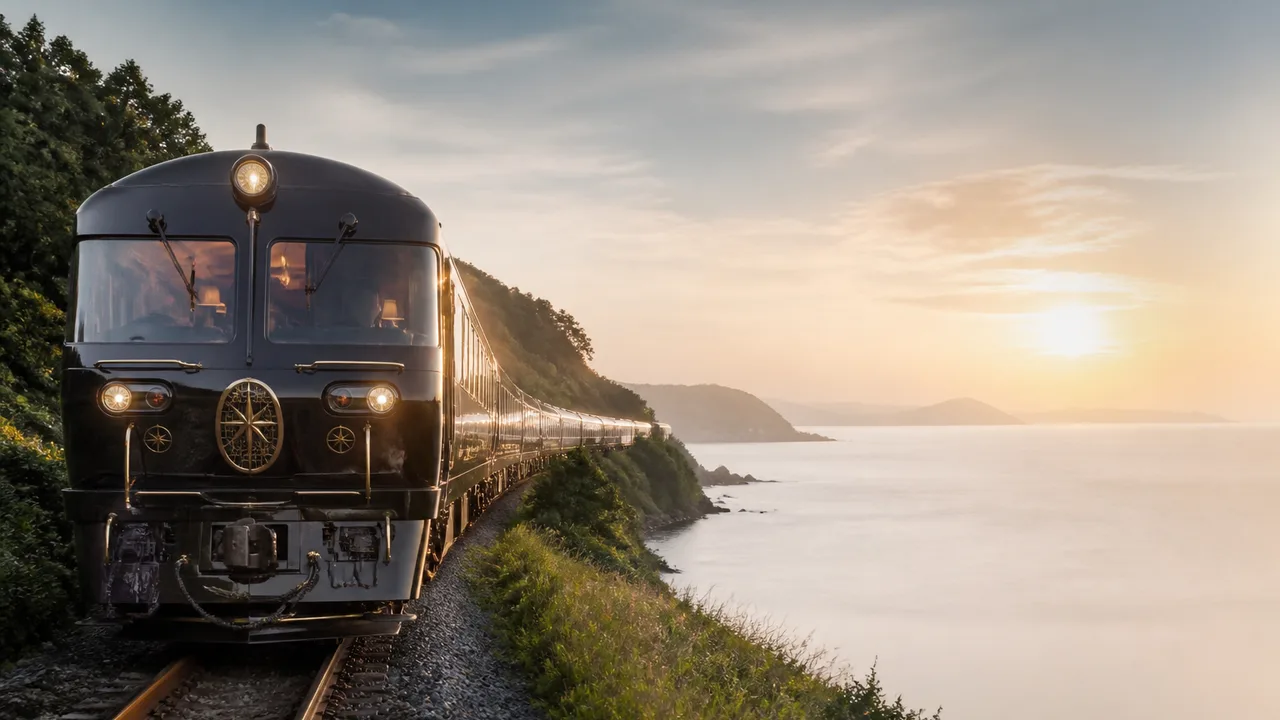
Photo: AI. Hayden Cross
There is a category of travel product that exists not to move you from one place to another, but to make the moving itself the entire point. Japan understands this better than almost anyone. The country built a rail culture so refined that it spawned a genre — the cruise train — and the Seven Stars in Kyushu is that genre's most extreme expression.
Travel creator Jeb Brooks recently documented a two-day, one-night journey aboard the Seven Stars for his channel, greenergrass.com, and the resulting footage offers something more useful than a highlight reel: it surfaces the real mechanics of how this experience works, what it costs, and where the seams show, even on a train this polished.
Getting On Is the First Problem
Before you think about food or panoramic windows, you face the lottery. The Seven Stars runs ten suites, accommodates a maximum of twenty passengers per departure, and does not sell open tickets. Each quarter, a selection process opens through the operator's website. Brooks reports that for every hundred applicants, approximately five receive boarding passes. He and his travel companion tried for years before their number came up.
That is not a marketing flourish. It is a structural fact that shapes the entire experience. The exclusivity is not performed — it is baked into the math of the thing. Which raises a question the video doesn't fully resolve: who is the lottery actually selecting? Applications are submitted, and winners are drawn, but the operator does not publish its methodology. Is it random? Weighted? The answer matters if you are genuinely considering applying.
Brooks's ticket price: 700,000 Japanese yen per person, or roughly $4,300. That figure covers all food and drink aboard, the dedicated suite, and the excursions — but not the speakeasy bar in Car 3, which runs an additional $150 per person for a ninety-minute reservation.
The Train Itself
Seven cars. Wine-dark exterior with gold accents. Panoramic windows at each end. These are the visual facts, and they hold up: the deep lacquered finish of the Seven Stars is, by any reasonable measure, one of the more striking train exteriors currently in operation.
Inside, the design philosophy leans hard into Japanese craft traditions. Brooks notes that even the basin in the suite bathroom is hand-painted. Handmade tissue box holders — no nails, he reports — appear in the salon cars. The woodwork, replicated in the custom-designed motor coach used for excursions, signals that the aesthetic was conceived as a total environment rather than a collection of luxury furniture. The name itself refers to the seven prefectures of Kyushu, which gives the design program its coherence: this train is about a specific place.
The two lounge cars anchor the communal experience. Car 1, the Blue Moon, holds the bar and the dining tables, and contains the train's signature panoramic rear window — a floor-to-ceiling view of the receding landscape. Car 2, Salon Jupiter, offers a quieter retreat with a tea room and the train's stamp desk. (The stamp, Brooks suggests, rivals a passport mark for satisfaction. This may be the most Japanese thing about the whole enterprise.)
The kitchen, tucked into Car 2, is worth pausing on. It is, by Brooks's description, microscopic. The original concept had passengers dining off the train at restaurants around Kyushu; that model was abandoned, and now a guest chef operates out of a space that most restaurant professionals would find unusable. That the meals produced here are multi-course and Michelin-adjacent is either a testament to Japanese culinary discipline or a very good argument for keeping expectations calibrated.
The Food, Which Is Genuinely the Point
If the lottery is the first problem and the ticket price is the second, the food is where the Seven Stars makes its case most convincingly.
Lunch on day one was an eight-course Japanese menu built around hyperlocal Kyushu ingredients — mackerel sashimi finished with salt and lime, sea urchin soup, sushi wrapped in leaves in the style of chakin sushi (a traditional Japanese preparation documented by Japan House LA), grilled local fish alongside a single beautifully prepared onion. Brooks's companion was not entirely at ease with the sea urchin. Brooks was. The meal moved forward regardless.
Dinner that evening was presented by a Michelin-starred chef from Kyushu working in a French-Japanese register. The wine was French. The fifth course — black Wagyu in a preparation Brooks identifies as Chateau Bion — was, by his account, the best thing he ate during his entire Japan trip. That is a significant claim from someone who has been eating around Japan for long enough to have a documented track record. The seventh or eighth course brought a warm crepe. The exact count, Brooks admits, was unclear by the end.
The second day's lunch took place at a private Seven Stars restaurant beside the platform at Aso Station — a facility that exists solely for this train's passengers. The executive chef prepared a Western-style menu that included guinea fowl two ways (katsu-fried breast, roasted thigh), and a beef-and-rice course to which the chef added a signature curry tableside. Brooks describes the beef as melting. The framing is enthusiastic, but it tracks with what Kyushu beef has built its reputation on.
"Japanese food is intimidating," Brooks says aboard the train, "but everything was approachable. They described it in great detail to us. It was really just beautifully presented." That's an honest read. The Seven Stars is not trying to challenge you into a culinary awakening; it is trying to make an unfamiliar cuisine legible through service and curation.
Out the Window and Off the Train
The "cruise train" designation means excursions are built into the itinerary, and the Seven Stars treats them as seriously as the meals. On day one, passengers were given a choice: remain aboard for a local crafting session or board the custom motor coach for a forty-five-minute ride into the Kuju Mountains. Brooks chose the mountains.
The destination was Aso Kuju National Park, where the Kyushu Azaleas on Mount Aso were in bloom — a pink wash across the slopes of what Nippon.com identifies as one of the world's largest volcanic calderas. The Aso-City Tourism Association notes that the park's grasslands support over 600 plant varieties. The weather cooperated. It would not the following day.
Day two's excursion targeted Oka Castle ruins above Bungo Taketa — a city that Wikipedia places at approximately 20,000 residents, and which retains the bones of its Edo-period castle-town history. Rain had made the rocks too slippery for a safe ascent, so the crew redirected passengers into the town below. Brooks, to his credit, reads this correctly: "It adds to the moodiness and mystery of the experience." The Bungo Taketa station, designed to evoke a samurai residence in reference to the castle above, is itself worth the stop.
The Speakeasy, Which Cannot Be Photographed
Car 3 contains a four-seat bar called Casbar, named for the Seven Stars' first-ever employee, who remains on staff as its bartender to this day and who — in a detail that is either charming or slightly surreal — also paints personalized artworks for guests depicting what they consumed during their visit. The no-cameras policy is strict. Brooks emerged from his ninety-minute session with a painting and no footage.
What he describes: inventive cocktails and mocktails, rare Japanese whisky poured at the bartender's discretion, an atmosphere unlike anything else on rails. The $150-per-person charge is an add-on that not every passenger will elect. The painting waiting at breakfast the following morning is, by any measure, an unusual souvenir.
What It Is and Isn't
One honest note from the overnight: the tracks were rough in places, and tree branches scraped the exterior through the night. The train parks from roughly midnight to 4 a.m., which Brooks identifies as the best window for sleep. "It was kind of a rough ride last night," he says the next morning, with the pragmatism of someone who has slept on enough trains to have a reference set. The bed itself was comfortable. The journey was not a sleeper train experience in the conventional sense — it is a moving hotel with occasional interruptions.
That distinction matters for how you evaluate the price. At $4,300 per person, you are not paying primarily for transportation or accommodation. You are paying for a curated two-day immersion in Kyushu's food culture, craft traditions, and landscape — delivered at a pace and scale of service that no fixed hotel can replicate, precisely because the scenery changes every hour.
Whether that justifies the price is a calculation that depends entirely on what you value and what you can absorb. The lottery, at least, means the market isn't purely self-selecting by wealth alone — only by persistence.
Applications open quarterly at the Seven Stars operator's website. Brooks has linked the registration page in his video description, and the odds remain what they are: five in a hundred.
More Like This
Small Group Italy Tours Are Reshaping Travel
Small group Italy tours promise authenticity over crowds. But do they deliver — and at what cost to the communities they claim to honor?
Casa del Desierto: Barstow's Forgotten Harvey House
Barstow's Casa del Desierto is a stunning 1911 Harvey House in the Mojave Desert—and one of America's least-visited Amtrak stations. Here's why it still matters.
Luxury Train Journey Across Australia: Worth the Cost?
Explore a luxurious 80-hour train journey across Australia and its opulent offerings.
Inside the Airbus A380: The $375M Gamble That Rewired Aviation
The Airbus A380 promised to solve airport congestion and cut fuel costs. What it actually delivered was more complicated—and more interesting.
Southwest Airlines in 2026: What Actually Changed?
Southwest Airlines overhauled everything in 2026—assigned seats, bag fees, new fare tiers. A 12-flight stress test reveals what the changes actually mean for travelers.
What to Expect When Staying in European Hotels
European hotels operate by different rules than North American ones. Here's what actually differs—room size, beds, breakfast pricing, accessibility, and more.
Bosnia Travel Tips: What to Know Before You Go
From Mostar's slick cobblestones to Balkan time, here's what seasoned travelers wish they'd known before visiting Bosnia and Herzegovina.

Lima's Neighborhoods and the Inequality Dividing Them
A street-level look at Lima, Peru's capital, where gang-controlled districts and wealthy enclaves exist just blocks apart—and government neglect connects them both.