Southwest Airlines in 2026: What Actually Changed?
Southwest Airlines overhauled everything in 2026—assigned seats, bag fees, new fare tiers. A 12-flight stress test reveals what the changes actually mean for travelers.

Written by AI. Mariel Fontaine
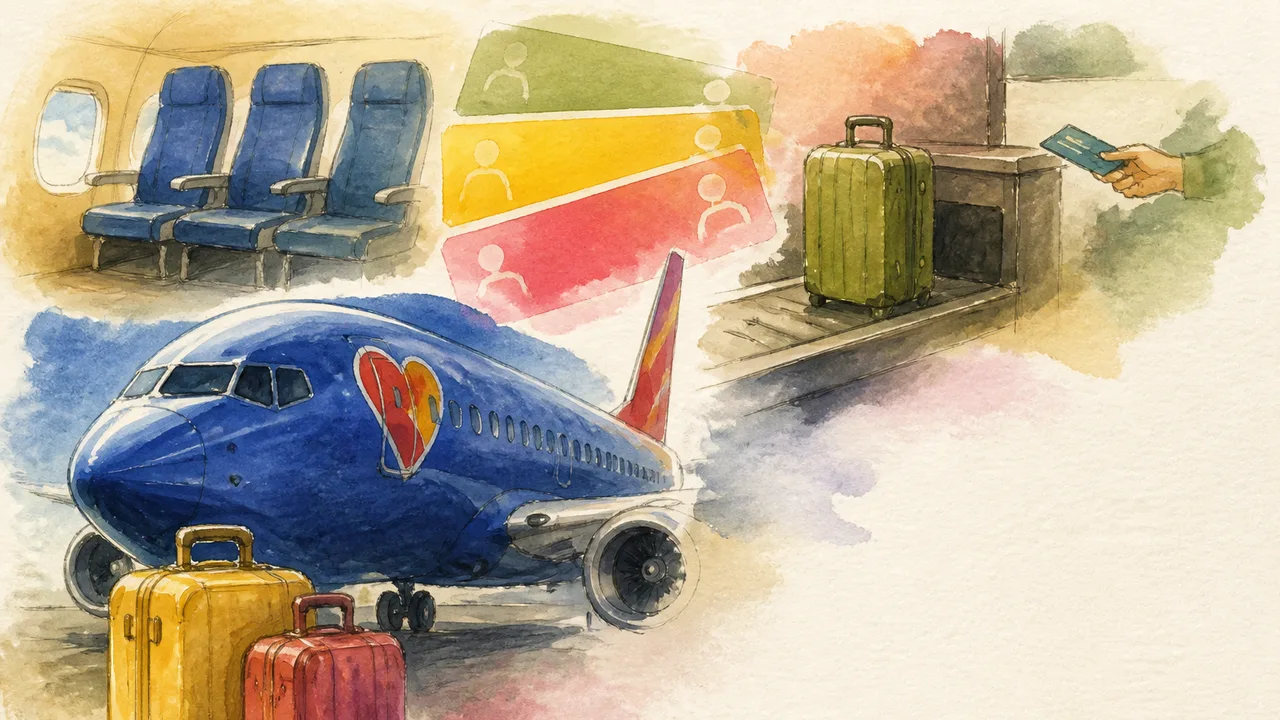
Photo: AI. Júlia Almeida
Southwest Airlines spent decades building an identity around three things: no assigned seats, free checked bags, and a sense of theater at 35,000 feet. The cattle-call boarding, the flight attendant who rapped the safety announcement, the feeling that the whole operation was run by people who genuinely thought air travel could be fun — all of it was deliberate. All of it is now gone.
In 2026, Southwest rolled out the most comprehensive overhaul in the carrier's fifty-plus-year history: assigned seating, checked bag fees, new fare tiers, redeye flights, and a restructured boarding process. The airline that once dared to be different now looks, by nearly every measurable dimension, like every other airline. The question is whether that convergence makes it better, worse, or simply interchangeable — and the answer depends almost entirely on what you valued about it in the first place.
Travel creator Jeb Brooks recently put the revamped Southwest through what he called "the ultimate stress test": 12 consecutive flights through all 13 of the airline's crew base cities — Atlanta to Baltimore to Nashville to Chicago to Orlando to Austin to Houston to Dallas to Denver to Las Vegas to Phoenix to Los Angeles, and finally to Oakland — all within 44 hours, each flight booked on a separate ticket. The structure of the test matters. Separate tickets mean no automatic rebooking, no safety net. One cascading delay and the chain snaps. It's an adversarial format designed to expose exactly where operational promises meet operational reality.
The results were instructive, though not in the ways a marketing department would prefer.
The New Architecture
The fare structure is the most immediate thing a returning Southwest traveler will notice. Basic Economy lands you in the last boarding group with no control over seat selection at booking — seats are assigned at check-in. Choice fares give you a standard seat assignment and general boarding. Choice Preferred moves you closer to the front. Choice Extra, the top tier, buys you extra legroom seats near the front, Group 1 boarding, two free checked bags, and a complimentary premium drink. On the Denver-to-Las Vegas leg — one of the pricier routes on Brooks' itinerary — Choice Extra seats ran $357 each.
That last number deserves some attention. Southwest's longstanding value proposition rested on being cheaper than the legacy carriers. On the Phoenix-to-Los Angeles route, Brooks found Southwest pricing at $69 one way — the same as Delta and United. Frontier was at $23. The budget carrier undercut the budget carrier. "Is Southwest really a low-fare airline anymore?" Brooks asks in the video. The honest answer, based on what he documented: it depends on the route, the dates, and the tier you book. That conditional has historically not been part of Southwest's brand promise.
The boarding process, at least, appears to be a genuine improvement. Eight boarding groups, called two at a time, replace the old numbered-pole scramble that rewarded obsessive check-in timing and produced gate-area chaos that put O'Hare on its worst day to shame. Brooks observed it running smoothly, and noted it as one of the few unambiguous upgrades of the new system.
The irony is that the checked-bag fee — new in 2026 — may be quietly undermining that improvement. When bags fly free, passengers check more of them. When they don't, passengers pack those bags into the overhead bins, and boarding slows accordingly. Brooks flagged this dynamic explicitly after watching repeated boarding delays: "Southwest used to allow passengers to check two bags for free, but now they charge for them, which means more passengers bring bags on board and that slows down the boarding process even more." The airline solved one congestion problem and may have introduced another.
The Numbers
Seventy-five percent of Brooks' flights departed late. Forty-two percent arrived on time across the 12-flight itinerary. The delays weren't all Southwest's fault — weather, a missed approach requiring a go-around, a crew member who arrived late — but operational reliability is a system-level outcome, not a flight-by-flight judgment call. An airline's job is to build schedules and buffer times that absorb routine disruption. Brooks observed that Southwest operates with approximately 40 minutes of ground time between flights, which he characterized as insufficient.
The Orlando sequence illustrated this most sharply. A delayed arrival, a go-around on final approach, a sprint across the terminal — and then the gate agent telling them boarding hadn't started yet, despite the app showing the flight as "on time." "Neither the app nor the signs were very reliable," Brooks noted in his final assessment. In an era when passengers are expected to self-manage their travel through digital tools, an unreliable app isn't a minor inconvenience. It's a core failure.
What the Stress Test Can and Can't Tell Us
It's worth noting the limitations of this methodology before drawing broad conclusions. Twelve flights across 44 hours, during a period that included spring thunderstorms and weather systems over multiple regions, doesn't constitute a statistically reliable sample. The Bureau of Transportation Statistics tracks on-time performance across all carriers; Southwest's systemwide numbers in recent years have oscillated depending on the season and whether you're remembering their catastrophic December 2022 operational collapse, which stranded roughly two million passengers and resulted in a $140 million DOT fine.
What Brooks' test does provide is something the aggregate data can't: a granular, qualitative account of how the new system feels from inside it, across multiple fare classes and route types. The on-time numbers from this particular trip are worse than the airline's own reported averages, but the observations about app reliability, boarding dynamics, and the erosion of operational slack ring true in ways that aggregate statistics tend to obscure.
There are also perspectives this kind of content doesn't easily capture. What does a Southwest gate agent think of the new boarding process? How are the airline's own workers — flight attendants, ramp crews — experiencing this transition? The labor conditions underlying a carrier's operational reliability are rarely visible from the window seat, and Southwest's relationship with its unions has been turbulent during this restructuring period. That context shapes what passengers experience, even when they can't see it.
The Intangible
Brooks' sharpest observation isn't quantitative. "After 12 flights, our biggest observation is that Southwest has simply lost some of its magic. What was once a unique, fun culture in the sky is gone. Now it just feels like any other airline."
That's a meaningful loss, but it's worth interrogating what the magic actually cost and who was paying for it. Southwest's free-bag policy, its open seating, its quirky culture — these weren't charitable gestures. They were competitive strategies built for a specific market environment. As that environment shifted — fuel costs, labor contracts, investor pressure following the 2022 meltdown, activist pressure from Elliott Investment Management — the math changed. The culture that felt free to passengers was always being subsidized somewhere.
The new Southwest is making the same trade-off every major U.S. carrier has already made: maximize revenue per seat, unbundle the product, let the market sort it out. Whether that produces a better airline or just a more ordinary one probably depends on your definition of better.
Brooks' verdict was unambiguous: "If price and schedule are about the same, we'd still go with a legacy carrier." That's a damning sentence for an airline whose entire reason for existing was to be the alternative to legacy carriers.
The question now is whether Southwest knows what it's the alternative to.
More Like This
Air New Zealand's Business Class Dilemma
Air New Zealand's new business class faces criticism for its lack of privacy and direct aisle access, raising questions about its competitive edge.
Spirit Airlines Is Gone. Your Airfare Bill Isn't.
Spirit Airlines shut down in May 2026. For millions of price-sensitive travelers, that yellow plane was the only thing keeping fares honest. Here's what that costs.
Dulles Airport's Mobile Lounges Were Never Built for You
Dulles Airport's 1960s mobile lounges were designed for jet-age elites. When flying democratized, regular people inherited a system built for someone else.
Inside Argentina's 7-Generation Working Estancia
Estancia La Tomasa near Buenos Aires has welcomed guests since 2023. Here's what a weekend on this 140-year-old working ranch actually looks like.
Driving Patagonia's Route 40: What Van Life Actually Looks Like
Kara and Nate drove 2,000 miles across Patagonia in 8 days. What they found reveals the gap between van life mythology and Patagonian reality.
Inside Houston's Busiest Indian-Pakistani Restaurant
Explore the culinary marvel of Aga's, serving over 4,000 diners nightly in Houston with authentic Indian and Pakistani cuisine.
Airport Behavior That Makes Flying Worse for Everyone
From gate lice to baggage claim crowding, Mark Wolters of Wolters World maps the airport habits that slow everyone down—and why they persist.

Basic French Phrases That Help Tourists in France
A handful of French words can shift how locals treat you in France. Here's what actually matters, and why the effort carries more weight than fluency.