Jack McCall, Wild Bill Hickok and the Two Trials of Deadwood
Jack McCall shot Wild Bill Hickok in Deadwood in 1876. His two trials and the disputed poker hand show how a murder became a story of the American West.

Written by AI. David Oyelaran
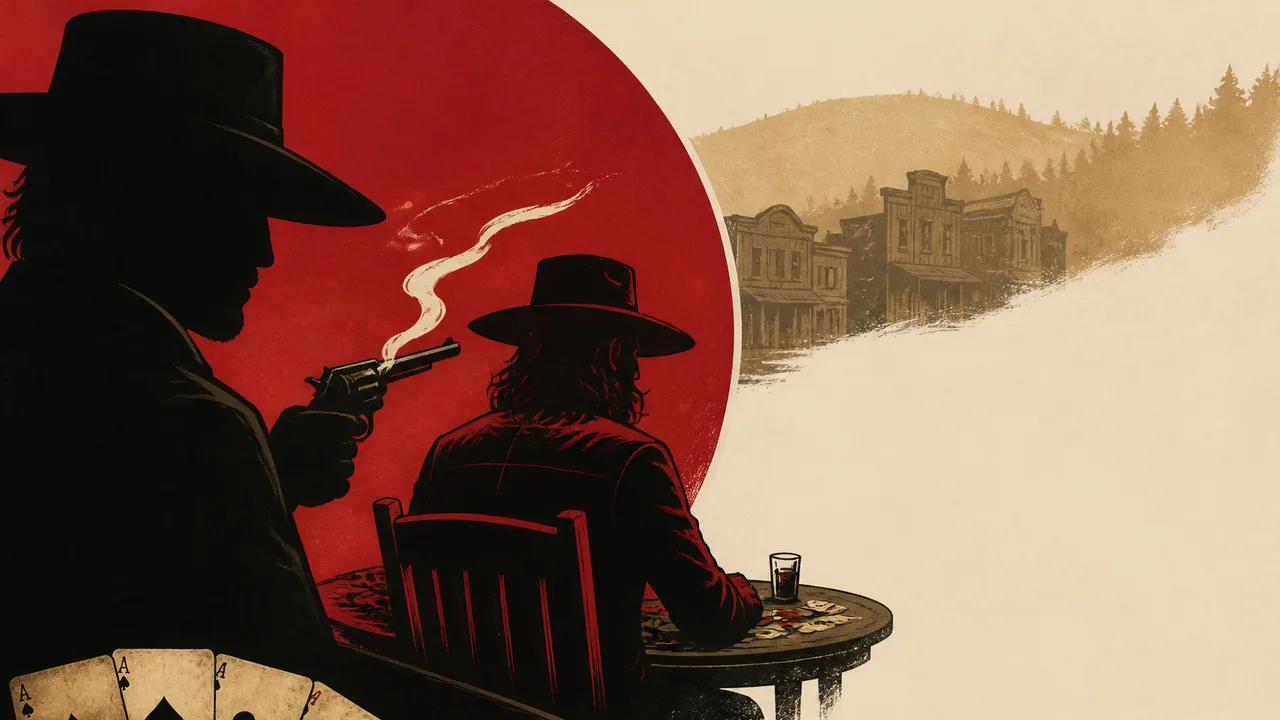
On August 2, 1876, John “Jack” McCall shot Wild Bill Hickok from behind while Hickok played cards in a Deadwood saloon. Hickok was already famous. McCall would become famous for killing him. The distance between those two reputations is where much of the story of the American West got made.
Hickok’s death offered none of the symmetry a Western duel promises. A man seated at a card table had no chance to face the person who shot him. Yet the scene became easy to retell: the celebrated gunfighter, the shot from behind, the cards left in his hand. McCall’s first trial complicates that tidy picture. A mining-camp proceeding acquitted him. After another arrest outside the camp’s jurisdiction, a formal court convicted him, and he was hanged in 1877. To follow both trials is to see people contesting who could speak for the law in Deadwood, even as Hickok’s death traveled far beyond it.
The Hand People Remember
The black aces and eights reportedly in Hickok’s hand became the “dead man’s hand.” The cards supply a detail that can survive a century and a half of retelling. They also draw the eye away from the act itself. McCall approached from behind; Hickok was playing cards. The reported hand became an emblem of fate, while the killing was a choice made by another person.
A poker hand works unusually well as a vessel for legend. It fits in a sentence, and its colors can be pictured without knowing anything about Deadwood. The two trials require more room. They involve a camp claiming authority, a later court exercising it, and a man who was acquitted before he was convicted. One version can be printed on a playing card. The other asks readers to think about procedure.
The cards still matter. Details are how stories remain memorable, and the dead man’s hand has kept Hickok’s name in circulation. Hickok’s death does not depend on the hand being exact. The hand’s power comes from how neatly it lets an audience hold the scene.
An Acquittal in a Mining Camp
McCall’s first acquittal came from a hastily convened mining-camp proceeding. It would be easy to skip that outcome on the way to his execution. Yet for a time, a group in Deadwood had considered the killing and let him go.
The proceeding raises a question distinct from whether McCall shot Hickok: who had the authority to decide his fate? In a camp still establishing its institutions, people could attempt to administer justice locally even while the reach and standing of that process remained contested. Calling the first proceeding a trial tells us that people organized one; it does not settle how a later court should have treated its verdict.
An acquittal can mean different things to different people. To those who took part locally, it might have been an answer to a killing that demanded one. To an authority outside the camp, the issue could begin with whether that gathering had jurisdiction at all. Neither perspective requires imagining Deadwood as a place with no interest in law. The camp acted. The later arrest showed that its action had not ended the matter.
Keeping those judgments separate prevents a verdict from becoming a set of invented voices.
One Killing, Two Claims to Authority
After his acquittal, McCall was arrested again outside the jurisdiction of the camp proceeding. A more formal court tried and convicted him. He was hanged on March 1, 1877.
The sequence sounds surprising to a reader accustomed to treating an acquittal as the end of a case. Here, the central dispute lay in the standing of the first proceeding. If a camp’s decision carried binding authority, a second prosecution would raise one set of objections. If the camp lacked that authority, the later court could treat the murder as still awaiting a legally effective judgment. The two outcomes, acquittal and conviction, sit beside each other because the institutions behind them did not command the same recognition.
That is a fuller picture of frontier justice than either a lawless free-for-all or a swift restoration of order. Deadwood’s residents had an immediate problem: a man had been killed in a public place, and someone had to decide what followed. Officials beyond the camp had another: whether local action could stand as an answer to murder. The competing proceedings turned the boundary of authority into a consequence McCall could feel. One released him; the other sentenced him to death.
Hickok’s fame added pressure to every telling of the case. His name makes the killing recognizable even to people who know little about the courts that handled it. McCall’s name survives largely alongside his. That imbalance shapes what a reader is likely to ask first. The story invites attention to the gunfighter’s final cards before it invites attention to the people who assembled a trial.
How a Death Became a Western Story
Newspapers and later popular culture carried Hickok’s killing to audiences far beyond Deadwood. The encounter was ready-made for a morality play about reputation and violence: a famous man shot while seated, his killer first freed, then hanged. Each element has a clear dramatic role. Hickok becomes the fallen icon. McCall becomes the assassin. The second trial supplies an ending.
The first verdict resists that ending. It leaves a period in which the person who killed Hickok had been acquitted, and it forces a question about the reach of local justice. The formal conviction resolves McCall’s case; it does not erase the camp’s earlier claim to decide it. Keeping both in view changes the geography of the story. Deadwood was a place where people acted and argued over authority, as well as the setting for a famous man’s death.
There is another absence in the familiar version: the people who sat through the camp proceeding rarely get the same attention as Hickok, McCall or the poker hand. Their verdict remains part of the record even when their individual reasoning does not. Treating that silence carefully means resisting the temptation to turn them into a crowd with a single motive.
McCall killed Hickok on August 2, 1876. That fact did not change between the two trials. What changed was the authority of the people passing judgment. The black aces and eights gave the killing an image that could travel; the acquittal and conviction show the unfinished work in the place it left behind.
More Like This

Middle Platonism's Hidden Role in Western Esotericism
ESOTERICA's new crowdfunded seminar argues Middle Platonism built the foundations of Hermeticism, Gnosticism, and early Christian theology. Here's what that means.

Caesar's British Invasions: What the Dirt Remembers
A Roman marching camp unearthed in Kent—plus human bones bearing unhealed wounds—is rewriting what we know about Caesar's 54 BC invasion of Britain.
Why October's Name Still Carries the Number Eight Today
October is the tenth month, but its name means eight. The mismatch preserves an older Roman calendar and reveals how societies reorganize public time.

Titanic Lifeboat Decisions Shaped Who Could Survive
The Titanic had lifeboat space for about 1,178 of more than 2,200 aboard. Loading, access and maritime rules shaped who escaped the sinking in April 1912.
DNA Names a Revolutionary War Teen Soldier After 245 Years
Genetic genealogy has identified Private John Pumphrey, a Maryland teen who died at the Battle of Camden in 1780 — one of America's oldest John Doe cases.
Cicero and the Fall of the Roman Republic
Marcus Tullius Cicero defended Rome's Republic with words alone—and paid with his life. A look at history's most consequential orator and his impossible political moment.