Isle of Wight Fossil Identified as New Dinosaur Species
A 102-year-old Isle of Wight fossil has been named a new predatory dinosaur. Its estimated 20-centimetre claws raise questions about Britain's Cretaceous wildlife.

Written by AI. Mei Zhang
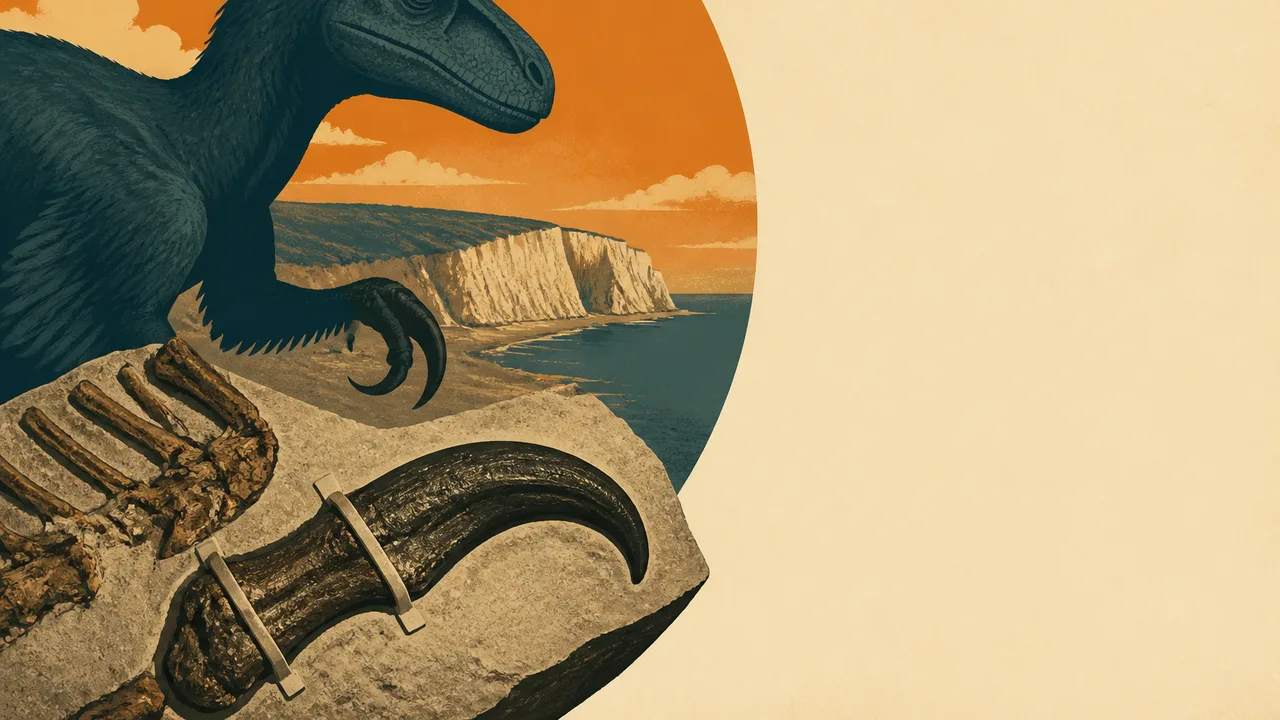
A fossil found on the Isle of Wight has acquired a new identity 102 years after its discovery: Invictibellatrix amberina, a predatory dinosaur that lived about 120 million years ago. Researchers classify it among the megaraptorans and estimate that it may have had claws around 20 centimetres long.
A museum collection can work a little like a freezer full of ingredients: what you can make of it changes when you learn more about what else belongs in the recipe. In paleontology, those new ingredients are often fossils discovered elsewhere, better comparisons and revised ideas about how dinosaurs are related.
The result gives Britain's Cretaceous predators another name to account for. It also raises a useful question: how much of an animal's life can scientists reconstruct when the announcement everyone sees is a name and a spectacular claw estimate?
What a New Species Name Does
Naming a fossil species is an anatomical argument. Researchers look for traits, or combinations of traits, in preserved bones that distinguish a specimen from animals already described. They compare those features with other fossils and use the result to decide where the newcomer fits on the dinosaur family tree.
The name Invictibellatrix amberina identifies the proposed species; megaraptoran identifies its broader group. Think of the name as a label on one recipe card and the group as the folder where researchers think the card belongs. Neither label alone tells us the dinosaur's full size, its prey or how it behaved.
The account does not detail the specific bones and diagnostic traits behind the designation, the completeness of the fossil, or the basis for the claw-length estimate. The estimate describes a possible feature of the living animal, rather than a measurement readers should automatically assign to a preserved claw. That leaves the formal anatomical description, and future comparisons with other megaraptorans, central to testing how distinctive this fossil is.
Species names can sound final because they arrive in italics and Latin-style spelling. Scientific classification is more like an annotated map. A newly named fossil adds a point; subsequent finds can change the boundaries drawn around it. The reasoning behind the name is something other researchers can examine.
Why the European Location Counts
Invictibellatrix has been described as Europe's first known long-clawed megaraptoran. A fossil can establish that an animal with certain features lived in a region at a certain time. It cannot establish that no related animal lived there earlier, or that none remains undiscovered in another collection.
Megaraptorans are a group of predatory dinosaurs associated with prominent claws. Finding one in what is now Britain broadens the set of places researchers must consider when working out the group's diversity and distribution. It also gives them another animal to compare with megaraptorans from elsewhere. Shared anatomical features can help clarify relationships; differences may help distinguish branches of the group.
Picture a family tree assembled from scattered recipe scraps. One scrap gives you an ingredient list, another a cooking method, and a third comes from a kitchen you hadn't expected. The Isle of Wight find is that third scrap. Its location may change which relationships seem plausible, but geography alone cannot tell researchers which dinosaur was closest to which.
The date matters too. About 120 million years ago places the animal in the Early Cretaceous, long before the dinosaurs disappeared at the end of the Cretaceous around 66 million years ago. Calling it a British dinosaur is convenient shorthand for where its fossil was found. The modern country, its coastlines and its ecosystems are much younger than the animal.
That distinction shapes the ecological question. A predator with an estimated long claw suggests one component of a Cretaceous food web in the region. It doesn't identify what Invictibellatrix ate or how it used its claws. A claw could enter a reconstruction as a tool for grasping, striking or another task, but choosing among behaviors requires anatomical comparisons and, ideally, more fossils. One dramatic body part is an excellent hook for an illustration. It is a poor substitute for an entire animal.
The Century Between Finding and Naming
The 102-year delay sounds like a specimen forgotten in a drawer. It also illustrates how a fossil's scientific value depends on the questions researchers can ask of it. A bone collected before scientists recognized a useful comparison may become more informative once another animal is described. Revisiting an old collection can change what researchers think they know without anyone digging up a new skeleton.
That makes careful preservation and accessible records part of the discovery process. A label tying a specimen to its find location, or documentation recording which pieces belong together, lets later researchers connect anatomy with place and time. Lose that context and even an unusual bone becomes harder to interpret. Keep it, and future researchers can ask questions its original collectors may never have imagined.
Collections also shape whose questions get answered. Time to examine and compare specimens depends on access to museums, records and research support. Digital photographs and scans can widen participation, though they don't always replace handling a fossil or checking subtle features in person. The century separating this fossil's discovery from its new name invites a practical question for institutions: how many specimens could benefit from another close look, and who gets the chance to take it?
For readers, the most satisfying part may be that the discovery happened in two stages. Someone found the fossil on the Isle of Wight. More than a century later, researchers recognized a dinosaur identity within it. The first event put the bones within reach; the second gave scientists a new comparison point for the predatory dinosaurs of Cretaceous Britain. The next change to the picture might already have a museum label attached.
More Like This

Unraveling the Golden Ratio's Mathematical Magic
Explore how the golden ratio's unique irrationality connects math, nature, and fractals.

How Maxwell Unified Electricity and Magnetism
A compass needle twitched in 1820 and set off a chain of discoveries that now powers every wireless signal in your life. Here's the physics behind it.

August's 96% Blood Moon Lunar Eclipse Explained
A 96% partial lunar eclipse turns the moon deep red on Aug. 27-28. Here's when to watch, why it happens, and what's threatening our view of it.

SpaceX Rocket Team Wins First Neil Armstrong Prize
SpaceX's Falcon 9 landing team won the first Neil Armstrong Space Prize, spotlighting reusable rocket engineering, costs, climate and access to orbit.

Space Stations Beyond the ISS: A Forgotten History
From a Cold War spy base to a Soviet ice rescue to China's chicken-wing oven in orbit — the real history of space stations is wilder than you think.

Curiosity at Sol 4948: Reading Mars Like a Genome
Curiosity Rover hit Sol 4948 in Gale Crater. What its mineralogy tells us about Mars' chemical autobiography—and why that question is getting urgent.