Iran Sanctions and the People Caught in the Crossfire
Trump's new Iran sanctions target trade networks spanning China, India, and Turkey. Here's what economic warfare looks like for the people living inside it.

Written by AI. Carmen Rodriguez
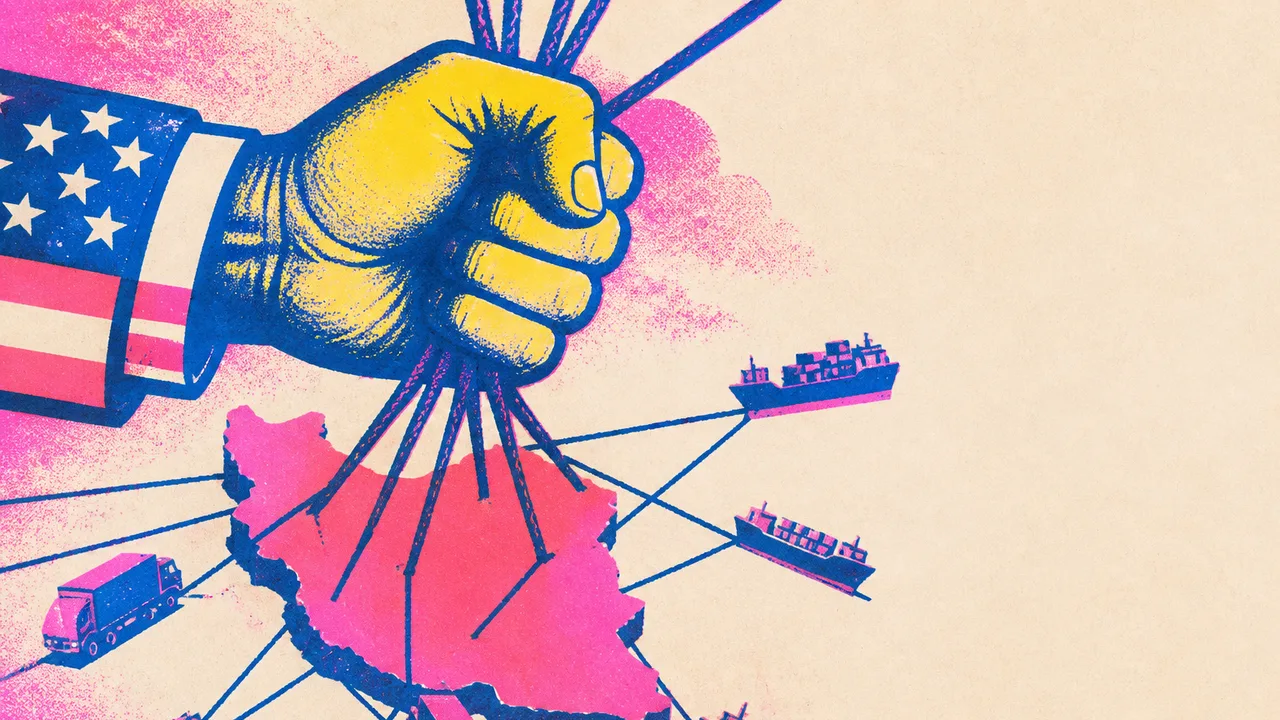
Start with a price tag. When Iran's rial collapses under a new sanctions wave — and it has collapsed before, losing the majority of its value during previous maximum pressure campaigns — the person who feels it first is not a government official or a sanctions-designated oil trader. It's the factory worker in Isfahan whose wage, denominated in rials, suddenly buys 30 percent less bread. The small business owner in Tehran who imports raw materials through intermediary countries and watches her input costs double overnight because the workaround just got more expensive. The informal sector laborer — and Iran's informal economy is enormous — who has no wage protections, no currency hedge, and no safety net between his family and what economists blandly call "severe hardship."
That's the entry point for this story, because that's what's actually at stake when Washington announces what CNBC is calling "economic warfare" against Iran. The Trump administration has threatened "tremendous" consequences for any country that continues backing Iran's economy. Morning Brew reports that the US has unveiled a "supersized" sanctions package — language that captures the scale, if not the weight. The BBC notes that despite years of sanctions, Iran has maintained a degree of economic stability by cultivating trade relationships with several key partners. Washington now wants to dismantle those relationships, or at minimum make them costly enough that other governments start doing the math.
The math is different depending on who you are.
China: Too Embedded to Panic, Too Exposed to Ignore
China is Iran's most significant trade partner, and the International Business Times lays out the exposure clearly: Chinese firms importing Iranian oil, Chinese banks processing those transactions, and Chinese companies that have built supply relationships over more than a decade of steadily deepening ties. Secondary sanctions — the tool Washington uses to punish third-country firms for doing business with designated entities — would put those firms in an impossible position. Do business with Iran and lose access to US markets and the dollar system, or comply with Washington and absorb the loss of a trade relationship Beijing has cultivated deliberately.
Beijing's calculation, historically, has been to compartmentalize: keep Iran trade in institutions that don't have significant US exposure, use workarounds that complicate enforcement, and negotiate loudly about sovereignty while quietly adjusting the flows. Whether that playbook still works under a maximum pressure campaign that the administration itself is calling "economic warfare" is an open question the Chinese government is currently working through. The people working through it at the ground level — shipping logistics workers, port officials, smaller import-export firms without the political insulation of state-owned enterprises — have less margin for error than the institutions making the decisions.
India's Chabahar Problem
If the China calculus is complicated, India's is almost paradoxical. New Delhi has invested in the Chabahar port on Iran's southeastern coast as part of a transit corridor designed to connect India to Afghanistan and Central Asian markets without routing through Pakistan. This is infrastructure that serves explicit US strategic interests in the region — bypassing Pakistan, reducing Chinese influence in Central Asian supply chains, keeping Afghanistan connected to southern trade routes.
Washington has, at various points, carved out exemptions specifically for Chabahar because the strategic logic of the project was obvious enough even to sanctions architects. But a blanket maximum pressure posture makes those carve-outs harder to maintain politically and legally. If Washington forces New Delhi's hand, the casualties aren't abstract. They're Indian port workers at Chabahar whose employment depends on the project moving forward. They're Afghan traders — and Afghanistan's economy is in dire enough shape that any reduction in viable trade corridors has immediate humanitarian consequences — who have used the corridor or planned to. They're the logistics and infrastructure workers on the Indian side of the supply chain who were building something that was supposed to matter. The BBC reports that Iran's trade relationships span multiple countries, each of which has its own calculations to make. India's calculation runs directly through a project that the US helped justify with its own strategic arguments. Watching Washington potentially sanction away its own strategic logic is the kind of institutional contradiction that doesn't get resolved — it just accumulates cost somewhere.
Turkey and the Compliance Gap
Turkey's position in Iran's trade network has been the subject of US legal scrutiny before, and that history shapes how Ankara reads the current moment. The risks for Turkey, per the International Business Times analysis, center on its role as a transit economy — goods and financial flows that move through Turkish territory and institutions on their way to or from Iran. Secondary sanctions applied aggressively would require Turkish banks and firms to make the same uncomfortable choice as their Chinese counterparts: dollar-system access versus Iran trade.
What's notable is how different Turkey's position is from China's. Turkey is a NATO member, has deep economic ties with Europe, and depends on US political relationships in ways that create different leverage points for Washington. That doesn't mean compliance is certain — economic interests are real — but it means the secondary sanctions threat lands differently in Ankara than it does in Beijing.
The Nuclear Variable
The administration's framing — "economic warfare" — is doing a lot of work here. CNBC reports that Trump has threatened "tremendous" consequences for Iran's backers, language calibrated to maximize uncertainty among third-country trade partners. The explicit goal appears to be forcing Iran to the negotiating table on nuclear and regional issues by making its economic relationships untenable.
Iran has not abandoned its nuclear program under sustained sanctions pressure, though I won't claim more than the sourced reporting here establishes about the trajectory. What the pattern of the last two decades shows is that sanctions have reshaped Iran's economy — pushed it toward self-sufficiency in some sectors, toward workarounds and shadow networks in others, toward deeper dependency on partners willing to absorb US secondary sanctions risk — without producing the political outcomes Washington wanted. The BBC notes that Iran has maintained economic stability despite longstanding sanctions. That stability is the evidence that the workarounds have worked, at least partially. A supersized campaign, per Morning Brew's reporting, is designed to close those gaps.
The Strait of Hormuz is central to why Washington thinks this pressure has leverage. CNBC's reporting on Trump's announcement makes clear that the threat of Iranian disruption to the waterway — through which a significant share of global oil supply transits — is part of the pressure dynamic running in both directions. Iran's ability to threaten the strait is part of what gives the confrontation its stakes; Washington's willingness to invoke "economic warfare" is what makes Iranian partners nervous.
The People Waiting
Here's where I keep landing: the people most exposed to the outcome of this confrontation are not the governments making the decisions, the state-owned firms with political cover, or the sanctions lawyers billing hours on both sides of the Atlantic. They're the rial-denominated workers in Iran's manufacturing sector, already navigating an economy that currency instability has squeezed for years. They're the Afghan traders who were finally getting a viable southern corridor at Chabahar, watching to see whether Washington's strategic logic survives its own sanctions pressure. They're the Turkish logistics workers whose employers are about to be asked to choose between compliance costs and lost business.
The International Business Times lays out the institutional risks for China and Iran's trade partners clearly. What the institutional risk framing tends to smooth over is that institutions absorb shocks by passing the cost down — to workers, to informal sector participants, to anyone who lacks the leverage to push back.
Those are the people waiting to see how this lands. They don't have lobbyists in Washington. They don't have secondary sanctions attorneys. They have this week's grocery bill and whatever trade corridor survived long enough to employ them.
More Like This
Business Rules 2026: Impact on Labor and AI
Explore how emerging business rules and AI technology reshape labor dynamics and worker dignity by 2026.

The Iran War's Surprise: Oil Markets Held Together
The Strait of Hormuz closed and oil didn't hit $200. Here's the layered, complicated story of why — and what it means for how energy flows next.

Financial Crises Follow Patterns — But Not for Everyone
Kuran Francis maps four recurring patterns behind every major financial crisis. The framework is solid. What it leaves out is the story of who pays when the system breaks.
Trump's Generic Drug Tariffs: Reshoring or Price Shock?
Trump plans 100% tariffs on generic drug imports from 2028, rising to 200% in 2029. What that means for drug prices, supply chains, and India's pharma industry.
Wall Street Knew the Crash Was Coming. Saying So Got You Fired.
Jeremy Grantham's famous poll revealed 398 analysts knew the dot-com crash was guaranteed. A 2003 study shows why none of them said so publicly: accuracy cost careers.

Dubai's Crisis Has a Worker Problem No One's Covering
Dubai's economic model was built on migrant labor with almost no rights. Now, with airstrikes and a blockaded strait, those workers face the worst of the fallout.

Apollo's EasyJet Buyout: What It Means for Workers
Apollo's £5.7bn EasyJet takeover is a win for shareholders. For cabin crew and ground staff across Europe, the calculus is far more complicated.
China's Robotaxi Push and the Workers in Its Path
China's robotaxi companies are expanding globally on EV supply chain strength—but what does that mean for the drivers whose livelihoods disappear in the process?