Trump's Generic Drug Tariffs: Reshoring or Price Shock?
Trump plans 100% tariffs on generic drug imports from 2028, rising to 200% in 2029. What that means for drug prices, supply chains, and India's pharma industry.

Written by AI. Raj Mehta
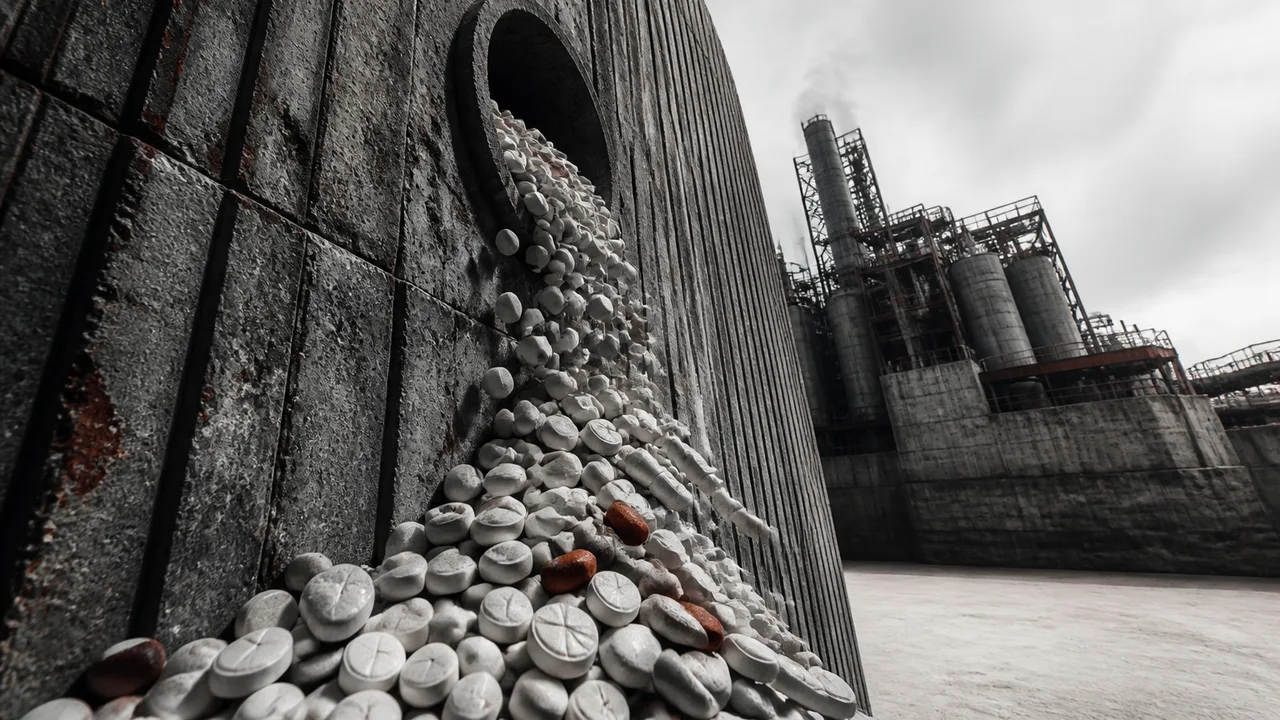
The message arrived, as consequential policy often does now, in all-caps on social media. "Effective August 1st, 2026, all Generic Drugs being brought into the United States will continue to have a TARIFF of ZERO PERCENT for a two year period of time, after which the TARIFF will be raised to 100% for a one year period of time, and 200% thereafter," President Trump wrote on Truth Social, as reported by Politico.
So: two years of calm, then a cliff. The structure is a negotiating ladder dressed up as industrial policy — manufacturers get a runway, but the destination is a wall.
The stated logic is straightforward. Generic drug production is heavily concentrated offshore, particularly in India and China, and that concentration has produced real supply-chain fragility. The administration wants to change that calculus by making imports expensive enough that domestic production becomes competitive. According to Bloomberg, generic drug manufacturers will have two years to move production to the U.S. or face a 100% import duty from August 2028. The New York Times notes the 200% rate kicks in August 2029 — months after the end of Trump's second term, which means a successor administration would inherit both the policy and its consequences.
That timing detail is worth sitting with. The full force of this tariff arrives after Trump leaves office. Whether that's political design or simply the logic of a two-year manufacturing runway is unclear. What's certain is that the political cost of price increases — if they materialize — lands on someone else's watch.
The Supply Vulnerability Argument Is Real — and the Tariff Mechanism Has Limits
The underlying concern is not confected. The COVID-19 pandemic exposed how dangerously thin U.S. pharmaceutical supply chains had become, with shortages in everything from basic antibiotics to ICU sedatives. Generics, which account for roughly 90 percent of U.S. prescriptions filled according to the FDA's Office of Generic Drugs, are disproportionately sourced from a small number of foreign facilities. That's a genuine systemic risk.
The administration's best-case argument is essentially this: the market has underpriced supply-chain risk because the cost of a shortage is diffuse and delayed, while the cost of domestic production is immediate and visible. A tariff corrects that market failure by forcing manufacturers to internalize the risk through their sourcing decisions.
That argument has structural merit. But here's where I'd push back on what the tariff mechanism can actually deliver against the list of requirements for reshoring: you need specialized engineers and chemists, purpose-built facilities, validated manufacturing processes, and a cleared FDA pathway. The FDA's own PreCheck pilot program — designed specifically to accelerate U.S. drug manufacturing site approvals — signals that the agency recognizes that greenfield-to-approval timelines are measured in years, not months.
A tariff changes the price signal. It does not conjure the workforce, compress the regulatory timeline, or fund the capital expenditure. The companies best positioned to respond to this signal are the large, well-capitalized manufacturers who were already considering U.S. expansion — not the generic producers operating on thin margins in commoditized therapeutic categories. The generics that are hardest to source domestically tend to be exactly the ones with margins too low to justify a new U.S. facility regardless of tariff rates. Price a 200% tariff into the landed cost of a generic antibiotic and you may simply get a more expensive generic antibiotic, not a domestically produced one.
CNBC called reshoring "a complex and costly task" — which is the polite version of saying the arithmetic is difficult even with the policy tailwind.
Who Pays in the Transition Period
The two-year zero-tariff runway sounds generous until you work through what it actually permits. Two years is not enough time to build and validate most pharmaceutical manufacturing facilities. It is enough time for manufacturers to negotiate, lobby, and hedge — and for importers to stockpile ahead of the cliff.
What it is almost certainly not enough time for is a meaningful reorientation of domestic manufacturing capacity. Which means the 100% tariff arriving in August 2028 is likely to hit a market that hasn't structurally changed much, and the cost will be passed somewhere. For brand-name drugs, manufacturers have pricing power and can absorb or pass on cost increases over time. For generics, where competition is the primary price-control mechanism, a tariff that applies uniformly to all imported generics removes that competitive floor. The result, in categories where no domestic alternative exists, is higher prices — not reshored production.
Who absorbs that? Uninsured patients paying out of pocket. Medicaid programs operating on fixed reimbursement schedules that don't adjust quickly. Pharmacies in rural areas with no substitute supplier. The distribution of harm here is not random.
India's Exposure — and Its Options
The geography of this policy is not neutral, and understanding it requires more than a paragraph. India is the most directly exposed exporter, and the structure of its pharmaceutical industry shapes what retaliation or adaptation looks like in practice.
India's large generic manufacturers — companies like Sun Pharma, Dr. Reddy's, Cipla, and Lupin — are not monolithic. The U.S. market represents a significant revenue share for the top-tier players: for several of India's largest generics exporters, the U.S. accounts for 30 to 40 percent of total revenues. That exposure is not evenly distributed. The companies with the most U.S. revenue also tend to have the most sophisticated regulatory capabilities and the most to lose — and, critically, the most to gain from compliance. A company generating $1 billion or more annually from U.S. generic sales has the balance sheet to consider U.S. manufacturing partnerships or acquisitions in a way that a smaller Indian API (active pharmaceutical ingredient) producer does not.
Below that tier, the picture is different. India's API manufacturers and smaller formulations companies are far more exposed to a tariff cliff with far fewer options. They can't simply build a U.S. facility. Their realistic alternatives are to redirect sales toward other markets — the European Union, where generics penetration is growing, or Southeast Asia and Africa — or to compete on cost with Chinese API suppliers in those same markets, which is a margin-compression story with no good ending.
New Delhi's formal response is the harder question. India and the U.S. are in an active phase of bilateral trade negotiations, and the Modi government has been careful not to escalate with Washington in ways that jeopardize that process or broader strategic alignment. India is unlikely to impose symmetric retaliatory tariffs on U.S. pharmaceuticals — it doesn't import enough branded U.S. drugs for that to be a credible threat. More likely pressure points are in agricultural goods, technology services access, or investment facilitation. But India's leverage in those negotiations is limited by its interest in the partnership itself.
What New Delhi can do — and may already be doing — is use this as a forcing function to accelerate Indian pharma's diversification away from U.S. market concentration. A policy environment that's been warning Indian exporters about U.S. tariff risk for years now has a concrete countdown clock. The question for Indian manufacturers isn't whether to diversify; it's whether they can do it fast enough to protect margins before August 2028.
The Structural Contradiction
There is a tension at the heart of this policy that the administration hasn't resolved in public: the goal of affordable medicines and the goal of domestic pharmaceutical manufacturing are in genuine conflict when the input is a tariff rather than a subsidy or a procurement guarantee.
Making generic drugs more expensive to import makes them more expensive, full stop, until domestic production scales — a process the FDA's own initiative acknowledges takes years. The administration appears to be betting that manufacturers will move fast enough and that the price shock will be short enough that voters won't notice or won't attribute it correctly. That's a political bet, not an economic one.
The policy could still work in a narrow sense: it might induce enough domestic investment to meaningfully reduce U.S. dependence on a small number of foreign facilities for critical drug categories. That would be a genuine supply-chain improvement. But the mechanism for getting there runs directly through the medicine cabinets of the Americans it's supposed to protect — and the 200% tariff rate, arriving conveniently after the next inauguration, suggests that whoever designed this schedule understood that arithmetic perfectly well.
More Like This
USMCA Won't Be Renewed: What Annual Reviews Mean
The Trump administration has blocked USMCA's 16-year renewal, opting for annual reviews. Here's what that means for trade, business, and North America.

Brand Authority Is Pricing Power—and Finance Knows It
Ryan Deiss's five brand "authority triggers" map onto real financial metrics. A global markets reporter translates what that actually means for valuations and beyond.

China's AI Models Are Splitting Washington in Two
Kimi and China's open-source AI models aren't just challenging Silicon Valley—they're fracturing the Trump administration's AI strategy along a fault line that won't close easily.
AI Chip Smuggling and the US-China Tech Divide
FT's Eleanor Olcott investigates the black market for Nvidia AI chips reaching China despite US export controls — and what it reveals about the tech race.
GameStop's $56B eBay Bid: What the Math Actually Says
GameStop bid $56B for eBay despite a $12B market cap. We broke down the financing—shares that don't exist, a non-binding bank letter, and a CEO incentive worth examining.

What 10 Million Cold Emails Reveal About Selling
Austin Schneider sent 10M cold emails and found 6 patterns that actually drive replies. Here's what globally-minded sellers need to know—and where the framework breaks.

McDonald's Rare Footprint Across Africa, Explained
McDonald's operates in just four African countries. Corruption, cold-chain failures, and the wrong potato explain more than you'd expect.

Kevin Warsh's First FOMC Meeting Signals a Quieter Fed
Kevin Warsh held rates steady at his first FOMC meeting, but his communication overhaul and hawkish signals are already reshaping global markets.