How Tycho's 1572 Supernova Challenged the Fixed Sky
Tycho Brahe's measurements placed the 1572 supernova beyond the Moon, challenging an ancient model of the heavens. Its remnant tells a newer stellar story.

Written by AI. Mei Zhang
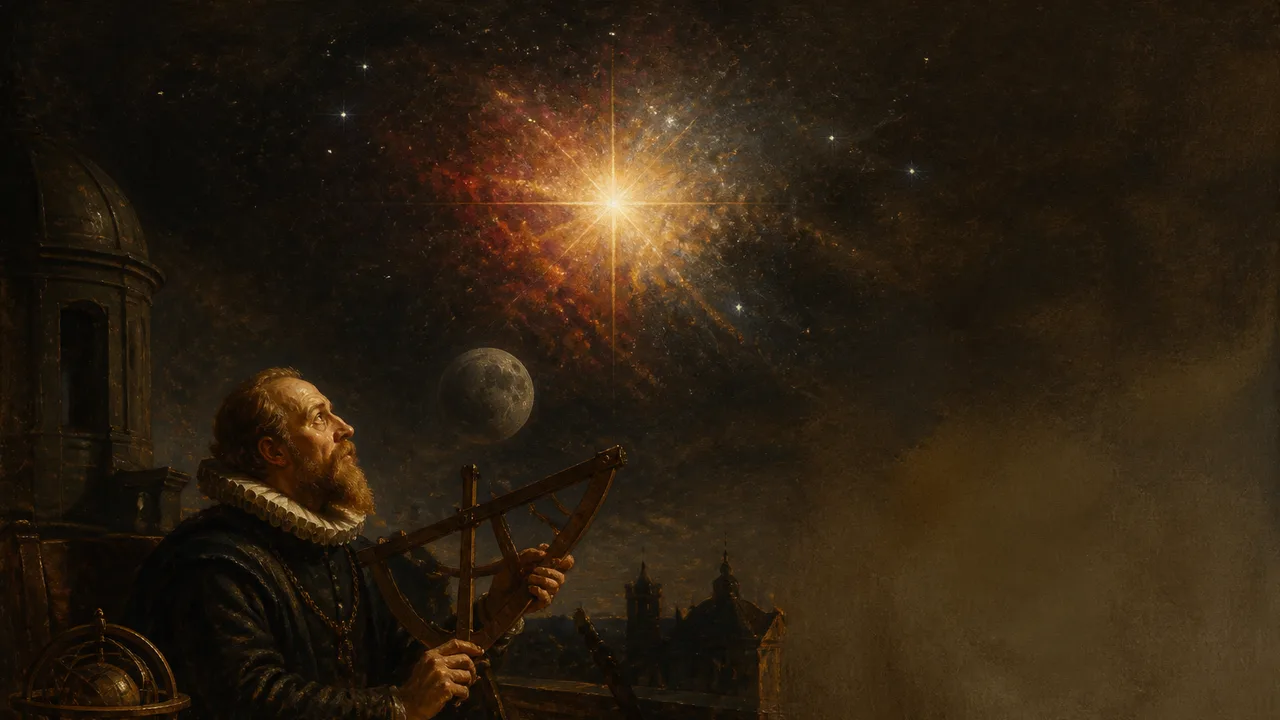
In November 1572, a brilliant new point of light appeared in the sky and stayed visible to the unaided eye for months. People could see the event without special equipment. Understanding what it meant required a much stranger task: checking whether the light shifted against the stars around it.
The object is now called Tycho’s supernova, or SN 1572. Tycho Brahe’s observations helped turn a spectacle into a challenge to an influential account of the universe. He found no detectable parallax, the apparent change in an object’s position when viewed from different places. That result placed the new light far beyond the Moon, in a region many scholars had been taught was unchanging.
Four and a half centuries later, astronomers study what remains of a Type Ia supernova, a thermonuclear stellar explosion. The two descriptions answer different questions. Brahe could investigate where the light appeared. Modern astronomy can investigate what produced it. The gap between those answers is part of the story.
Why the New Star Was a Problem
The Aristotelian picture of the cosmos drew a consequential boundary at the Moon. Below it lay a world of growth, decay and change. Beyond it, the heavens were supposed to be enduring and orderly. The stars could move across the sky as part of that order; a bright new object appearing among them posed a tougher question.
A person watching in 1572 had reason to be cautious. A bright light overhead does not arrive with a label saying how far away it is. If the new object belonged to the changeable region below the Moon, its appearance could fit the prevailing division of the cosmos. If it lay among the stars, that division had a problem.
Brightness alone could not settle the question. A nearby, modest light and a distant, powerful one can both look striking from Earth. Think of two lamps in a dark room: the one that catches your eye first needn’t be the closest. For SN 1572, the useful clue came from geometry rather than glare.
Brahe’s name has become attached to the event because his detailed observations made it influential, not because he was the only person who saw it. Accounts that credit a single German observer with discovering the new star compress a record involving multiple witnesses. The more revealing question is what an observer did after noticing it. Brahe measured its position against the surrounding stars and looked for a shift that a nearby object should show.
The Clue that Refused to Move
Parallax is easiest to see at arm’s length. Hold up a finger, close one eye, then switch eyes. Your finger seems to jump against the background because each eye views it from a different position. A distant building barely budges. Astronomical parallax uses the same geometry, though the distances make the apparent shifts much harder to detect.
Brahe’s measurements found no detectable parallax for the new star. That supported placing it far beyond the Moon. The result had a sharp consequence for the inherited celestial map: a brilliant object had appeared where an unchanging heaven was supposed to be.
“No detectable” does not give an exact distance. It says that any shift was smaller than Brahe could establish through his observations. The finding still gave him a way to test the relevant boundary. A proposed explanation had to account for the object’s position as well as its brightness, and a nearby appearance no longer fit the measurement.
That is why the history is richer than the familiar story of a brave observer spotting something everyone else missed. Many eyes could see the new light. A position measurement made its location into an argument. The sky had supplied the surprise; geometry made the surprise difficult to file away.
The result challenged a specific claim about the heavens. It did not hand Brahe a complete replacement theory or tell him what physical process had produced the light. Seeing a flaw in a model can be a major step even when the machinery behind the observation remains inaccessible. Science often works in that order, inconvenient as it is for anyone hoping for a tidy reveal.
What Astronomers Can Ask Now
Today, astronomers identify SN 1572 as a Type Ia supernova. In this class of event, a white dwarf, the dense remnant of a star, undergoes a thermonuclear explosion. The label supplies a physical explanation that Brahe could not have derived from positional measurements alone. Those measurements addressed the location of a new light; the modern classification addresses the kind of stellar event that made it.
The remnant also changes what can be studied. The original point of light faded from view, but material from the explosion remains an astronomical target. Astronomers can examine the aftermath to learn how the blast developed. The name “new star” captured what witnesses experienced in 1572: a light where they had not seen one before. “Supernova” describes the violent event modern astronomy recognizes behind that appearance.
Type Ia supernovae are studied partly because their behavior helps astronomers reason about events at immense distances. SN 1572 offers a particularly clear meeting point between a human record of an explosion and a remnant that can still be examined. The same occurrence can be approached through what people saw, where they placed it, and what the debris reveals.
Brahe’s conclusion also offers a useful check on how scientific discoveries get remembered. The person whose name survives is often the person whose work gave an observation lasting explanatory force. That need not erase the other witnesses. It clarifies why a centuries-old measurement, rather than a claim to have looked up first, remains central to this supernova’s history.
The light appeared in November 1572 and eventually faded. Its position supplied the more durable challenge: Brahe looked for a shift that would place it near Earth, and the shift did not appear.
More Like This
Unraveling the Golden Ratio's Mathematical Magic
Explore how the golden ratio's unique irrationality connects math, nature, and fractals.
How Maxwell Unified Electricity and Magnetism
A compass needle twitched in 1820 and set off a chain of discoveries that now powers every wireless signal in your life. Here's the physics behind it.
August's 96% Blood Moon Lunar Eclipse Explained
A 96% partial lunar eclipse turns the moon deep red on Aug. 27-28. Here's when to watch, why it happens, and what's threatening our view of it.

SpaceX Rocket Team Wins First Neil Armstrong Prize
SpaceX's Falcon 9 landing team won the first Neil Armstrong Space Prize, spotlighting reusable rocket engineering, costs, climate and access to orbit.
The 2026 Total Solar Eclipse: Science, Access, and Awe
The August 12 total solar eclipse crosses Spain and Iceland — but who actually gets to see it? The science, the biology, and the access gap, explained.
SpaceX Plans Robotic Lunar Factories to Build Satellites
Elon Musk says SpaceX will build robotic satellite factories on the moon. Here's what that actually means—and who gets to decide if it happens.