How Plato Shaped Christian Negative Theology
How Plato's "beyond being" became the backbone of Christian apophatic theology—from the Cappadocian Fathers to Byzantine hesychasm and the Cloud of Unknowing.

Written by AI. Helen Papadopoulos
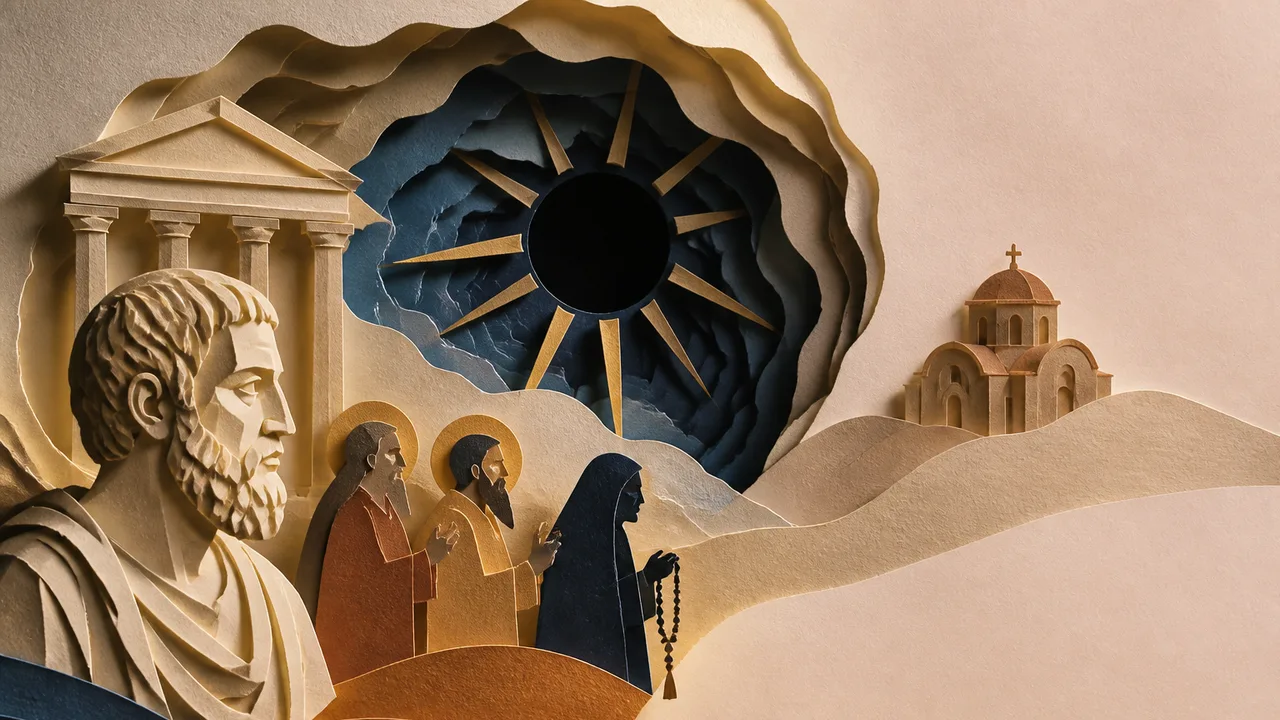
Photo: AI. Lila Bencher
Moses walks into the darkness at the summit of Sinai. Most readers have treated this as a hazard warning — divine radiation, do not approach. But a fourth-century Greek bishop named Gregory of Nyssa read the same passage and saw something else entirely. The darkness, in Gregory's reading, was the encounter. God's refusal to show his face was not a rebuff. It was the answer Moses had been climbing toward.
That counterintuitive interpretation is the seed of one of the most intellectually serious traditions in the history of Christian thought: apophatic theology, or negative theology — the practice of approaching God by refusing to say what God is. A recent video from the ReligionForBreakfast channel traces this tradition from its roots in Plato through the Cappadocian Fathers, the mysterious Pseudo-Dionysius, and the Byzantine contemplative practice of hesychasm. It's a dense twenty-one minutes, and it rewards attention.
Two Ways of Speaking About the Unspeakable
The vocabulary here is Greek, and worth getting straight. Cataphatic theology — from the Greek kataphasis, affirmation — is what most people do when they talk about God. God is good. God is wise. God is the creator of heaven and earth. These are positive claims, attributes stacked up to build a picture of the divine.
Apophatic theology — from apophasis, denial or "unsaying" — takes those same claims and negates them. Not to say God is bad or foolish, but to insist that the words themselves are inadequate tools. The video makes the case this way: when you say "God is good," you are using a word you learned from finite things — a good meal, a good friend, a good night's sleep. That word carries finite baggage. Point it at the infinite, and you have smuggled a small, graspable thing into your concept of the ungraspable.
Negation, the argument goes, doesn't do that. "God is not good in the way we mean good" adds no new content; it just refuses to smuggle in the finite. Apophatic theologians treated negations as sharper instruments precisely because they don't assert — they clear away.
This might sound like a philosophical parlor game, but the tradition grounds it in something much more concrete: the prohibition against idols. The video makes an etymological point that lands hard. The English words idea and idol both derive from the same Greek root — eidolon, meaning a visible form or image. An apophatic theologian warning that your idea of God can become an idol is not speaking metaphorically. They are using the word in its original sense. The too-comfortable mental image — kindly bearded patriarch, cosmic judge — is doing exactly what the golden calf did. It's mistaking a finite representation for the thing it represents.
Plato's Shadow Over the Baptismal Font
The tradition has two acknowledged roots: Hebrew scripture and Greek philosophy, and the video is admirably direct about how much weight the second one carries.
In the Timaeus, Plato writes that to discover the father and maker of the universe would be a difficult task, "and would be impossible to declare what one had found to everyone." In the Republic, he goes further: the Form of the Good — the highest reality in his philosophy — is beyond being. Not a being among other beings, but the source from which the very category of existence derives. To illustrate it, Plato offers the analogy of the sun: the sun is not something you can look at directly; it is what makes seeing possible at all. The Good works the same way for thought.
That phrase — beyond being — did not stay in the Academy. It moved through the Neoplatonists Plotinus and Proclus and arrived, transformed, in the hands of Christian theologians who were reading both Plato and the Hebrew Bible and noticing that they seemed to be pressing toward the same intuition. The ReligionForBreakfast video is careful not to collapse the two traditions into one, but the convergence is real, and it shaped what came next.
The Cappadocians and the Unapproachable Essence
The first great apophatic theologians in the Christian tradition were a cluster of fourth-century bishops from Cappadocia in what is now central Turkey: Basil of Caesarea, his brother Gregory of Nyssa, and their friend Gregory of Nazianzus. They are mainstream figures — not mystics on the fringes but architects of Christian doctrine.
Basil drew a distinction that became foundational: God's essence and God's energies. The essence — what God actually is — remains forever hidden, unapproachable, unknowable. The energies — the ways God acts in and toward the world — are knowable. As Basil puts it: "From his activities we know our God, but his very essence we do not profess to approach. For his activities descend to us, but his essence remains unapproachable."
The video offers a striking analogy for this: a photograph of the supermassive black hole at the center of our galaxy. What the image actually shows is the glowing disc of matter at the edge — the effect of something whose interior light cannot escape. We know the black hole through what it does to everything around it. Basil's claim is that this is the structure of all human knowledge of God: we study the disc, and we should not pretend we are studying the interior.
This distinction does important structural work. The obvious objection to apophatic theology is: if God is unknowable, why write theology at all? Why recite the Nicene Creed? Basil's answer is that you are not claiming to know the essence; you are knowing the energies. All that theology, all those creeds — they are real knowledge of something real. They just aren't knowledge of the thing itself.
Pseudo-Dionysius and the Art of Unsaying
The most influential apophatic theologian is also, fittingly, the most anonymous. Writing around the year 500 under the pseudonym Dionysius the Areopagite — borrowing the name of a minor New Testament figure to lend his work apostolic authority — the person scholars now call Pseudo-Dionysius was the first to deploy the technical vocabulary of apophatic versus cataphatic for Christian theology, lifting it directly from the Athenian Neoplatonist Proclus.
His innovation was linguistic as well as philosophical. Because no human word is adequate to God, Pseudo-Dionysius invented a vocabulary that straps the Greek prefix hyper- — beyond — onto conventional theological terms. God is not just good but hyperagathos, beyond good. Not just being but hyperousios, beyond being. Not even just God but hypertheos, beyond God. He writes: "God is therefore known in all things and as distinct from all things. He is known through knowledge and through unknowing. Of him there is conception, reason, understanding... On the other hand, he cannot be understood. Words cannot contain him, and no name can lay hold of him."
The paradox is deliberate. The hyper- prefix acknowledges the cataphatic starting point — yes, God is good — while immediately marking that the word overflows its own container. It is language performing its own inadequacy.
Theology Embodied: Hesychasm and the Limits of the Controversy
Apophatic theology did not remain confined to treatises. In the medieval Byzantine world, it became a contemplative practice. Hesychasm — from the Greek hesychia, stillness or quiet — developed on Mount Athos, the Orthodox monastic peninsula in northern Greece, and its method is precisely what apophatic logic would predict.
The hesychast monk sits in extended stillness, synchronizes his breathing, and repeats the Jesus Prayer — "Lord Jesus Christ, Son of God, have mercy on me, a sinner" — over and over, for hours. The repetition is not devotional decoration; it is a tool for disabling the discursive mind, the part that constantly generates concepts, images, and judgments about God. Every one of those concepts, as the tradition insists, is a potential idol. The prayer is designed to get underneath all of it.
Practitioners who sustained the practice over years reported experiencing God as uncreated light — a direct participation, they believed, in the light of the Transfiguration, what they called theosis: union with God. In the 1300s, this triggered a sharp controversy. The scholar Barlaam attacked the hesychasts, arguing that claiming any direct experience of God was theologically incoherent — God is unknowable, full stop. Gregory Palamas defended the practice by returning to Basil's distinction: what the hesychasts encounter is not God's essence but God's energies, which are real and genuinely divine. Palamas won the argument, the essence-energies distinction became a cornerstone of Eastern Orthodox theology, and the hesychast tradition has continued to the present day.
The Western tradition produced its own variation. An anonymous fourteenth-century English text called The Cloud of Unknowing compressed the entire apophatic project into a single line: God can be loved but not thought. Seven words, and the whole edifice stands behind them.
What the Tradition Is Actually Arguing
A few things deserve to sit with readers before they move on. First, this is not a fringe tradition. Gregory of Nyssa and Basil of Caesarea defined doctrine for the wider church; they were not writing for a mystical minority. Apophatic theology is, as the ReligionForBreakfast video correctly identifies, the spine of Eastern Orthodox thought and a major current in medieval Western Christianity.
Second, its critics have a real point. Western scholastic theologians worried — and still worry — that pushed to its limit, apophatic theology becomes self-undermining. If nothing can be said, you cannot even say that. The tradition has answers to this (the cataphatic-apophatic tandem; the essence-energies distinction), but the tension is genuine and has not been resolved in fifteen centuries of argument.
Third — and this is what I find most interesting about the whole tradition — it is not primarily a claim about God. It is a claim about language, and about the limits of the human mind's capacity to grasp what it has made. Gregory of Nyssa's reading of Moses is, at its core, a warning against category error: the moment you think you have God figured out, what you have is a figure, not God. The darkness at the summit is not an absence. It is what adequate knowledge of an infinite thing actually feels like from the inside of a finite mind.
Whether that is a profound spiritual insight or a very elegant way of avoiding the question is, perhaps, exactly the kind of thing you have to sit in stillness for a long time to find out.
More Like This
Middle Platonism's Hidden Role in Western Esotericism
ESOTERICA's new crowdfunded seminar argues Middle Platonism built the foundations of Hermeticism, Gnosticism, and early Christian theology. Here's what that means.
WW1 Trench Life: What the Western Front Was Really Like
From Pals' Battalions to the Vickers gun, a new documentary unpacks the grim machinery of survival on the WW1 Western Front in unflinching detail.
MLK: The Ancient Echoes of Justice and Leadership
Explore MLK's legacy through ancient lenses of justice and leadership. Discover unexpected connections.
Why "Bad at Math" Is a Mental Health Story
Math anxiety is a documented psychological condition. A Poincaré-inspired video about intuition vs. rigor reveals what rote math education does to people's sense of self.
The Gods of Pre-Islamic Arabia, In Their Own Words
Ancient desert inscriptions reveal the polytheistic world before Islam—gods, prayers, sacrifice, and fate, recorded by the nomads who lived it.
What a Victorian Ghost Says About the Afterlife
In a 1963 Leslie Flint séance, a voice claiming to be Elizabeth Fry described the afterlife as a thought-built world. Here's what that cosmology actually says.
Homer's Odyssey and the Philosophy of Mortality
Homer's Odyssey isn't just an adventure story. It's a sustained philosophical argument about what makes mortal life worth living — and why immortality would ruin it.
Myth, Obsession, and the Men Who Dug for Troy
Arthur Evans and Heinrich Schliemann both found ancient civilizations while chasing myths. What does that tell us about archaeology—and obsession?